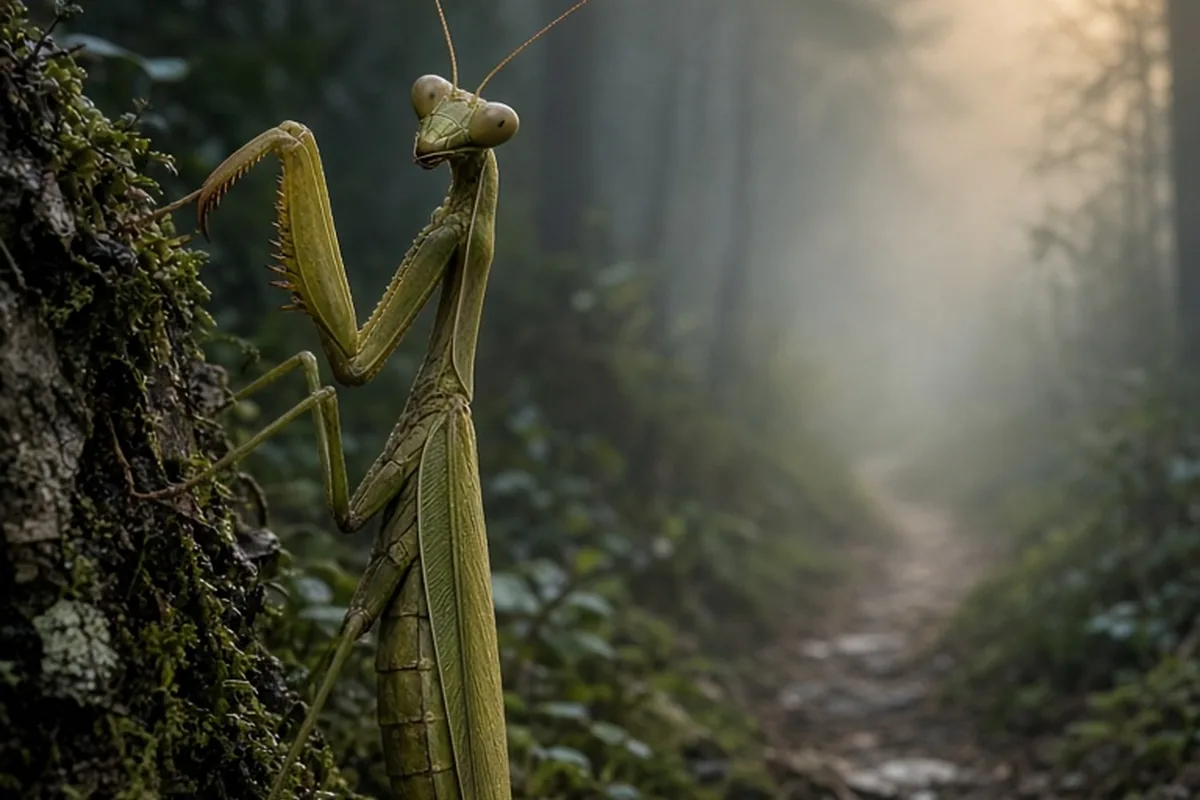
To tell if a praying mantis is male or female, count the visible abdominal segments on the underside of its body. Adult and older nymph males have eight distinct segments, while females have six broader segments ending in a large terminal plate. Adult females are significantly heavier and wider, whereas males have longer antennae, slender bodies, and fully developed flight wings.
Determining the biological sex of a praying mantis is an essential skill for hobbyists, naturalists, and educators looking to optimize care routines or understand insect behavior. Because housing requirements, feeding schedules, and natural lifespans vary sharply between male and female mantises, accurate sexing allows you to tailor your husbandry and avoid common captive-care pitfalls.
Counting Abdominal Segments on the Underside
The single most dependable method for sexing a praying mantis across nearly every known species is counting the abdominal segments, also called sternites, located along the insect's underside. Both sexes have segmented abdomens, but their anatomical structure diverges significantly as they grow. A male mantis displays eight distinct, narrow abdominal plates extending toward the rear of the body. In contrast, a female displays six visible abdominal plates, with the final sixth segment being noticeably enlarged into a wide, smooth subgenital plate designed to support an internal ovipositor.
To perform an accurate count, you must view the mantis directly from underneath while the insect is stationary. Placing the mantis on the clear lid of a ventilated enclosure or letting it walk across a pane of clean glass gives you an unobstructed view of the venter without causing stress. Count backward starting from the segment just behind the third pair of walking legs down to the tip of the abdomen. If you see eight tightly spaced, uniform segments, the specimen is a male. If you count five narrow bands followed by one broad, cupped terminal plate, you have identified a female.
While segment counting is considered the gold standard, it requires careful observation. In younger nymphs or heavily fed specimens, the folds of soft tissue between plates can stretch and create optical illusions that look like additional segments. Using bright, indirect light and taking a macro photograph through the glass allows you to zoom in on your screen and verify each plate boundary without rushing or disturbing the insect.
Evaluating Antenna Length, Thickness, and Structure
Antennal morphology provides another clear physical clue, especially once a mantis reaches its final developmental stages. The antennae of a praying mantis are sophisticated sensory organs packed with chemical and tactile receptors. Because adult males actively track down receptive females across large distances in the wild, their antennae are evolved to detect airborne female sex pheromones with remarkable precision.
In adult and late-stage subadult specimens, male mantises feature antennae that are noticeably longer, thicker, and more prominent relative to their head size. Depending on the species, male antennae may appear distinctly thread-like, comb-like, or feathery. In comparison, female mantises possess slender, short, needle-thin antennae that remain modest in proportion to their broad triangular heads. In species such as the Ghost Mantis or the Wandering Violin Mantis, the male's antennae are strikingly robust and easy to distinguish from several feet away.
A key limitation of this method is that antennal differences are barely perceptible in younger nymphs. During the early developmental instars, antennae in both sexes appear nearly identical in thickness and length. Furthermore, if a male insect sustains physical damage during a difficult molt or an enclosure fall, a regenerated or broken antenna can easily mislead an observer into assuming the specimen is female. For this reason, antenna inspection should always serve as a supportive observation rather than a stand-alone diagnostic.
Comparing Overall Body Proportions and Abdominal Mass
Sexual dimorphism in praying mantises is heavily expressed through overall body mass, muscular density, and abdominal proportions. Adult female mantises are evolved to carry and produce substantial oothecae, the frothy egg cases that protect dozens to hundreds of developing embryos. As a direct result, female bodies are stocky, wide, and heavily built, featuring broad thoracic regions and thick, robust abdomens that dominate their physical silhouette.
Male mantises, on the other hand, prioritize aerodynamic efficiency and mobility over pure mass. A male mantis possesses a narrow, pencil-thin abdomen, a lighter thorax, and a generally wiry, streamlined build designed to conserve energy during flight. Even when fully grown, an adult male will typically weigh a fraction of what a mature female of the same species weighs. If you place a mature male and female of a common species like the Chinese Mantis or European Mantis side by side, the female will look twice as voluminous.
However, body shape can be temporarily deceptive based on feeding status. A male that has just gorged on large feeder insects can display a swollen, rounded abdomen that mimics the natural girth of a female. Conversely, a dehydrated or malnourished female may present an uncharacteristically flat, slender profile. To evaluate body proportions accurately, always assess the structural width of the thoracic plate and head rather than relying solely on the fullness of the digestive tract.
Examining Wing Length and Flight Adaptations
Wings appear only after a mantis completes its final molt into adulthood, but once present, their size and functional mechanics reveal clear sexual differences. In many popular captive species, male wings are noticeably longer than the abdomen itself, extending past the rear cerci to form a sleek, tapered shield. These wings are lightweight, flexible, and supported by powerful flight muscles, enabling the male to take flight readily when hunting or seeking a mate.
Females exhibit a much wider variety of wing adaptations, many of which reflect their grounded lifestyle. In species where females possess full wings, such as the Giant Asian Mantis, the wings are dense, heavy, and typically terminate flush with or slightly shorter than the tip of the swollen abdomen. Because of their heavy body mass, adult female mantises of larger species are generally flightless or restricted to brief, clumsy gliding descents if dropped from a perch. In some species, such as the Budwing Mantis, females are brachypterous, meaning their wings are permanently reduced to short, non-functional decorative flaps, while the males retain full flight wings.
When using wing characteristics for identification, remember that wing length variations are species-specific. You cannot assume that every mantis with short wings is automatically a female without first researching the specific physical traits of the species you are keeping. Always combine wing observations with a verification of the insect's underlying abdominal sternites.
Timing Your Observation Across Different Molting Stages
Praying mantises undergo incomplete metamorphosis, passing through a sequence of growth stages known as instars before reaching adulthood. Hatchlings emerge at the first instar (L1) and shed their rigid exoskeleton periodically until their final molt into the adult stage (often L7 for males and L8 or L9 for females). Trying to sex a mantis during the earliest stages (L1 through L3) is virtually impossible without specialized laboratory magnification, as the abdominal plates are minuscule and structurally indistinct.
Reliable sexing through visual segment counting generally becomes feasible around the fourth instar (L4) or fifth instar (L5). At this developmental milestone, the insect has grown large enough that the terminal abdominal plates begin settling into their permanent configurations. By looking through a clean container wall with a magnifying loupe or smartphone zoom, you can usually differentiate the developing wide plate of a female from the divided segments of a male with reasonable accuracy.
As the mantis enters the subadult stage (the molt directly preceding adulthood), the insects develop visible wing buds on their backs. Male wing buds are often slightly longer and more pointed, reflecting the larger flight wings to come, while female wing buds remain compact. Furthermore, because males require fewer molts to mature, a male mantis will frequently reach adulthood weeks ahead of female clutch-mates hatched on the exact same day. Recognizing these developmental timelines prevents you from mistaking an older male for an underdeveloped female.
Recognizing Behavioral Differences and Energy Demands
Beyond structural differences, male and female mantises exhibit distinctly different behavioral patterns and metabolic demands throughout their adult lives. Adult females operate primarily as stationary ambush predators with voracious appetites. They spend hours perched motionless in foliage, expending minimal energy while waiting for prey to pass within striking distance. A female's primary biological objective is to accumulate adequate nutritional reserves to produce multiple protein-rich oothecae, which drives continuous, aggressive feeding behavior.
Adult males display an entirely different behavioral profile characterized by restlessness, heightened alertness, and reduced appetite. Once mature, a male will frequently pace the top mesh of its enclosure, flutter its wings, and wander actively in search of female scent markers. Males often eat far less frequently than females, consuming only enough calories to fuel their search for a mate. In mixed communal setups or breeding scenarios, a male's twitchy movements and acute sensitivity to vibration reflect its instinct to avoid detection by predatory females.
Another distinct behavioral marker is female pheromone dispersion, known as 'calling.' During the evening hours, a sexually mature female will often arch her abdomen downward, exposing intersegmental glands at the rear tip while rhythmically flexing her abdomen to pump pheromones into the surrounding air currents. Males never exhibit this abdominal flexing posture; instead, they respond to ambient chemical cues by lifting their heads, grooming their antennae, and scanning their environment with intense focus.
Safe Handling and Inspection Techniques to Prevent Injury
Attempting to sex a mantis through improper handling can cause catastrophic physical injury to the insect. Mantis exoskeletons, particularly along the abdomen, are delicate and vulnerable to internal rupture if subjected to manual pressure. You should never pinch, hold down, or physically restrain a mantis with your fingers or tweezers in an attempt to turn it upside down for a closer look. Doing so can break its raptorial forelegs, damage its delicate wing membranes, or crush vital abdominal organs.
The safest inspection method involves gentle redirection onto a transparent, clean surface. Allow the mantis to walk freely onto the outside of a clear acrylic cylinder, a clean glass cup, or a fine-mesh observation cube. By raising the container above eye level or observing from below, you gain an unobstructed, well-lit view of the ventral abdominal plates while the mantis remains calm and supported on all six feet.
If your mantis refuses to remain still, you can place a small feeder insect on the glass in front of it. While the mantis focuses on capturing and consuming the food item, its body will remain anchored in place, providing an ideal window of opportunity to capture high-resolution photos with your smartphone camera. You can then review the photos at your leisure, zooming in on the posterior sternites to verify the segment count without causing any disruption to the animal.
Frequently asked questions
Can you sex a mantis before its final adult molt?
Yes, you can reliably sex most mantis species starting around the fourth or fifth instar (L4 to L5). At this stage, counting the visible abdominal plates on the underside provides an accurate distinction between six-segmented females and eight-segmented males.
Do male and female mantises have different lifespans?
Yes, females generally live significantly longer than males. While an adult male mantis typically lives between two to four months after reaching maturity, an adult female can survive for six to ten months or longer under proper environmental conditions.
Why does a fed male mantis look like a female?
Feeder insects expand the flexible pleural membrane along the sides of a mantis's abdomen, making a recently fed male appear broad and plump. To avoid confusion, count the sternite plates on the underside rather than judging by overall abdominal girth.
Do all female mantis species have wings?
No, wing development varies across species. While some females develop full wings, others possess shortened, non-functional wings (brachyptery) or lack flight wings entirely, whereas males of those same species almost always retain fully functional wings.
Your next step
Gently guide your mantis onto a clean, transparent surface and count the abdominal plates along its underside under bright lighting to establish its sex with certainty.