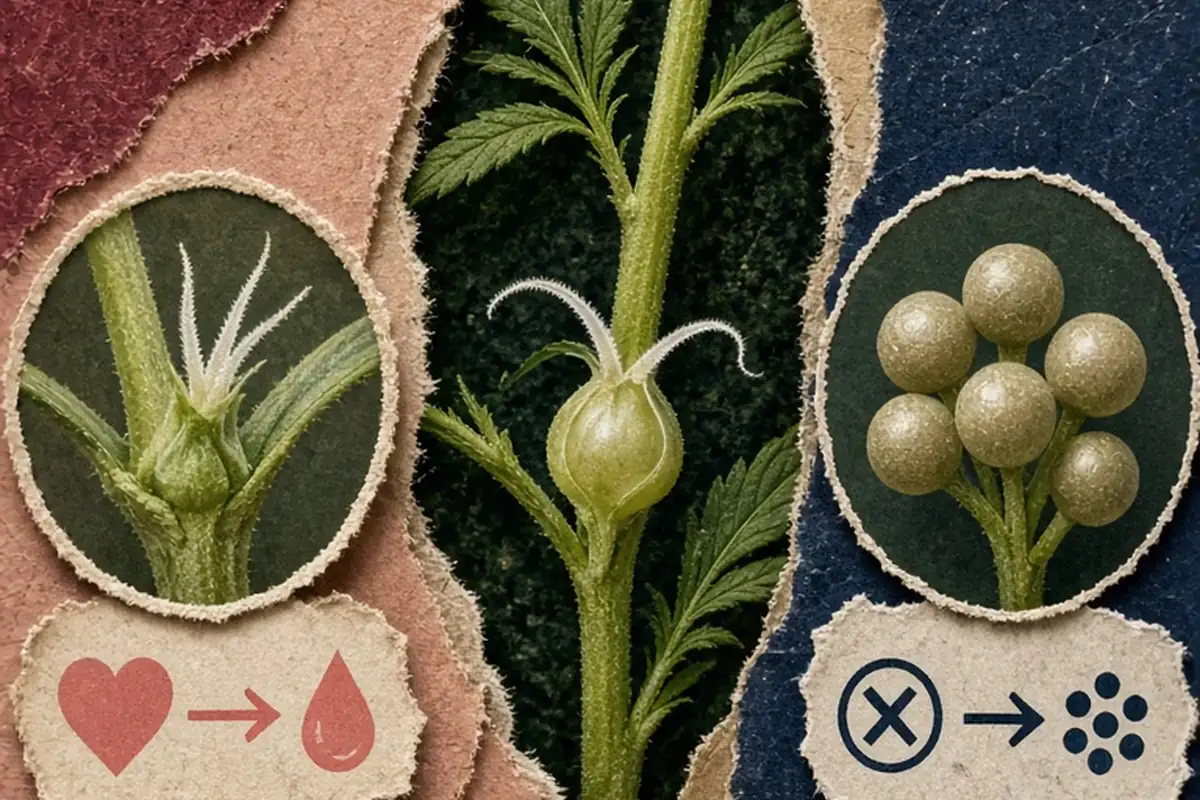
To tell if your plant is female, inspect the nodes where branches meet the main stem during early flowering. Female plants produce teardrop-shaped structures called calyxes or bracts that sprout two fine, hair-like white strands known as pistils or stigmas. Male plants instead develop smooth, oval pollen sacs on tiny stems that resemble small balls or clusters without any protruding hairs.
Identifying the sex of dioecious plants is an essential skill for gardeners aiming to produce fruit, seeds, or unpollinated blossoms. Knowing what physical signs to look for early in the growth cycle prevents accidental pollination and ensures you dedicate your garden resources to productive plants.
Understanding Dioecious Biology and Why Sex Identification Matters
Most flowering plants are monoecious or hermaphroditic, meaning a single plant carries both male and female reproductive organs on the same individual. However, several popular cultivated species, including cannabis, holly, kiwifruit, spinach, and ginkgo, are dioecious. In dioecious species, individual plants are distinctly male or distinctly female. Recognizing which sex you are growing dictates whether your plant will bear fruit, drop pollen, or develop resinous floral clusters. For growers seeking seedless yields or heavy berry production, separating or selecting specific sexes is the foundation of a successful crop.
Allowing a male plant to mature unnoticed near female plants can alter your garden goals within days. Male plants release airborne pollen that fertilizes nearby female flowers, shifting the female plant's energy away from essential oil, flower, or fruit production and directly into seed formation. In crops grown for seedless floral tissue, pollination significantly reduces harvest quality and market value. Conversely, in fruiting landscape crops like winterberry holly or sea buckthorn, keeping at least one male plant within wind range is mandatory to ensure your female plants set decorative fruit. Knowing how and when to determine sex puts you in control of these outcomes.
Examining Pre-Flowers at the Nodes for Female Characteristics
The most reliable visual method for confirming a female plant is checking the node junctions where side branches connect to the main stem. During the late vegetative phase or the first two weeks after shifting to a flowering light schedule, plants produce immature floral structures known as pre-flowers. To inspect these areas, use a clean magnifying lens or a jeweler's loupe under bright, direct light, focusing on the upper third of the plant where new growth is most active.
A female pre-flower emerges as a small, pear-shaped or teardrop-shaped green pocket called a bract or calyx. Within a few days of emergence, this structure extends two delicate, fuzzy white or translucent hairs known as stigmas or pistils. These pistils grow outward to capture airborne pollen. If you see two distinct white threads emerging from a single green capsule tucked right into the branch joint, you have confirmed that the plant is female. As the plant matures, these bracts multiply and cluster together to form dense floral tops.
Recognizing Male Indicators and Distinguishing Them from Females
Spotting male plants early requires understanding how male reproductive anatomy differs from female anatomy in its earliest stages. Male pre-flowers typically develop a few days to a week earlier than female pre-flowers. Instead of a tapered bract with fine hairs, a male pre-flower forms a smooth, spherical or oval pod attached by a tiny stem. These pods are immature pollen sacs, often described by growers as looking like miniature balls, eggs, or tiny spades.
As male pre-flowers develop, they form small clusters that look like tiny bunches of grapes at the nodes. Unlike female calyxes, male pollen sacs never produce white pistils or fuzzy hairs. If an unattached, rounded nodule appears on a small stalk without any emerging hairs, it is almost certainly male. If your goal is to prevent pollination, you should carefully remove the male plant from the growing area before these sacs swell, turn yellow-green, and split open to disperse pollen into the surrounding air.
Spotting Hermaphrodites and Managing Environmental Triggers
Under certain conditions, a plant with female genetics can develop both male and female floral structures on the same branch. These plants, known as hermaphrodites or intersex plants, pose a hidden pollination risk because they can self-pollinate and fertilize surrounding female plants. Intersex expression can appear as distinct male pollen clusters growing alongside female pistils, or as small, bright yellow stamen structures called anthers that emerge directly from within a female floral cluster.
Hermaphroditism is frequently caused by environmental stress that prompts the plant to ensure its survival through self-pollination. Common triggers include erratic light schedules, light leaks during dark periods, extreme temperature fluctuations, severe under-watering, root damage, or excessive chemical feeding. To minimize this risk, maintain stable environmental conditions throughout the plant lifecycle. If you observe only one or two isolated male anthers on a late-stage female plant, you can gently remove them with sterile tweezers misted with water to neutralize pollen. However, if a plant shows widespread male and female flowers early, culling it is usually the safest choice.
Optimizing Timing and Light Schedules to Reveal Plant Sex
Plants rarely show their sex during the early seedling stage because they require a certain level of physiological maturity before expressing reproductive traits. In annual crops like cannabis, natural pre-flowers typically become visible around four to six weeks into the vegetative stage from seed. If you inspect a young seedling before it reaches this developmental milestone, the nodes will show only small, green, pointed leaf stipules that can easily be mistaken for pre-flowers by beginners.
For indoor growers cultivating photoperiod-sensitive varieties, the most dependable way to force sex expression is adjusting the light cycle. Switching your lighting timer from a vegetative cycle of eighteen hours of light to a flowering cycle of twelve hours of uninterrupted darkness signals autumn conditions to the plant. Within seven to fourteen days of this photoperiod change, clear male or female pre-flowers will emerge at the upper nodes. If you grow outdoors, this transition happens naturally as summer days shorten past mid-season.
Determining Plant Sex in Common Landscape and Fruit Species
Sex identification principles extend across many perennial garden and fruit crops, though the timeframe for identification is often longer than with fast-growing annuals. For instance, common holly varieties (Ilex species) require both male and female shrubs to produce bright red winter berries. Female holly blossoms feature a prominent, raised green center, which is the ovary, surrounded by small, non-functional stamens. Male holly blossoms feature four prominent, pollen-dusted stamens radiating from a flat, yellow-green center with no swollen ovary.
Similarly, perennial fruiting vines like kiwi (Actinidia deliciosa) and sea buckthorn (Hippophae rhamnoides) exhibit distinct floral morphology once they reach reproductive age, which may take two to three years from seed. Kiwi flowers on female vines have sticky white stigmas fanning outward in a starburst pattern from a central white ovary, whereas male flowers feature bright yellow, pollen-heavy anthers in their center without a central fruit pad. When purchasing landscape dioecious species, choosing nursery-tagged, cutting-propagated specimens eliminates guesswork because cuttings retain the exact sex of the female or male mother plant.
Using Early Genetic Testing and Clonal Cuttings to Confirm Sex
If waiting weeks for visual pre-flowers does not suit your production timeline, modern agricultural methods offer earlier confirmation. Agricultural testing laboratories provide DNA sexing services using a single leaf sample taken from a seedling as young as one to two weeks old. By analyzing specific sex-linked genetic markers through polymerase chain reaction assays, these tests confirm whether the seedling is genetically male or female with high accuracy, saving weeks of soil, space, and nutrient investment.
Another practical method used by experienced home growers is taking a cutting or clone from a vegetative plant and rooting it under a flowering light schedule. While the main plant continues to grow vegetatively under an eighteen-hour light cycle, the small cutting placed under twelve hours of darkness will rapidly develop pre-flowers in roughly ten days. This reveal technique lets you identify the parent plant's sex definitively without interrupting its vegetative growth or forcing the main crop into premature flowering.
Frequently asked questions
What is the difference between a stipule and a female pre-flower?
A stipule is a small, narrow, green leaf-like spike that grows flat against the main stem at the node, present on both male and female plants. A female pre-flower is a rounded, teardrop-shaped calyx that forms behind the stipule and sprouts two visible white hairs called pistils.
Can a female plant turn male during its growth cycle?
A purely female plant cannot permanently change its core genetic sex into a true male plant. However, severe stress or genetic instability can cause a female plant to become intersex and grow male pollen sacs alongside its female flowers.
How early can you visually tell if a plant is female without testing?
Visual identification is usually possible between four and six weeks from germination during natural vegetative growth, or within seven to fourteen days after switching to a twelve-hour flowering light cycle. Attempting to identify sex before this developmental stage often leads to misidentifying leaf stipules.
Do feminized seeds guarantee a female plant?
Feminized seeds produce female plants with an accuracy rate of around ninety-nine percent because they are bred without male chromosomes. However, extreme environmental stress can still trigger intersex traits, so regular node inspection remains a good practice.
Your next step
Inspect the upper node junctions of your plants with a magnifying loupe this week, looking specifically for small teardrop-shaped bracts with two white pistil hairs to confirm female status before floral development progresses.