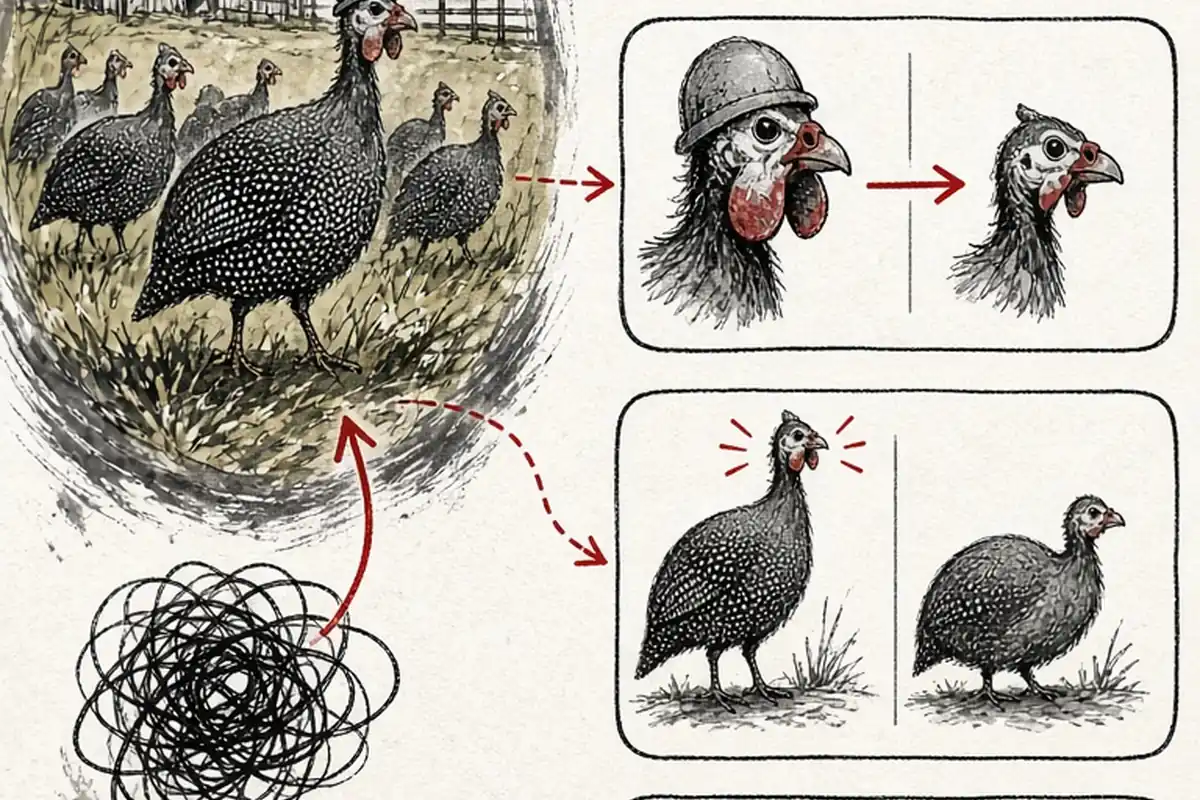
The most reliable way to tell male from female guinea fowl is by their vocal calls. Female guinea fowl make a distinct two-syllable sound often transcribed as buck-wheat or pot-rack, whereas males only produce a single-syllable screech or chatter. Additionally, mature males typically have larger, thicker helmets and wider, cup-shaped wattles compared to the smaller, flatter features found on females.
Raising guinea fowl brings natural pest control, predator warnings, and lively activity to a homestead, but telling the sexes apart is notoriously challenging for both beginners and experienced keepers. Because guinea fowl are monomorphic, males and females share the exact same feather coloration and general body shape across standard color varieties. Determining who is who requires paying close attention to specific sounds, subtle anatomical markers on the head, and social dynamics within the flock.
Listening to Vocalizations and the Two-Syllable Call
Sound is universally recognized by poultry specialists as the single most dependable method for sexing guinea fowl. Starting around six to eight weeks of age, females begin developing their signature two-syllable vocalization. This sound alternates in pitch and rhythm, frequently sounding like buck-wheat, pot-rack, or good-luck. When a female is content, wandering the pasture, or lightly separated from her companions, she will repeat this rhythmic cadence consistently. Males are physically incapable of making this specific two-tone call, making any bird that clearly produces it a confirmed female.
In contrast, male guinea fowl produce only a harsh, sharp, single-syllable sound that resembles a repetitive cherk, kek, or machine-gun chatter. While females can also make this single-syllable alarm call when startled, frightened, or agitated, males will never graduate into the alternating two-note pattern. To use this method effectively, separate an individual bird briefly into a secure crate or adjacent pen where it can still hear the flock. An isolated bird will naturally call out to locate its peers, allowing you to listen carefully in a quiet environment without confusing which bird made the noise.
A common trade-off with auditory sexing is patience and timing. Young keets sound identical for their first month and a half of life, meaning vocal sexing cannot be done immediately after hatching. Furthermore, a female bird that feels nervous or remains in high-alert mode may exclusively use the single-syllable alarm call for hours, temporarily masquerading as a male. Giving the birds a calm, familiar setting where they feel safe enough to communicate casually is essential before making a final determination.
Comparing Headgear, Helmets, and Wattle Architecture
While sound remains definitive, secondary physical characteristics on the head provide strong visual clues once birds reach full maturity at around six to nine months. The casque, commonly called the helmet, sits atop the guinea fowl's head as a bony protrusion. In males, this helmet tends to be noticeably thicker, wider at the base, and slightly more upright or backward-curving. A female helmet generally appears more slender, delicate, and shorter when viewed straight on or in profile alongside a male of identical age.
Wattles, the fleshy red lobes dangling from the lower jaw on either side of the beak, offer even more structural distinction than the helmet. A mature male guinea fowl features larger wattles that fold outward along the edges, giving them a distinct cupped, spoon-like, or curved appearance. These wattles often stick out horizontally from the jawline. Female wattles, on the other hand, usually remain smaller, narrower, and lie relatively flat against the sides of the neck without the prominent outward scoop.
Relying solely on headgear has natural limitations because individual genetics and nutrition play heavy roles in physical development. An older, dominant female may possess larger wattles than an underdeveloped young male, which can easily mislead a keeper attempting visual-only sexing. Head features should always serve as supporting evidence alongside sound and posture rather than an absolute standalone test, especially in mixed-age or hybrid flocks.
Observing Posture, Stature, and Territorial Body Language
Body language and everyday movement patterns reveal distinct differences between male and female guinea fowl, particularly during the spring and summer breeding seasons. Males frequently carry themselves with an exaggerated, high-stepping strut. When a male patrols his territory or attempts to impress surrounding birds, he elevates his back, arches his neck backward, lowers his wings slightly, and walks up on his tiptoes. This posturing, often called the hunchback walk, makes him look larger and more intimidating to rivals.
Females exhibit a noticeably different daily carriage focused on efficiency, foraging, and camouflage. While females can certainly run fast and stretch tall when sounding an alert, their standard gait is lower, more level to the ground, and less theatrical. During foraging expeditions across the yard, females spend the majority of their time with their heads down searching for insects, seeds, and greens, whereas males spend significant portions of their time standing sentry on vantage points like fence posts, woodpiles, or low branches.
Recognizing these behavioral nuances takes deliberate observation over several days. For instance, if you toss a handful of mealworms or scratch grains into an enclosure, a dominant male will often pace the perimeter or stand tall while watching the surroundings before eating, while females will immediately focus on feeding. However, during moments of high predator stress or inclement weather, all birds may adopt alert postures, making calm, routine observation vital for accurate assessment.
Understanding Vent Sexing for Young Keets and Breeding Stock
Vent sexing involves manually inspecting the internal genital structures within the bird's cloaca. This technique is often attempted by experienced commercial breeders when sex identification is needed well before vocalizations or headgear develop. In day-old to week-old keets, a tiny rudimentary papilla can sometimes be everted and identified by an expert eye. In adult birds, examining the pelvic bone spacing can also provide valuable reproductive data, as females approaching or actively in egg-laying condition possess wider spacing between their pelvic pin bones to accommodate egg passage.
Performing vent sexing requires gentle, precise restraint and specialized training to avoid harming the bird. Guinea fowl are notoriously high-strung and fragile; applying incorrect pressure to a keet or struggling with an adult can cause cloacal tears, internal bruising, or extreme cardiac stress. For the average backyard keeper or homesteader, the physical risks of vent sexing usually outweigh the benefits, especially when waiting a few weeks for vocal calls presents zero health risk to the flock.
If vent sexing or pelvic palpation is necessary for urgent breeding selection, consider having an experienced poultry practitioner demonstrate the proper hold first. The bird should be inverted securely against the handler's forearm with the legs stabilized, minimizing thrashing while allowing a brief, illuminated look at the vent tissues without prolonged handling.
Tracking the Developmental Timeline from Keet to Adult
Understanding the growth stages of guinea fowl prevents premature conclusions and unnecessary flock adjustments. From hatching through the first five weeks, keets are virtually indistinguishable by sight and sound. Their downy feathers give way to juvenile plumage, and their vocal apparatus remains undeveloped, producing only soft, high-pitched peeping regardless of genetic sex. Attempting visual or vocal sexing during this earliest phase almost always results in guesswork.
Between six and twelve weeks, the juvenile transition begins. This is the window where attentive owners can first begin listening for the two-tone buck-wheat call from developing females. Wattles and helmets also begin their initial growth spurts during this period, though they remain small and pale. By six to eight months, birds reach biological maturity: male wattles cup and broaden, helmet ridges thicken, and breeding behaviors such as perimeter guarding and nesting site exploration become established flock routines.
Keeping a simple log during this developmental window can streamline identification across a growing flock. Placing temporary, color-coded leg bands on birds as soon as you positively hear them make the two-syllable call ensures you do not repeatedly re-test the same individuals. If a bird reaches eight or nine months without ever vocalizing a two-syllable call despite calm conditions, it can be categorized as a male with a high degree of confidence.
Balancing Flock Ratios for Harmony and Egg Production
Knowing how many males and females you possess is critical for maintaining flock health and preventing chronic social friction. While wild guinea fowl naturally form monogamous pairs during the breeding season, domestic flocks managed in homestead settings thrive best with a ratio of one male to every three to five females if your goal is fertile hatching eggs with minimal aggression. An overabundance of males often leads to relentless chasing, feather pulling, and stress-induced drops in laying rates.
Conversely, if your primary interest in guinea fowl is tick control, property alarms, or garden companionship rather than breeding, exact male-to-female ratios become far less critical. All-male or predominantly male flocks will still consume thousands of pests and sound alarms when strange animals approach. However, having too many males confined in small coops or limited runs during the peak of spring mating season can result in severe territorial scuffles and injury.
When balancing your flock, consider the available acreage and shelter space before deciding whether to cull, separate, or rehome excess birds. Guinea fowl that free-range over broad pastures can disperse naturally and work out social hierarchies with far less conflict than birds maintained in confined coops, allowing keepers greater flexibility in their final gender distribution.
Frequently asked questions
Can male guinea fowl ever make the two-syllable buck-wheat sound?
No, male guinea fowl cannot physically produce the alternating two-syllable call. If you distinctly hear an individual bird make a two-note call such as buck-wheat or pot-rack, that bird is definitively female. Males only emit single-note shrieks, chirps, or chattering calls.
At what age can you definitively tell the sex of guinea fowl?
Most keepers can reliably sex guinea fowl between six and twelve weeks of age by listening for female vocalizations. Physical markers like wattle curvature and helmet size become fully distinct between six and nine months of age as the birds reach full adulthood.
Why do some female guinea fowl look almost identical to males?
Guinea fowl possess natural physical monomorphism, meaning their feather patterns, body sizes, and baseline traits are nearly identical between sexes. Individual genetics, flock dominance, and nutritional differences can also cause some females to develop slightly larger wattles or helmets than average.
What is the best way to catch an individual bird to check its gender?
Catch guinea fowl at night while they are roosting inside a dark coop using a soft towel or poultry net, rather than chasing them during daylight hours. Night handling drastically reduces stress, lowers the chance of injury, and makes applying identification leg bands simple.
Your next step
Take an hour during early morning or late afternoon to observe your flock in a quiet setting, and apply a temporary colored leg band to every bird you distinctly hear making the two-syllable buck-wheat call.