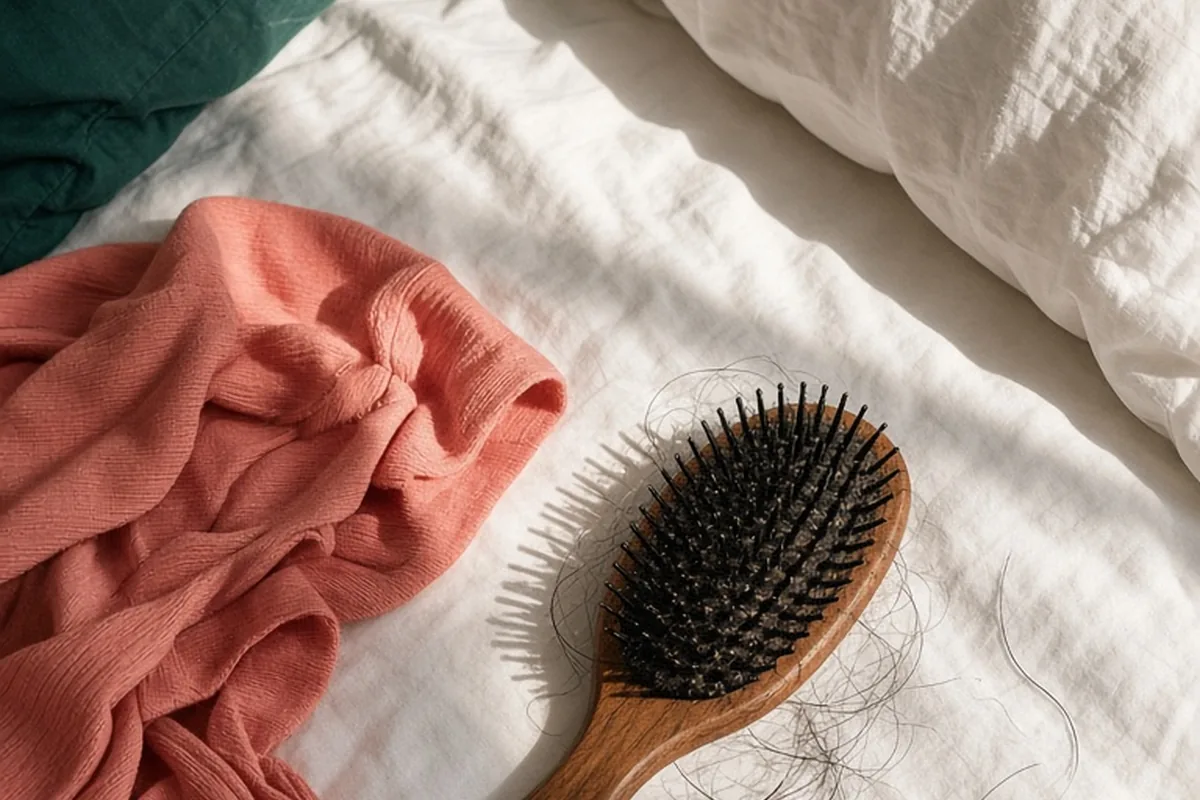
The primary way to tell shedding from breakage is by inspecting the strand length and the root end. Shed hair naturally releases from the scalp at full length and features a small, white or translucent bulb at the tip. Broken hair consists of shorter, irregular fragments without a root bulb, often displaying frayed, split, or jagged ends. While shedding is a normal biological renewal cycle, breakage stems from mechanical tension, dryness, heat, or chemical damage along the hair shaft.
Finding loose strands in your hairbrush, on your pillowcase, or around the shower drain often causes immediate concern. However, treating every stray strand as hair loss can lead to using the wrong treatments, spending money on unnecessary products, and ignoring the real structural or scalp needs of your hair.
The Root Bulb Test and Physical Strand Inspection
The fastest and most reliable method for distinguishing between shed hair and broken hair is a close physical examination of the fallen fibers. To perform this check accurately, collect several strands that have detached during styling or washing and place them across a flat surface that contrasts with your hair color, such as a white sheet of paper for dark hair or a dark towel for blonde or silver hair. Look closely at both ends of each strand under good lighting.
A shed strand will almost always display a tiny, firm, off-white or translucent bead at one end. This bead is the follicular bulb, composed of keratinized cells from the root sheath that naturally detach when the hair completes its growth cycle. Furthermore, a shed strand matches the overall length of your hair from root to tip. In contrast, broken hair lacks this white bulb entirely. Both ends of a broken strand will appear blunt, frayed, or split, and the piece will usually measure noticeably shorter than the rest of your hair length.
You can also use a tactile test to evaluate the strand's integrity. Gently slide your thumb and index finger along the length of the fallen fiber from top to bottom. A shed strand that fell naturally will feel relatively smooth in the direction of cuticle growth. A broken fragment often feels rough, uneven, or brittle, and you may detect tiny nodules along the fiber where the internal cortex has fractured before snapping.
Understanding Natural Shedding Within the Biological Growth Cycle
Shedding is an essential physiological process that makes room for new hair growth. Every individual hair follicle on your scalp operates independently through a continuous life cycle consisting of an active growth phase, a brief transitional phase, and a resting phase. At the conclusion of the resting phase, the follicle prepares to produce a new fiber and releases the old, club-ended strand. Because every follicle is on its own separate timeline, humans naturally shed hair every single day without experiencing visible bald patches or thinning.
Daily shedding volume varies from person to person based on baseline hair density, genetics, and wash frequency. For example, someone who washes and detangles their hair daily will see a small, consistent amount of shed hair each morning. Conversely, someone who wears their hair in protective braids, twists, or buns for several days will accumulate naturally detached hairs that remain trapped within the style. When that person finally uninstalls the style and washes their hair, days worth of shed strands release all at once, creating the illusion of sudden hair loss when it is simply accumulated natural shedding.
It is also important to distinguish normal shedding from excessive shedding, known clinically as telogen effluvium. Excessive shedding happens when a systemic trigger—such as high physical stress, major dietary shifts, hormonal fluctuations, high fever, or postpartum changes—shocks a larger-than-normal percentage of follicles into the resting phase simultaneously. Even during excessive shedding, the hair continues to fall out with the intact root bulb at full length. While distressing, true shedding originates beneath the scalp and cannot be fixed by conditioning masks or bond-building treatments applied to the hair fiber.
Common Causes of Mid-Shaft Hair Breakage
While shedding originates beneath the scalp within the follicle, breakage is an external, structural failure of the hair shaft itself. Each strand of hair consists of an inner cortex protected by an outer layer of overlapping cuticle scales. When external stressors erode or lift these protective cuticles, the inner protein bonds of the cortex become exposed, dry out, and eventually snap under minimal tension.
Mechanical friction is one of the most frequent culprits behind breakage. Aggressive brushing, dry detangling with fine-tooth combs, pulling hair back with tight elastic bands, and sleeping on coarse cotton pillowcases cause continuous abrasive wear. This friction gradually wears away the cuticle layers in high-contact areas, such as the crown, the nape of the neck, and the hairline. When styling tension exceeds the elastic limit of the weakened fiber, the strand snaps mid-shaft.
Chemical processing and thermal tools compound this vulnerability. Bleaching, chemical straightening, and permanent dyes alter the hair's internal disulfide bonds and strip its natural protective lipid layer. When followed by unshielded heat from blow dryers, flat irons, or curling wands, the moisture inside the cortex rapidly expands and boils, creating structural fractures known as bubble hair. Hair compromised in this manner loses its stretch and breaks during routine washing, detangling, or light manipulation.
Assessing Breakage Patterns Across Coils, Curls, Waves, and Straight Hair
Hair texture significantly influences where and why breakage occurs. Straight and loosely wavy hair types allow natural scalp oils to travel down the shaft with relative ease, keeping the fibers naturally lubricated. In these textures, breakage commonly manifests as split ends at the perimeter or snapped strands around the crown where hair ties and brushing create focused friction. Because straight strands hang at their true length, identifying broken pieces scattered on your shoulders or bathroom sink is generally straightforward.
In curly, coily, and tightly textured hair, identifying the difference between shedding and breakage requires greater nuance due to natural shrinkage and structural geometry. Textured hair fibers have an elliptical cross-section and bend sharply at every curl curve or coil twist. These bend points represent natural areas of structural vulnerability where cuticles are slightly lifted, making curly hair naturally more prone to snapping if handled without adequate moisture and slip.
Textured hair is also susceptible to single-strand knots, often called fairy knots, where an individual curl loops and ties around itself during movement. When detangled without sufficient lubrication, these microscopic knots act as catch points that shear the hair shaft, resulting in short, broken fragments. Furthermore, because curl shrinkage can shorten the visual appearance of a strand by more than half, a full-length shed hair with a root bulb can easily be mistaken for a broken piece unless you manually stretch and inspect the ends.
Conducting a Practical Daily and Wash-Day Hair Audit
To accurately determine whether your primary concern is shedding, breakage, or a combination of both, you should track where, when, and how your loose hair gathers across a full wash cycle. Begin by observing your styling environment between washes. If you notice tiny, short hair specks dusting your bathroom sink, counter, or shirts after using a comb or brush, you are experiencing active mechanical breakage.
During your wash routine, evaluate the hair that collects in your hands, wide-tooth comb, or drain cover. Strands that come out smoothly while your hair is fully coated with conditioner and saturated with water are predominantly shed hairs that were trapped by neighboring strands. Take a moment to stretch a few of these wet strands gently. Healthy hair will stretch slightly and return toward its shape; brittle, damaged hair will snap instantly with almost no resistance, indicating significant structural degradation.
Finally, examine your overall hair silhouette in the mirror. Normal physiological shedding results in a uniform, subtle reduction in density across the entire scalp without changing the geometry of your haircut. Breakage, on the other hand, produces localized thinning, uneven hemlines, fuzzy halos of short standing hairs along the top layers, and noticeably thinner, see-through ends while the roots remain thick and dense.
Targeted Recovery Plans: Correcting Breakage Versus Managing Shedding
Once your audit clarifies what is happening, you can implement a targeted plan that addresses the root cause rather than wasting effort on misaligned solutions. If your primary issue is breakage, your entire focus must center on fiber preservation, friction reduction, and structural reinforcement. Stop detangling dry hair; always apply a slippery leave-in conditioner or oil to provide glide before using a wide-tooth comb or flexible detangling brush, working methodically from ends to roots.
For broken and chemically compromised strands, establish a balanced regimen of moisture and protein. Deep conditioning treatments containing hydrolyzed proteins temporarily fill structural gaps along damaged cuticles, restoring tensile strength, while emollient-rich conditioning agents replenish lost flexibility. Replace standard cotton pillowcases with satin or silk alternatives, switch to silk scrunchies or seamless claw clips, and lower the operating temperature on hot tools while always using a verified heat protectant.
If your inspection reveals that you are dealing with excessive shedding rather than breakage, structural hair products and deep conditioners will not solve the issue. Instead, shift your attention to scalp health and internal wellness. Ensure your scalp is clean and free of inflammatory buildup by washing regularly with a gentle, clarifying shampoo when needed. Avoid styles that place excessive, prolonged tension on your roots, such as overly tight extensions or ponytails, which can cause traction-induced shedding. If excessive shedding persists for more than three months, consult a board-certified dermatologist or trichologist for blood work and a professional scalp evaluation.
Illustrative Scenarios
Diagnosing Crown Thinning: Shedding vs. Breakage in Practice
A person noticed a dramatic loss of volume around their crown and assumed they were suffering from hereditary hair shedding. They invested in expensive scalp serums and anti-hair-loss supplements for four months without seeing any improvement. Upon closer inspection on a white sheet of paper, the fallen strands coming from the crown area were only two to three inches long, lacked root bulbs, and had jagged ends, while strands from the rest of the head were full-length with intact white bulbs. The individual frequently wore a tight topknot secured with a rubberized elastic band during workouts and work hours.
Key point: Mistaking localized mechanical breakage for biological hair shedding leads to ineffective scalp treatments. Identifying the absence of root bulbs and the short fragment length allows for practical routine changes—such as using claw clips and lowering styling tension—that directly solve the problem.
Frequently asked questions
Can a single hair strand experience both shedding and breakage?
Yes. A hair strand can complete its natural growth cycle and shed from the scalp, but if it was already structurally compromised, it may also fracture and break into pieces during the detangling or washing process. Inspecting multiple strands from different areas gives a more accurate overall diagnosis than relying on a single fiber.
Does having a white bulb at the end of a fallen hair mean it will never grow back?
No, seeing a white bulb is a normal sign that the hair completed its telogen resting phase and released naturally. The underlying follicle remains intact beneath the scalp and will typically begin producing a new hair shaft in the subsequent anagen growth phase.
Why does my hair seem to break more when it is wet compared to dry?
When hair is wet, water temporarily disrupts the hydrogen bonds within the cortex, making the fiber more elastic but also significantly more fragile and prone to overstretching. Aggressive brushing or pulling on saturated hair can easily exceed its elastic limit, causing wet breakage.
Can split ends cause shedding from the root?
Split ends do not cause shedding from the root because the follicle operates independently of what happens at the tip of the hair shaft. However, untreated split ends can travel upward along the fiber, causing extensive mid-shaft breakage that makes hair appear thinner and shorter over time.
Your next step
Collect five to ten detached strands from your next styling session, place them on a contrasting surface, and check for the presence of a white root bulb to determine whether your routine requires fiber-strengthening breakage care or scalp-focused shedding management.