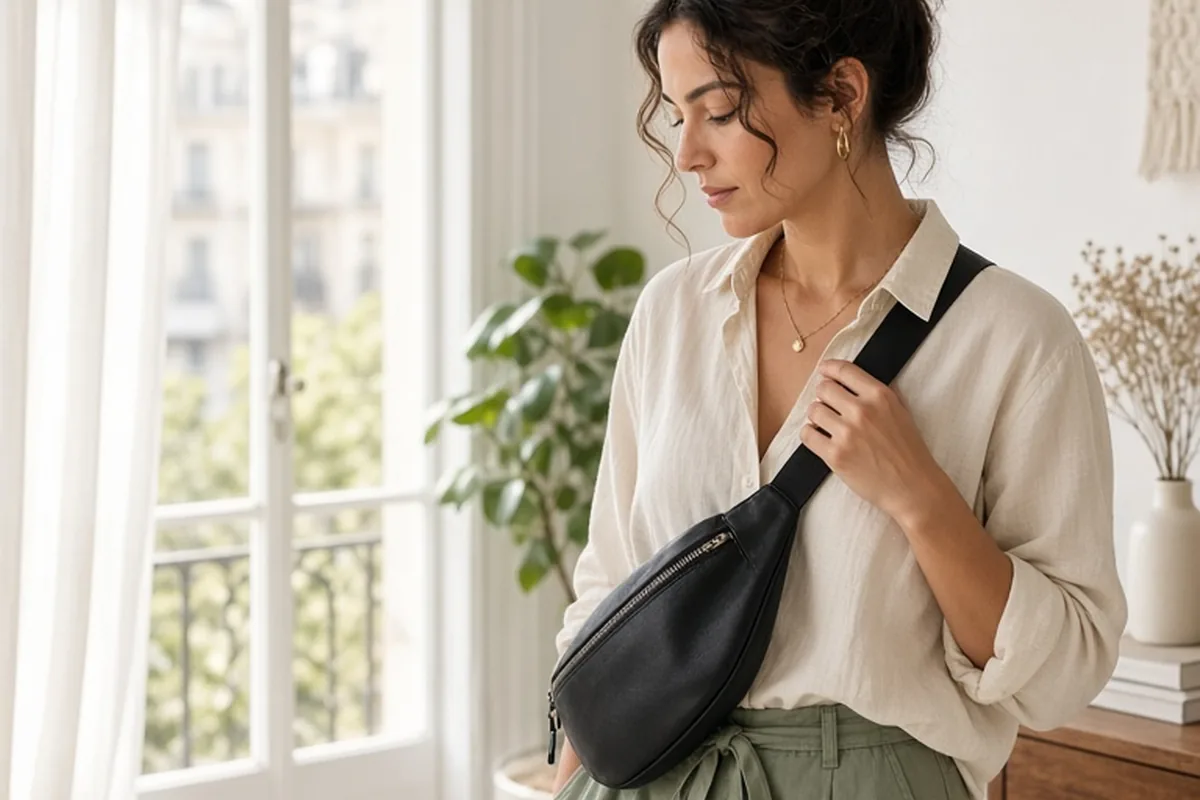
To wear a sling bag as a woman, position the strap diagonally across one shoulder so the bag rests securely against your mid-chest or upper back. Adjust the strap to sit snug without digging into your collarbone or shifting as you move. Alternatively, sling it over one shoulder like a tote for quick errands or around your waist like a belt bag for active travel.
A well-chosen sling bag bridges the gap between hands-free utility and streamlined style, freeing you from heavy totes without forcing you into an oversized backpack. Finding the right orientation, strap tension, and outfit pairing ensures your bag supports your day smoothly rather than slipping off your shoulder or pulling awkwardly on your neck.
Positioning the Bag Across the Front Chest
Wearing a sling bag across the chest is the most practical configuration for urban environments, crowded transit, and fast-paced errands. In this position, the strap crosses from the top of one shoulder down across your torso, placing the main pack resting either against your sternum or just below the bust line. This placement keeps your essential items visible, protected against pickpocketing, and accessible without requiring you to unbuckle or swivel the strap. For women, positioning the pouch slightly off-center toward the side ribcage often feels significantly more natural and comfortable than centering it directly over the breastbone, especially if the pack carries denser everyday carry items like a metal water bottle or portable charger.
To get the fit right, tighten the strap until the pack sits flush against your upper body without bouncing when you walk. If the bag sags toward your lower stomach, the strap is too loose, which creates leverage that tugs at the back of your neck. Conversely, overtightening can compress the chest and cause your shirt or jacket to bunch awkwardly under the strap. A helpful guideline is to leave just enough slack that you can slide a flat hand between the strap and your collarbone. While the front carry provides unmatched security and immediate access to your phone or transit card, it can feel slightly warm during humid summer afternoons due to continuous fabric contact against your torso.
Shifting the Bag Across the Upper Back
Sliding your sling bag onto your back clears your visual profile and frees up your entire front torso, making it ideal for walking long distances, cycling, or spending an afternoon running active errands. When set on the back, the strap rests over your preferred shoulder, running diagonally across your chest to anchor the pack between your shoulder blades or in the curve of your upper back. This configuration distributes weight similarly to a compact single-strap backpack while retaining a much sleeker, lower-profile outline that does not snag on door frames or public seating.
Proper height adjustment is essential when wearing a sling on your back. If the bag sits too low along the lumbar curve, it will sway rhythmically against your hips with every step, straining your shoulder muscle and throwing off your natural gait. Tighten the webbing so the bag sits higher, anchoring firmly against your upper thoracic spine. The primary trade-off of the back carry is accessibility and awareness: retrieving your wallet requires either swinging the bag under your arm around to your stomach or slipping one arm out of the strap entirely. In packed subway cars or dense event crowds, swinging the bag back around to your front maintains better control over your belongings.
Using Single-Shoulder and Waist Alternatives
While diagonal cross-body wear is standard, many sling bags offer enough strap adjustability to serve as a casual single-shoulder drop or a structured waist pack. Dropping the strap over a single shoulder mimics a classic shoulder bag or miniature tote. This approach works well when you are wearing a delicate silk blouse, structured blazer, or knit sweater that you prefer not to crease under a tight cross-body strap. It offers rapid removal when sitting down at a cafe or desk, though it lacks the stability needed for brisk walking or bike riding since it can slip off smooth fabrics.
Shortening the strap fully transforms many compact slings into a modern belt bag or hip pack. Fastened around your natural waist or resting low on the hips, this style removes all weight from your neck and shoulders, making it exceptionally comfortable for long travel days, festivals, or light day hikes. However, waist carry works best with smaller, flatter silhouettes; bulky or rigid sling packs can look cumbersome around the hips and can bounce against your thighs if loaded with heavy gear. Evaluating how long you will be standing or moving helps determine whether the shoulder drape or hip mount suits your day.
Adjusting the Strap to Protect Your Neck and Bust
A common frustration for women wearing sling bags is friction along the side of the neck or unwanted compression across the bust. Because female upper bodies vary widely in shoulder width, torso length, and bust projection, a factory-set strap position rarely fits comfortably without deliberate adjustment. The key is guiding the strap to lie flat across the fleshy midpoint of your trapezius muscle rather than creeping inward against the sensitive skin of your neck. If your bag features a reversible strap anchor, switch the attachment point to the side that feels most natural for your dominant hand and shoulder slope.
Bust comfort depends on finding the natural diagonal channel of your torso. For larger busts, running the strap diagonally between the breasts and letting the pouch rest at the lower rib or hip line prevents the bag from flattening your chest or pulling the strap into the breast tissue. For smaller busts, resting the pouch higher on the upper sternum often feels stable and prevents the strap from shifting. If you regularly carry heavier gear like a compact camera or full water bottle, look for slings with wider webbing (at least 1.5 inches) or add a removable padded strap sleeve to disperse focal pressure points before soreness sets in.
Styling Sling Bags with Different Wardrobe Silhouettes
Pairing a sling bag with your everyday wardrobe comes down to balancing texture, volume, and visual proportions. When dressing casually in an oversized crewneck, wide-leg denim, and sneakers, a technical nylon or canvas sling worn high across the chest balances the relaxed drape of the clothes by adding a structured focal point. The clean diagonal line cuts across loose garments, preventing them from appearing swallowed by excess fabric while keeping your hands completely free.
When styling tailored or professional pieces, such as wool overcoats, trench coats, or relaxed blazers, the placement of the bag relative to your outerwear makes a substantial difference. Wearing a slim leather sling underneath an open tailored coat keeps the silhouette sharp and prevents the strap from crushing structured shoulder pads. Conversely, wearing a soft, crescent-shaped cross-body sling over an oversized trench creates a modern, layered streetwear aesthetic. If you are wearing dresses or delicate knits, opt for smooth leather or woven straps with minimal exposed plastic hardware to prevent snags and friction pulls against fine yarns.
Packing Intentionally to Preserve Bag Shape
How you pack the internal compartments of a sling directly influences both its comfort against your body and its external visual profile. Because sling bags rest close to your ribs or back, dense or irregularly shaped objects packed improperly can poke into your torso and distort the clean lines of the bag. Treat the rear interior wall—the side resting against your body—as the foundation. Place flat, smooth items such as your phone, passport holder, slim wallet, or pocket notebook in the rear pocket to create a cushioned, even buffer against your ribs.
Store three-dimensional items like sunglasses cases, keys, lip balm, and hand sanitizer toward the front exterior pocket or centered along the bottom. Distributing weight evenly along the base prevents the sling from tipping outward or sagging away from your chest, which minimizes the torque on your shoulder strap. Resist the urge to pack a sling until the seams bulge; overstuffing turns a sleek, aerodynamic accessory into an awkward sphere that rolls around your torso as you walk. If your daily carry regularly requires a full-sized water bottle, tablet, and heavy makeup pouch, pairing a compact sling with an open canvas tote for overflow is far more comfortable than forcing everything into one small bag.
Selecting Materials and Hardware for Your Lifestyle
Choosing between technical fabrics, natural canvas, and full-grain leather determines how versatile your sling bag will be across changing weather and social settings. Water-resistant ripstop nylon, Cordura, and recycled polyester excel in active routines, outdoor travel, and rainy commutes. These fabrics are lightweight, easy to wipe clean, and flexible enough to conform gently to your body contours, though they naturally carry a sporty, utilitarian aesthetic that may clash with formal workwear.
Full-grain or pebble leather slings offer a polished, elevated finish that pairs seamlessly with office attire, evening dinners, and tailored trousers. Leather holds a defined shape, keeping your items organized even when the bag is half-empty, but it adds noticeable base weight before you even put your keys inside. Beyond the main material, inspect the hardware carefully. Look for smooth, two-way zippers that can be operated with one hand, swivel clips that prevent the strap from twisting, and quick-release buckles that allow you to take the bag off easily without pulling it over a wide-brim hat, headphones, or styled hair.
Illustrative Scenarios
Adjusting Carry Angles Across an Active Day
Elena, an illustrator who commutes by public transit and works from shared studios, struggled with neck tightness and wrinkled blazers while carrying a standard canvas tote. Switching to a medium water-resistant sling bag, she initially wore it tight across her chest for fast access to her transit card and phone while navigating crowded subway stations. Upon arriving at morning meetings, she loosened the strap slightly to slide the bag under her open trench coat, preventing the strap from pulling against her lapels. During afternoon walking errands, she pivoted the pack to her mid-back to balance the weight of a portable sketchbook and charger.
Key point: Altering the strap tension and shifting the bag between the chest, back, and under-coat positions allows a single sling bag to adapt smoothly between heavy transit security and tailored professional comfort.
Frequently asked questions
Where should a sling bag sit on a woman's torso for best comfort?
The most balanced position is diagonal across the mid-chest, resting just under the bustline or angled slightly toward your ribcage. This placement prevents the pack from bouncing against your hips while keeping the weight evenly supported by your shoulder and upper back. If worn on the back, aim to anchor the bag between your shoulder blades rather than low on your waist.
How can I prevent the strap from digging into my neck?
Lengthen the strap slightly so it shifts outward onto the center of your trapezius muscle, away from the base of your neck. Choosing a bag with a wider strap (around 1.5 inches) or adding a soft shoulder pad will also disperse pressure across a broader surface area and eliminate localized friction.
Can I wear a sling bag over a tailored coat or blazer?
Yes, you can wear a sling over outerwear, though wearing it loosely across the chest or sliding it underneath an unbuttoned blazer often looks cleaner and preserves the shape of padded shoulders. Opt for smooth leather or fine nylon straps to prevent abrasive rubbing against delicate wool or tweed fabrics.
Which shoulder should carry the sling strap?
Carry the strap over your non-dominant shoulder if you prefer using your dominant hand to unzip pockets and grab items from your chest. Alternating shoulders periodically throughout the day is also helpful to balance muscular load and prevent fatigue on one side of your neck.
Your next step
Pick your favorite sling bag, pack only your five daily essentials with flat items against the back panel, and adjust the strap so the bag rests comfortably across your mid-chest before heading out.