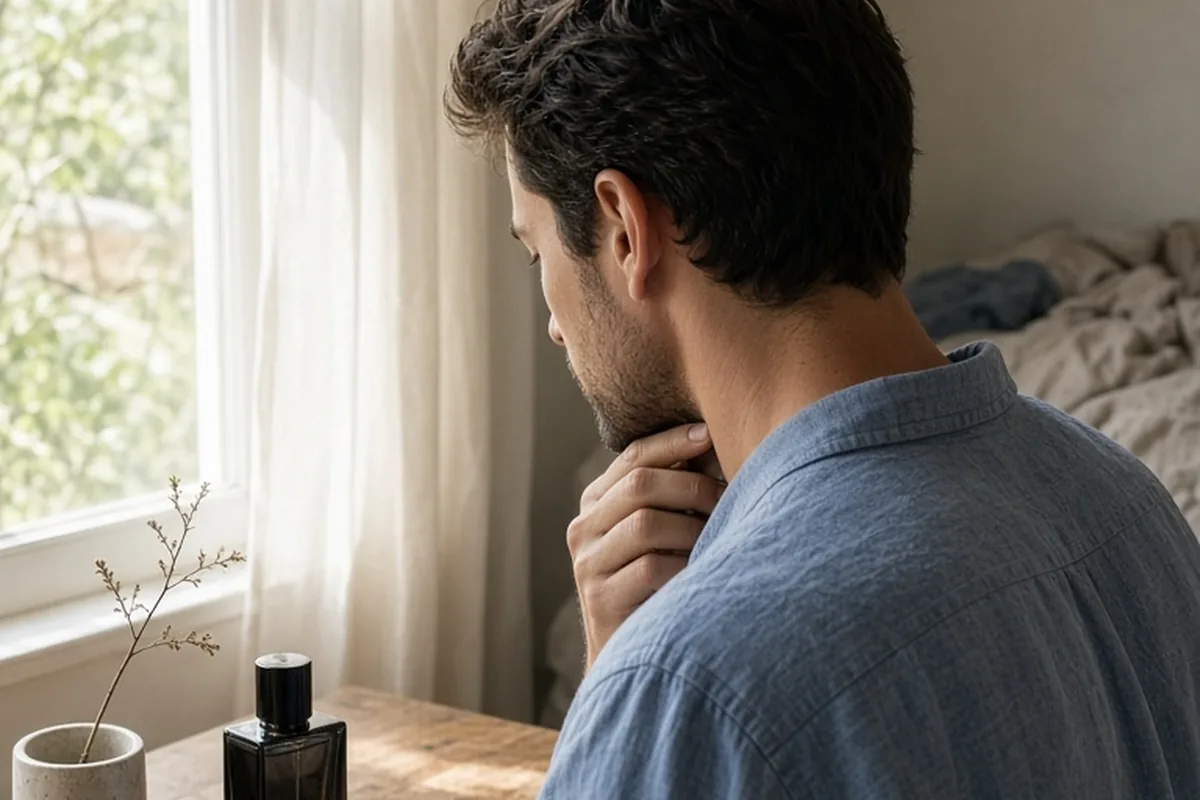
Apply cologne directly to clean, dry skin on one or two pulse points, such as the base of the neck, collarbone, or inner wrists. Begin with one to two light sprays held three to six inches away. Avoid misting the air or rubbing your skin together, and choose your spray count based on the fragrance concentration and your environment.
A well-chosen fragrance should enhance your presence rather than announce your arrival before you enter a room. Wearing cologne effectively comes down to understanding how scent interacts with body heat, how different environments alter projection, and how to maintain a subtle, personal scent radius that feels intentional.
Targeting Pulse Points for Natural Projection
Cologne relies on your natural body heat to warm the fragrance oils and release notes gradually over several hours. Pulse points are locations where blood vessels sit closest to the surface of the skin, generating the steady warmth necessary for this diffusion. The most reliable target areas include the base of the throat, the hollow beneath your collarbones, the sides of the neck just below the jawline, and the inside of the wrists.
Choosing which pulse points to target depends on where you expect people to be in relation to you. If you are sitting across from someone in a quiet meeting or at dinner, applying scent to the collarbone or base of the neck allows the fragrance to rise naturally into your immediate space without overwhelming those nearby. Spraying the inner wrists works well if your hands move naturally while talking, but it comes with a trade-off: frequent handwashing throughout the day will wash away wrist applications much faster than applications placed beneath your shirt collar.
For the most balanced result, pick one or two spots rather than spraying every available pulse point. Focusing on your upper chest and lower neck creates a warm, stable core that releases fragrance subtly through your shirt collar throughout the day without projecting a sharp cloud.
Determining the Right Spray Count for Your Routine
The ideal number of sprays depends on the strength of the bottle, your skin type, and where you will be spending your day. For most standard daily fragrances, two sprays provide an optimal balance between longevity and discretion. Applying one spray to the base of the neck and one across the chest gives enough coverage for normal workday interactions without causing olfactory fatigue for you or those around you.
Olfactory fatigue, or nose blindness, happens when your sensory system becomes accustomed to a persistent aroma and stops registering it after twenty to thirty minutes. When this happens, it is tempting to believe the cologne has worn off completely and add another three sprays. In reality, people around you can still detect the scent clearly. If you are unsure whether your application is still active, ask a trusted friend or partner rather than adding more sprays immediately.
A useful boundary is to keep your fragrance within an arm's-length bubble. If someone standing more than two feet away can identify your fragrance in an open room, you have likely used too much. In close-quarters environments like crowded offices, classrooms, or airplanes, dialing back to a single light spray ensures you remain courteous to people with scent sensitivities.
Understanding Fragrance Concentrations and Lifespans
Not all bottles labeled as men's fragrance carry the same oil concentration, and confusing these categories often leads to accidental over-application or premature fading. Higher oil percentages stay close to the skin longer, while formulations with higher alcohol ratios project strongly at first before dissipating more quickly.
Knowing which concentration you own helps you set realistic expectations for reapplication and spray volume so you do not treat a heavy extract like a light body splash.
- Eau de Cologne (EDC): Features two to four percent aromatic compounds; lasts roughly one to two hours; ideal for a brief, refreshing post-shower routine.
- Eau de Toilette (EDT): Contains five to fifteen percent oil concentration; lasts four to six hours; typically projects brightly and serves as the standard choice for casual daytime use.
- Eau de Parfum (EDP): Carries fifteen to twenty percent fragrance oil; lasts seven to nine hours; offers richer base notes with a more moderate, intimate projection radius.
- Parfum or Extrait: Contains twenty to forty percent pure oil; lasts ten to twelve hours or more; sits very close to the skin with minimal projection, requiring only one delicate application.
Application Habits to Avoid for Better Scent Longevity
One of the most common habits is spraying cologne onto one wrist and vigorously rubbing both wrists together or rubbing the wrists against the neck. This friction generates sudden heat that breaks down the lighter top notes—such as bright citrus and crisp herbs—accelerating their evaporation before they can blend naturally with your skin chemistry. Simply spray the liquid directly onto the skin and allow it to dry naturally without touching it.
Another ineffective technique is the spray-and-walk-through method, where a cloud of mist is launched into the air and walked into. This approach wastes most of the product on the floor and your hair while leaving an uneven, fleeting dusting on your clothes. Fragrance requires direct skin contact to develop its middle and base notes properly over time.
Additionally, avoid spraying cologne onto clothing as your primary application method. While fabrics can hold fragrance for a long time, alcohol-based perfumes can leave dark watermarks or oil stains on delicate materials like silk, linen, and light-colored cotton. Scent on fabric also remains static and linear, missing out on the warmth and personal skin chemistry that make a fragrance unique to you.
Matching Scent Weight to Seasons and Occasions
Temperature and humidity directly influence how fragrance molecules volatilize and travel through the air. Summer heat and high humidity intensify scent projection, making heavy, sweet, or spicy colognes feel cloying and dense. During warmer months, lighter compositions featuring bergamot, neroli, vetiver, sea salt, or crisp green notes provide a clean, invigorating profile that stays pleasant in the sun.
Conversely, cold winter air reduces skin moisture and slows down the evaporation of aromatic molecules. Lighter summer fragrances can disappear quickly in freezing temperatures. Cooler weather provides the right environment for richer, grounding profiles featuring amber, cedarwood, cardamom, tobacco, leather, or vanilla, which have the density to project steadily through heavy clothing.
Occasion also dictates your selection. A high-stakes professional interview or a quiet clinical setting calls for neutral, soap-clean, or subtle woody scents applied sparingly. An evening dinner date or an outdoor social gathering allows for deeper, warmer compositions that invite closer contact without occupying the entire room.
Preparing Your Skin for Maximum Performance
The condition of your skin plays a significant role in how long a cologne lasts. Dry skin lacks the natural lipids needed to anchor fragrance oils, causing the alcohol and aromatic compounds to evaporate far more rapidly than intended. Applying your fragrance directly after a warm shower—once your skin is completely dry but your pores remain receptive—yields significantly better retention.
To extend the lifespan of a lighter fragrance, apply an unscented moisturizing lotion or body oil to your pulse points a few minutes before spraying. The emollient layer acts as a primer, giving the fragrance oils an adhesive base that slows down evaporation throughout the day. Using an unscented moisturizer ensures your skin stays hydrated without introducing competing fragrances that distort your chosen cologne.
Store your cologne bottles properly to protect their chemical integrity over the years. Keep them away from high-heat and high-humidity areas like bathroom counters, as well as direct sunlight on windowsills. A dark, temperature-stable drawer, wardrobe shelf, or bedroom dresser will preserve the original formulation and prevent top notes from turning sour or flat.
Illustrative Scenarios
Adjusting Daily Application for a Shared Office Space
Marcus recently purchased a rich Eau de Parfum featuring leather and amber notes. Eager to make an impression at his new desk job, he applied four generous sprays across his neck, wrists, and shirt collar every morning. By midday, colleagues in adjacent cubicles began stepping outside for fresh air, and Marcus noticed people keeping extra distance during small huddle meetings. Initially assuming the cologne had faded because he could no longer smell it himself, he considered applying another spray at lunch. Instead, he paused and asked an honest coworker if the scent was strong. The coworker politely mentioned that the aroma lingered in the hallway long after Marcus walked by. Marcus adjusted his routine the next day: he switched to a lighter citrus-wood Eau de Toilette and limited himself to one spray on his lower chest under his undershirt. The subtler scent remained noticeable only during close greetings without overwhelming the room.
Key point: Nose blindness can trick you into thinking a fragrance has vanished, but respecting shared spaces means keeping your scent bubble within personal conversational distance.
Finding the Right Approach for a Dinner Date
Julian was preparing for a second date at a quiet restaurant. Feeling slightly nervous, he sprayed a heavy gourmand cologne five times right before heading out the door, misting his jacket, hair, and neck. When he greeted his date with a hug, she leaned back slightly, and throughout the meal, the heavy vanilla and spice aroma competed directly with the food they were eating. Julian felt self-conscious about whether he had seemed overeager or careless. For their next outing, Julian gave himself time to reset his routine. He took a warm shower, applied an unscented moisturizer, and used two light sprays of a clean cedar fragrance thirty minutes before leaving the house. This allowed the sharp opening notes to settle into a warm, inviting base scent by the time they sat down together.
Key point: Applying fragrance thirty minutes before an event lets the intense opening settle into a pleasant dry-down that complements rather than dominates the environment.
Frequently asked questions
Should you spray cologne on your clothes or your skin?
Apply cologne directly to clean skin so your natural body heat can warm the oils and unlock the full progression of notes. Spraying clothes can occasionally stain delicate fabrics and prevents the fragrance from developing naturally, though a faint mist on heavy outerwear can be used with caution.
How do you tell if you are wearing too much cologne?
If you can clearly smell your own fragrance without moving your wrist to your nose after an hour, or if people comment on your scent from more than two feet away, you have applied too much. A properly dosed cologne should only be noticeable to someone stepping into your personal space for a handshake or hug.
Can you reapply cologne in the middle of the day?
You can reapply lighter Eau de Cologne or Eau de Toilette formulations after five or six hours if the scent has completely dissipated. Stick to a single spray on one pulse point to refresh your profile without creating a harsh, competing layer over any lingering base notes.
Where is the best place to store fragrance bottles?
Store your bottles in a cool, dark, and dry environment such as a bedroom dresser drawer, closet shelf, or dedicated box. Avoid keeping cologne in the bathroom, where frequent heat and steam fluctuations can degrade the fragrance oils over time.
Your next step
Tomorrow morning, choose one versatile bottle, apply two measured sprays to clean skin on your lower neck or chest immediately after moisturizing, and let the scent settle naturally throughout your day.