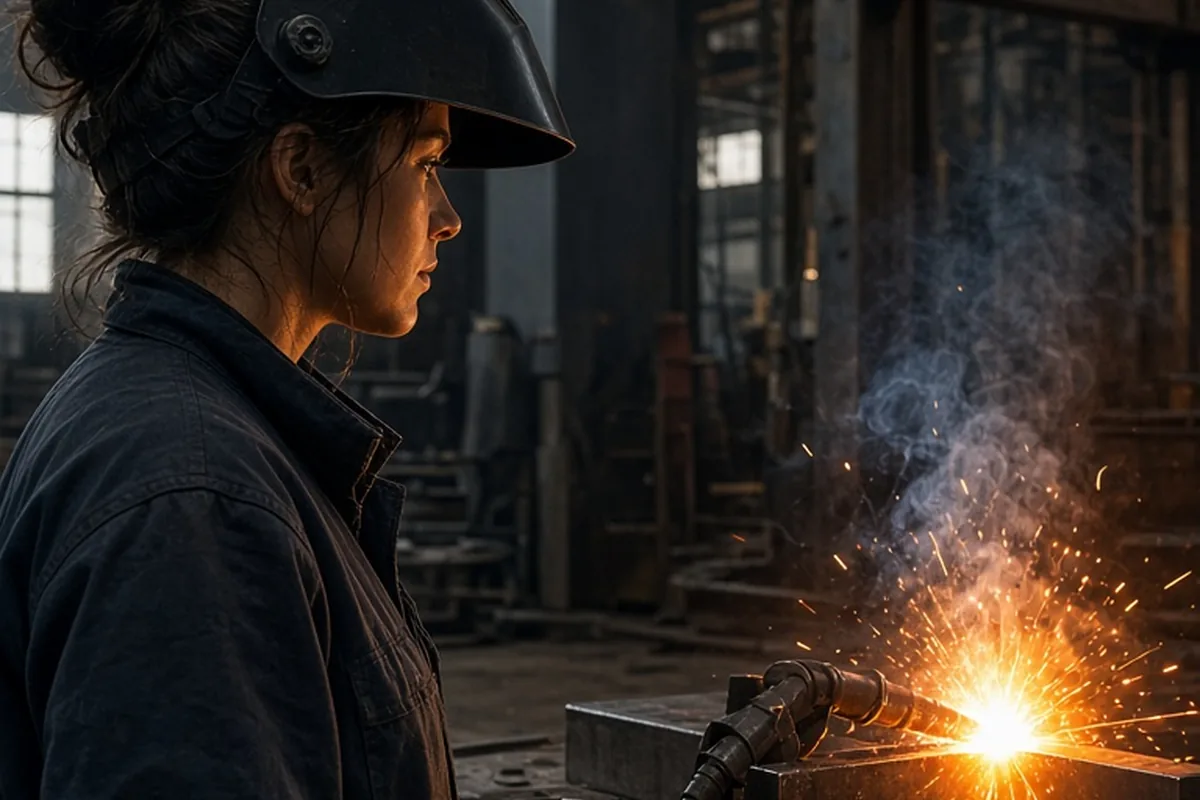
Yes, welding can be a deeply rewarding, financially viable career for a woman who enjoys tactile problem-solving, independent craftsmanship, and clear technical progression. The trade offers strong earning potential without four-year degree debt, portable skills across multiple industries, and growing institutional support. However, it demands physical stamina, resilience in navigating male-dominated shop floors, attention to long-term safety hazards like fumes and heat, and careful selection of supportive employers or union programs.
Stepping into a fabrication shop or construction site as a woman often means standing out immediately in an environment shaped by long-standing trade traditions. While more women are pursuing skilled trades than in previous decades, deciding whether to invest time, tuition, and physical effort into welding requires an honest evaluation of daily conditions, physical sustainability, workplace culture, and long-term earning trajectories.
Understanding the Daily Physical Demands and Ergonomics
Welding is fundamentally manual labor carried out in environments that can be hot, loud, dirty, and physically unyielding. A typical workday involves lifting heavy steel stock, climbing scaffolding, crouching inside confined weldments, and maintaining static postures for extended periods while running a bead. Welders routinely handle heavy power tools like nine-inch angle grinders, pneumatic chipping hammers, and heavy lead cables that place constant strain on the wrists, forearms, and lower back. The thermal environment can also be punishing, particularly during summer months when full leather personal protective equipment must be worn next to preheated metal.
Success in the trade depends far more on leverage, body mechanics, and fine motor control than on sheer brute strength. Experienced female welders often excel by relying on deliberate rigging techniques, mechanical clamps, pry bars, and overhead chain hoists rather than trying to muscle materials into place. Welding torch manipulation requires a steady hand, precise muscle memory, and steady breathing similar to fine bench work, especially in processes like Gas Tungsten Arc Welding (TIG). The trade-off is cumulative physical fatigue; developing a deliberate habit of stretching, joint care, and smart positioning is essential to avoid repetitive stress injuries over a multi-decade career.
Compensation Patterns and Industry Earning Pathways
Financial autonomy is one of the most compelling reasons women enter welding. Because the trades generally compensate workers based on observable skill, certifications, and production speed, wage growth can occur faster than in entry-level corporate or retail positions. Many newcomers enter through paid apprenticeships where they earn an escalating wage while completing their classroom training, completely avoiding the burden of student loan debt that often accompanies traditional collegiate career tracks.
Compensation varies substantially depending on the industrial sector, geographic location, and union affiliation. Production or assembly-line welding in a local fabrication shop typically offers lower entry pay and predictable shifts, whereas heavy industrial construction, structural ironwork, and pipeline maintenance offer significantly higher wages supplemented by per diem and overtime. Specialized fields like aerospace TIG welding, sanitary stainless tube welding for pharmaceuticals, and nuclear facility repair offer top-tier compensation but require stringent non-destructive testing qualifications and absolute consistency under inspection.
- Structural and construction welding: High physical demand, strong union presence, excellent hourly rates, seasonal travel requirements.
- Manufacturing and production fabrication: Steady local hours, climate-controlled shop environments, moderate starting wages with predictable scheduling.
- Sanitary process piping and aerospace: Clean working conditions, exceptional precision requirements, high hourly premiums, lower physical strain.
- Mobile repair and field maintenance: High independence, significant equipment overhead, lucrative billing rates for emergency work.
Navigating Shop Culture and Working on Male-Dominated Crews
The cultural aspect of welding remains one of the most prominent hurdles for women entering the field. Women still represent a small single-digit percentage of the welding workforce, meaning you will frequently be the only woman on a crew, in a department, or on an entire jobsite. Jobsite banter is direct, informal, and occasionally coarse. While many crews are genuinely welcoming and judge newcomers purely on their work ethic, some environments still harbor outdated attitudes, skepticism regarding a woman's physical capability, or paternalistic behaviors where male colleagues attempt to do your work for you.
Thriving on the shop floor requires clear personal boundaries, emotional composure, and assertive communication. Letting the quality of your weld passes speak for itself is the most effective way to earn credibility, but you must also feel confident correcting coworkers who overstep boundaries or attempt to take over tasks you are qualified to handle. Finding a workplace that prioritizes professional accountability—often found in larger union contractors, progressive fabrication companies, or shops with structured safety programs—makes an immense difference in job satisfaction and career longevity.
Protective Equipment, Gear Sizing, and Long-Term Health
Historically, the welding industry manufactured personal protective equipment (PPE) exclusively scaled to male proportions. Ill-fitting equipment is not merely uncomfortable; it is an active safety hazard. Oversized welding gloves reduce tactile dexterity, making it harder to control filler wire, while baggy flame-resistant jackets leave gaps at the neck where hot spatter can enter, and oversized respirators fail to achieve an airtight seal against toxic fumes. Wearing boots that lack proper arch support or heel lock can lead to severe foot and knee pain when standing on concrete floors for ten hours a day.
Fortunately, the equipment landscape has improved significantly in recent years. Several manufacturers now design welding jackets, tapered gloves, and safety footwear specifically tailored to female body frames. Prioritizing safety also means taking respiratory health seriously from day one. Inhaling hexavalent chromium from stainless steel, zinc fumes from galvanized metal, and manganese from structural wire poses documented health risks. Insisting on working under operational source-capture fume extractors or investing in a powered air-purifying respirator (PAPR) helmet is critical for long-term health preservation.
Training Routes: Trade Schools vs. Apprenticeships
Entering the trade typically follows one of three distinct paths: community college vocational programs, private welding institutes, or formal union apprenticeships. Community college programs offer an accessible, low-cost way to learn core processes (Stick, MIG, TIG, and Flux-Cored) while earning college credits. Private trade academies provide fast-paced, highly focused booth time that can prepare you for structural certification tests in six to nine months, though their tuition costs can be substantial.
Union apprenticeships—such as those run by the United Association of Plumbers and Pipefitters, the International Brotherhood of Boilermakers, or the International Association of Bridge, Structural, Ornamental and Reinforcing Ironworkers—offer arguably the most comprehensive training model. Apprentices receive debt-free instruction, health insurance, and retirement benefits while earning a scheduled percentage of a journeyperson's wage. The application process for unions can be competitive and periodic, requiring patience and mechanical aptitude testing, but the long-term career stability and pension structures represent a massive advantage.
Long-Term Career Progression Beyond the Welding Hood
Welding does not have to remain a physically demanding field job forever. Many experienced tradespeople use their hands-on fabrication experience as a stepping stone toward less physically taxing, higher-paying roles within the industrial sector. Because you understand metallurgy, weld sequencing, distortion control, and structural drawings from the inside out, your field expertise is directly transferable to management, design, and oversight positions.
A common career advancement route is becoming an American Welding Society Certified Welding Inspector (CWI). Inspectors examine welds visually and oversee non-destructive testing methods like ultrasound and radiography to ensure compliance with building and pressure vessel codes. Other viable transitions include becoming a welding educator, a robotic welding programmer, a structural cost estimator, or a shop superintendent. Some women also leverage their skills to launch independent fabrication businesses, custom furniture studios, or mobile repair operations where they have complete autonomy over their work schedule and clients.
Illustrative Scenarios
Navigating Entry into Structural Steel Fabrication
An early-career worker left low-wage retail to complete a nine-month certificate in Shielded Metal Arc Welding and Flux-Cored Arc Welding at a local technical college. Upon entering her first industrial fabrication shop, she struggled with the weight of standard heavy grinders and felt self-conscious about her upper-body strength compared to seasoned shop hands. Instead of trying to force workpieces manually, she learned proper rigging techniques, upgraded to an ergonomic grinder with lower vibration, and invested in fitted women's leather sleeves that did not slip down her arms. Within six months, her weld consistency on ultrasonic testing passed at a higher rate than several senior fabricators, earning her an assignment on critical architectural beams and a merit-based wage increase.
Key point: Mastering mechanical leverage, acquiring properly sized safety gear, and delivering consistent weld quality outweigh raw physical size when building a sustainable career in a fabrication shop.
Frequently asked questions
Is welding harder on a woman's body than other physical trades?
Welding places high demands on joint health, core stability, and upper body endurance regardless of gender. However, because women often have lower upper-body mass on average, developing correct leverage, posture, and tool positioning is critical to avoid premature shoulder and wrist strain.
Which welding process is the best starting point for a beginner?
Gas Metal Arc Welding (MIG) is widely considered the easiest process for beginners to learn due to its continuous wire feed and forgiving arc characteristics. Shielded Metal Arc Welding (Stick) is ideal for understanding puddle control and heat inputs, while Gas Tungsten Arc Welding (TIG) is best suited for fine detail work.
Can you raise a family while working as a professional welder?
Yes, but your ability to balance family life depends heavily on the industry sector you choose. Local shop fabrication, municipal utility work, and plant maintenance offer predictable eight-hour day shifts, whereas pipeline work, shutdown outages, and heavy ironworking require extensive travel and mandatory overtime.
Do female welders encounter difficulties finding entry-level work?
Most commercial contractors and union halls focus primarily on whether an applicant can pass the required weld bend or radiographic tests. While individual shop cultures vary, employers facing trade labor shortages are generally eager to hire qualified, dependable welders who show up on time and produce code-compliant work.
Your next step
Visit a local community college welding lab or union training hall to try running a practice bead under the hood before investing in expensive gear or enrollment tuition.