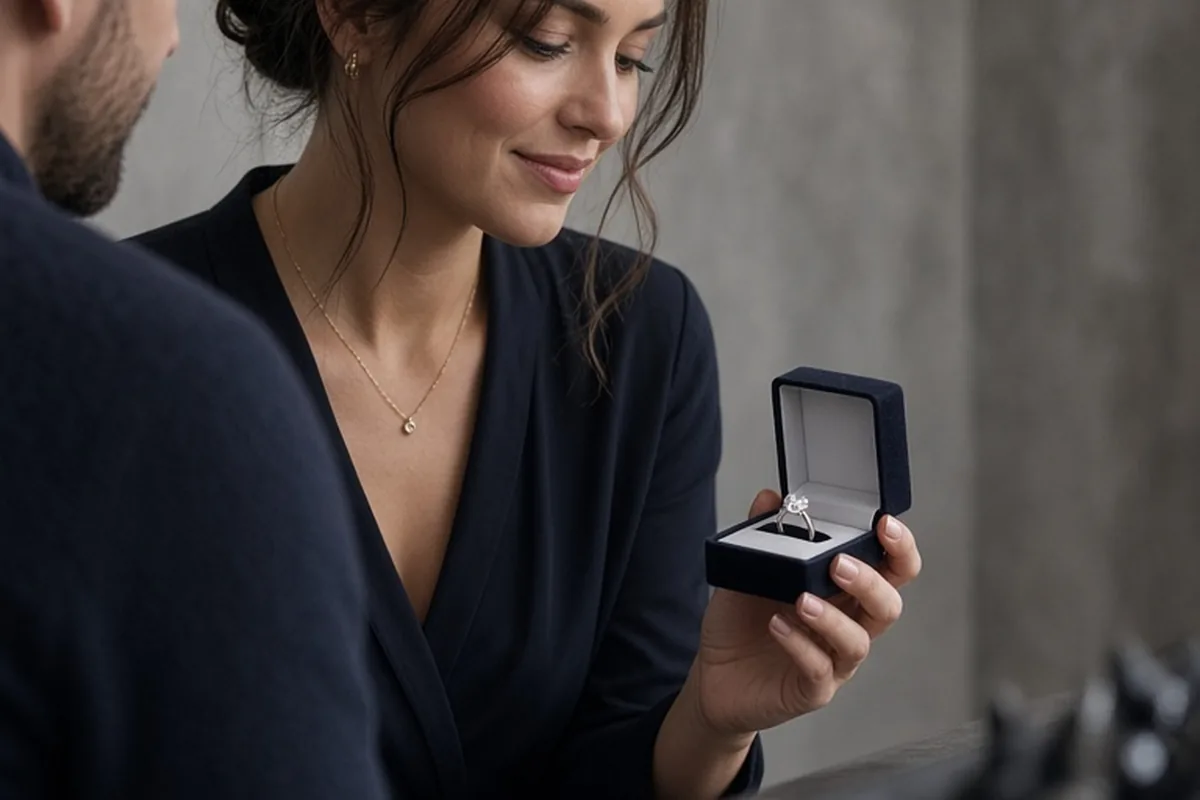
Lab-grown diamonds generally retain minimal secondary market value because manufacturing efficiencies continue to increase supply while lowering production costs. Buyers seeking better value retention or financial flexibility should consider alternatives such as certified natural diamonds with documented trade-in policies, vintage or estate jewelry bought below retail markup, durable colored gemstones with verified provenance, or choosing lower-cost alternatives like moissanite while investing the upfront savings into traditional financial assets.
When shopping for fine jewelry or an engagement ring, the financial conversation often centers on balancing initial aesthetic impact with long-term financial preservation. While lab-created stones deliver the exact optical and physical properties of mined gems at a lower upfront cost, their secondary market remains structurally limited for sellers seeking to recoup funds later.
Why Lab-Grown Diamonds Carry Limited Secondary Market Liquidity
To understand alternatives, buyers must first understand why manufactured stones behave differently from scarce natural commodities on the secondary market. Lab-grown diamonds are produced through industrial processes such as Chemical Vapor Deposition (CVD) or High Pressure High Temperature (HPHT). Because production capacity scales with technology and energy efficiency, the cost to create new rough synthetic material trends downward over time. When a consumer buys a lab-created diamond from a retail store, that price includes design, marketing, retail overhead, and retail profit margins. If that same buyer attempts to sell the piece back to a jeweler, pawnshop, or secondary dealer, the buyer faces a structural hurdle: wholesale jewelers can purchase brand-new, perfectly graded lab stones directly from growers for a fraction of original retail costs.
Consequently, secondary market buyers offer very low liquidation bids for pre-owned lab-grown stones, and many independent jewelers decline to purchase them outright. Unlike gold, platinum, or historically scarce untreated natural gems, manufactured diamonds lack a floor price supported by raw material scarcity. Approaching a lab diamond purchase with the expectation of future equity often leads to disappointment. Recognizing this reality allows shoppers to reframe their buying strategy around specific alternatives that either provide better capital recovery or reduce upfront expenditures so drastically that resale value becomes irrelevant.
Certified Natural Diamonds with Guaranteed Upgrade and Buyback Policies
For shoppers who want a traditional diamond aesthetic while preserving a clear path to value recovery, natural diamonds backed by documented retail upgrade programs represent a direct alternative. While natural diamonds sold on the open secondary market also sell below their original retail prices due to retail markup spreads, established diamond retailers frequently offer contractual trade-in policies. These programs allow the original purchaser to apply the full initial purchase price of the natural stone toward a future diamond upgrade, provided the new piece meets specific minimum value thresholds.
When pursuing this path, verification of the contract terms is critical. Inquire whether the trade-in credit applies solely to the center stone or includes the setting, whether the upgrade requires spending double the original amount, and whether the policy remains valid if the diamond suffers minor surface wear. Additionally, ensure the natural diamond comes with an independent grading report from an internationally recognized laboratory, such as the Gemological Institute of America (GIA), which standardizes color, clarity, cut, and carat weight for any future liquidation or insurance appraisal.
Vintage, Antique, and Estate Jewelry for Market-Tested Value
Purchasing pre-owned, vintage, or antique jewelry eliminates the immediate depreciation associated with buying new retail inventory. When you buy an Art Deco, Edwardian, or mid-century estate ring, the original retail markup was absorbed decades ago by the initial purchaser. The price you pay on the secondary market reflects current estate valuation, craftsmanship value, and raw material content rather than contemporary corporate advertising overhead.
Antique pieces often feature historical cuts—such as Old European, Old Mine, or transitional cuts—that are no longer produced in volume. Collectors and estate jewelers actively trade these items based on period authenticity, hand-crafted metalwork, and distinctive visual character. If financial flexibility or secondary recovery is a priority, acquiring a verified estate piece from a reputable dealer offers two distinct benefits: you secure an authentic luxury item at true secondary market pricing, and you retain the ability to resell the piece into that same estate market without suffering a standard retail-to-scrap price cliff.
Moissanite and Low-Cost Simulants Paired with Disciplined Savings
Another practical alternative shifts the financial calculation entirely away from asset recovery and toward upfront expense minimization. Silicon carbide, commercially known as moissanite, shares substantial visual similarity with diamond, scores exceptionally high on the Mohs hardness scale for daily wear, and costs a small fraction of either natural or lab-grown diamonds. Rather than spending thousands of dollars on a lab diamond that may lose most of its trade-in appeal, a buyer can spend a modest sum on a durable moissanite ring.
The financial leverage in this approach comes from what you do with the unspent capital. By redirecting several thousand dollars into high-yield savings accounts, broad-market index funds, real estate down payments, or debt reduction, you generate tangible financial returns. In this framework, the ring is treated purely as a personal accessory and sentimental keepsake with zero financial burden, while the preserved funds build measurable personal equity through standard wealth-building vehicles.
Prioritizing High-Purity Precious Metal Settings over Center Stone Expenditure
When secondary liquidity matters, the precious metal in a ring often provides the most reliable cash floor. Gold (in 14k, 18k, or 24k iterations) and platinum are globally traded commodities with transparent spot prices published daily. While labor and artistic fabrication markups are not fully recovered in scrap sales, the underlying precious metal can always be liquidated based on weight and purity at precious metal refineries, pawn brokers, and jewelry buyers worldwide.
Buyers seeking to anchor their purchase in tangible value can design a ring that emphasizes heavier, high-purity platinum or solid gold bands with intricate metalwork, halo filigree, or structural bezels, while using a modest or lab-grown center stone purely for visual accents. If financial needs ever require selling the piece, the precious metal weight provides an immediate, easily calculated baseline value that is completely independent of consumer trends in the gemstone market.
Natural Colored Gemstones with Documented Origin and No Heat Treatment
Fine natural colored gemstones—such as untreated sapphires, natural rubies, and emeralds—occupy a distinct tier in the jewelry market. Unlike colorless lab diamonds, which can be synthesized in limitless quantities, fine-grade colored gemstones with documented geographical provenance and no thermal enhancement are geologically rare. The market for high-clarity, unheated Ceylon sapphires or Colombian emeralds has remained active across decades of retail and auction house trading.
Entering the colored gemstone space requires careful verification and specialized grading reports from gemological laboratories recognized for colored stone analysis, such as AGL (American Gemological Laboratories) or SSEF. Buyers must verify whether a stone has undergone heat treatment, fracture filling, or diffusion, as artificial enhancements drastically reduce secondary collectibility. When acquired in natural, untreated condition, fine colored gems serve as distinctive, wearable jewelry that holds sustained interest among specialized collectors and vintage jewelers.
Key Steps to Verify Trade-In, Buyback, and Consignment Contracts
Before finalizing any jewelry purchase under the assumption that it can be returned, traded, or resold, consumers must thoroughly review written store policies. Many verbal promises made across sales counters regarding future buyback values fail to hold up when ownership changes, store management turns over, or retail contracts are examined closely. Always request a clear, written copy of the retailer’s lifetime upgrade, trade-in, or buyback agreement prior to payment.
Check specifically for clauses regarding physical condition requirements, mandatory price differentials on upgraded items, non-refundable administrative or restocking fees, and whether the buyback is paid in cash or store credit. If relying on consignment jewelers for future liquidation, review standard consignment fee structures, insurance coverage while the piece is on display, and the expected timeline for payout once a secondary buyer is secured.
Illustrative Scenarios
Illustrative Comparison: Estate Acquisition vs. Low-Cost Simulant Strategy
A couple evaluating engagement ring options weighed spending a substantial budget on a newly minted lab-grown diamond versus alternative paths. One partner preferred historical design, while the other focused on minimizing unrecoverable costs. They explored two distinct alternatives: purchasing an authenticated 1930s Art Deco platinum diamond ring through a licensed estate jeweler, or selecting a custom-set moissanite ring while placing the remaining budget into a dedicated home savings fund.
Key point: Both paths avoided modern retail depreciation: the estate piece retained stable secondary value anchored by its antique provenance and platinum weight, while the moissanite option eliminated reliance on resale entirely by keeping liquid capital in an interest-bearing account.
Frequently asked questions
Can I sell a lab-grown diamond back to the jeweler who sold it to me?
Most retail jewelers do not offer cash buybacks for lab-grown diamonds, though some offer partial trade-in credit toward more expensive pieces. Policies vary significantly by retailer, so you must review written buyback terms prior to purchase rather than relying on general sales conversations.
Do pawn shops and secondary dealers buy lab-grown diamonds?
Some pawn shops and secondary dealers accept lab-grown stones, but offers are typically based on nominal wholesale material costs or solely on the scrap value of the precious metal setting. Because wholesale supply is abundant, secondary offers for the stone itself are often minimal.
How does precious metal weight affect the resale floor of an engagement ring?
Precious metals like platinum and gold have transparent, standardized global spot prices based on purity and gram weight. Even if a center stone loses market demand, the physical setting retains intrinsic melting or refining value that can be calculated and recovered through standard precious metal buyers.
Is moissanite a better financial choice than a lab-grown diamond?
Moissanite is not an investment asset, but it costs significantly less upfront while providing high durability and sparkle for daily wear. Choosing moissanite allows buyers to avoid high initial retail expenditures entirely, freeing up cash for practical savings and investments.
Your next step
Request written copies of trade-in and upgrade terms from your jeweler, or obtain an independent appraisal on an estate piece, before finalizing your jewelry purchase.