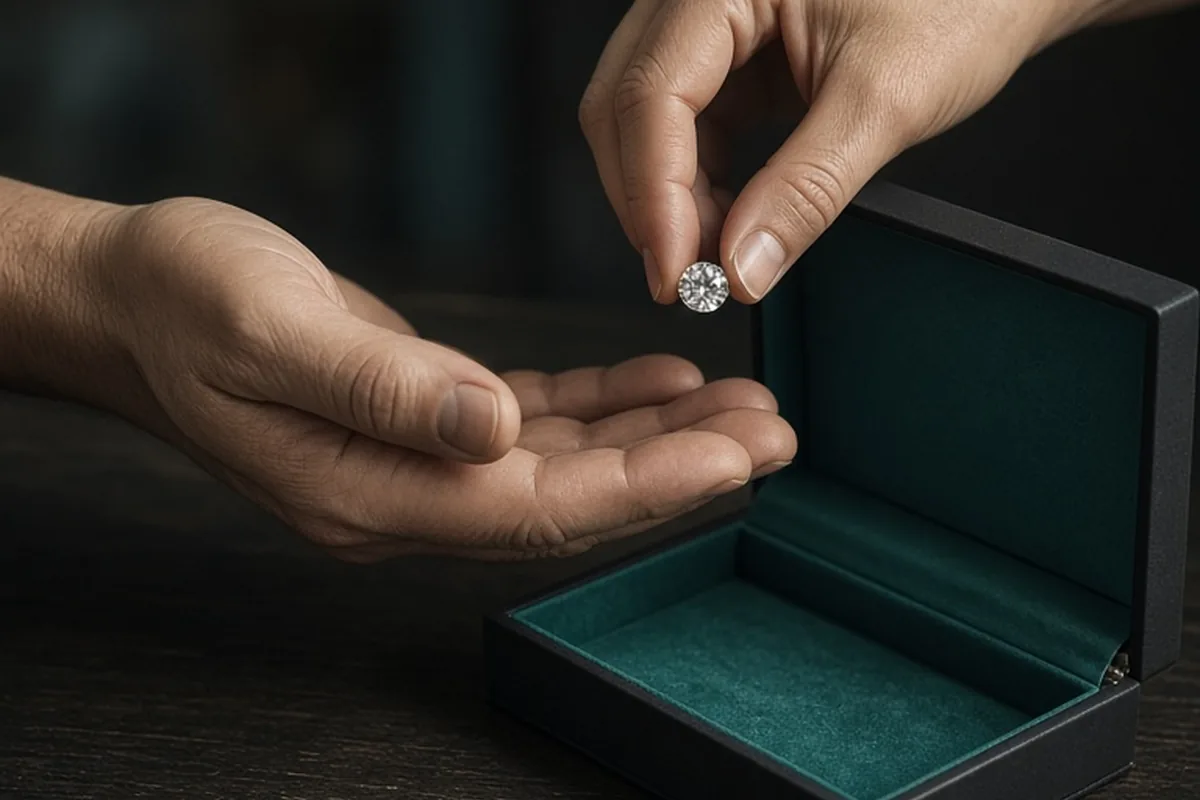
Lab-grown diamond resale payment schedules depend on the selling channel you choose. Direct dealer buyouts typically disburse funds via bank wire, direct deposit, or company check within one to three business days following gemological inspection. Consignment arrangements release payouts only after an end customer buys the piece and the mandatory return window closes, which can take several months. Peer-to-peer platforms hold funds in third-party escrow until buyer verification clears.
Selling a previously owned lab-grown diamond requires navigating a secondary market shaped by expanding production volume, evolving consumer demand, and distinct dealer policies. Understanding how secondary pricing interacts with vendor payment structures helps you select the right sales channel, protect your financial interests, and avoid unexpected delays or deductions during the settlement process.
The Financial Realities of Lab-Grown Diamond Resale Value
The secondary market for lab-created diamonds operates under different economic principles than the mined gemstone market. Because synthetic diamonds are produced in controlled laboratory settings using Chemical Vapor Deposition (CVD) or High Pressure High Temperature (HPHT) methods, manufacturing capacity continues to expand while wholesale production costs decrease over time. Consequently, secondhand buyers and commercial jewelers rarely treat lab-grown stones as scarce assets, which leads to secondary offers that represent a modest fraction of original retail purchase prices.
When evaluating resale value, diamond brokers and pawnbrokers base their offers strictly on current wholesale replacement rates rather than the price paid on your original receipt. Jewelers can readily order brand-new, certified lab-grown stones directly from growers at low trade pricing. Therefore, an offer for your pre-owned stone must sit low enough beneath current trade costs for the buyer to justify inspection labor, recertification, inventory holding risks, and eventual profit margins upon resale.
Precious metal settings frequently constitute a major share of an engagement ring's immediate liquid value. Platinum, eighteen-karat gold, and fourteen-karat gold retain predictable scrap or melt value based on published spot commodity prices. In many secondhand transactions involving smaller lab-grown center stones, the refined value of the mounting can rival or exceed the cash offer for the diamond itself.
Upfront Cash Buyouts vs. Consignment Payment Schedules
Choosing between an outright dealer purchase and a consignment contract is the primary factor dictating your payment schedule. An upfront cash buyout provides immediate closure and eliminates long-term market risk. Once a professional diamond buyer, local jeweler, or specialized estate buyer physically inspects your stone and verifies its specifications against your grading certificate, they generate a firm purchase agreement. Payment via direct bank wire, automated clearing house (ACH) transfer, or certified company check typically settles within twenty-four to seventy-two hours of agreement execution.
Consignment agreements yield a higher gross sales figure but introduce substantial timeline uncertainty and delayed payment schedules. In a consignment model, the jeweler or digital resale platform takes physical custody of the diamond, displays it to prospective retail buyers, and only disburses funds after a completed sale. The listing phase itself may take anywhere from several weeks to over a year, depending on market demand for your stone's specific cut, carat weight, color, and clarity.
Payment release under consignment is further governed by mandatory post-sale holding periods. Most retail jewelers and luxury consignment houses provide retail customers with a standard return period, typically lasting fourteen to thirty days. Your consignment contract will state that payment disbursements are frozen until that customer satisfaction window lapses without a return, adding an additional month to your overall payout timeline.
Online Peer-to-Peer Marketplaces and Escrow Holding Periods
Selling directly to another consumer through specialized online jewelry exchanges, general peer-to-peer marketplaces, or auction forums allows you to bypass dealer markups and capture true market value. However, these platforms rely on multi-stage escrow payment schedules to protect both parties from fraudulent activity, counterfeit goods, or mischaracterized gemstone attributes.
Under standard peer-to-peer marketplace escrow workflows, the buyer initiates payment at the moment of purchase, but the funds are held securely by the platform or an independent escrow provider rather than transferred directly to your bank account. You are then instructed to ship the diamond using trackable, fully insured shipping. Many jewelry-specific platforms require the parcel to route through a central third-party gemological laboratory for authentication and condition verification before it travels to the buyer.
Once the authenticated diamond arrives at the buyer's destination, a predefined inspection window commences, generally lasting forty-eight to seventy-two hours. During this period, the buyer confirms that the item matches the listing description and has arrived undamaged. Once the buyer formally accepts the shipment or the inspection window elapses without a dispute, the platform releases the escrowed funds to your linked account, a transfer that usually completes within two to five business days depending on banking channels.
Jewelry Trade-In Programs and Store Credit Disbursement Terms
Many brick-and-mortar jewelers and online retailers offer trade-in or upgrade programs that provide a higher nominal valuation for lab-grown stones than cash buyouts. Instead of receiving liquid currency, you receive structured store credit or a direct offset against the purchase of a new, higher-value piece of fine jewelry, such as an upgraded natural diamond, a larger lab-grown stone, or bespoke metalwork.
The disbursement structure for store credit often contains contractual stipulations that govern how and when the balance can be applied. Retailers frequently require that the new purchase exceed the original item's purchase value by a specific ratio, such as spending at least double the original purchase price. Store credit balances may be issued as instant electronic gift vouchers, ledger credits applied at checkout, or deferred credits valid only after original merchandise passes in-house quality assurance audits.
Before agreeing to a trade-in schedule, examine whether the store credit expires, whether it applies to custom manufacturing fees, and whether it can be combined with seasonal sales promotions. If your goal is to extract liquid cash for personal expenses, a store credit structure will not serve your needs, regardless of how attractive the trade-in valuation appears on paper.
How Grading Reports and Verification Affect Payout Speed
The presence and provenance of independent grading documentation directly influence the speed of your secondary payout. Diamonds accompanied by reports from recognized gemological laboratories, such as the International Gemological Institute (IGI) or the Gemological Institute of America (GIA), move through dealer evaluation pipelines significantly faster than uncertified stones. A reputable certificate contains a laser inscription number engraved on the diamond's girdle, allowing appraisers to match the stone to its official digital dossier in minutes.
If you attempt to sell an uncertified lab-grown diamond, dealers and consignment platforms must schedule a comprehensive in-house evaluation or submit the loose stone to an outside laboratory. This evaluation determines whether the stone was created via CVD or HPHT processes, detects potential post-growth color treatments, and verifies standard cut, color, clarity, and carat specifications. This additional testing adds several days or weeks to the pre-sale phase and delays any formal purchase offer or payout agreement.
Dealers frequently deduct the cost of gemological verification, cleaning, and stone unset procedures from the gross offer. To streamline your payment schedule, locate all original physical paperwork, digital laboratory verification links, original purchase receipts, and prior insurance appraisals before soliciting quotes from prospective buyers.
Contractual Deductions, Processing Fees, and Settlement Delays
The gross figure agreed upon during negotiations is rarely the exact net amount disbursed to your bank account. Consignment agreements, marketplace transactions, and online buyer buyouts incorporate distinct fee structures that affect your final payout. Reviewing these deductions in advance prevents unwelcome surprises when your final settlement statement arrives.
Consignment platforms commonly charge a sliding-scale commission fee, alongside administrative costs for high-resolution photography, insurance coverage while the diamond resides in showroom vaults, and routine cleaning. Marketplace platforms deduct transaction processing fees, listing fees, and escrow management surcharges. If the buyer pays through a credit card or financing plan, merchant processing fees may also be deducted from your net balance.
Payment release timelines can experience administrative delays caused by banking holidays, international wire clearances, identity verification compliance under federal Anti-Money Laundering (AML) regulations, or dispute resolutions. Clarify in writing which party bears the cost of wire transfer fees or shipping insurance, and ensure the contract stipulates a precise calendar deadline for fund disbursement following the completion of all contractual milestones.
Evaluating Alternatives When Cash Offers Fall Below Expectations
Because lab-grown diamond resale values can be substantially lower than original purchase costs, accepting an immediate cash buyout is not always the most practical or rewarding decision. When cash offers do not meet your financial expectations, several alternative paths allow you to preserve the inherent aesthetic and sentimental value of the gemstone without absorbing steep secondary market losses.
One practical approach is redesigning the diamond into a new piece of custom jewelry. An experienced local jeweler can remove the center lab-grown stone from an engagement setting and repurpose it as a pendant necklace, a custom solitaire dress ring, or one half of a matched pair of earrings. This allows you to enjoy high-grade fine jewelry without paying for a newly grown gemstone, paying only the labor and metal costs for the new setting.
Another option is gifting the stone within your family as an heirloom piece or reserving it for future life celebrations. Alternatively, donating certified jewelry to a registered nonprofit organization may allow you to claim a non-cash charitable tax deduction based on a qualified independent appraisal, subject to current tax regulations and professional advice from a certified public accountant.
Frequently asked questions
How long does it take to receive payment when selling a lab-grown diamond online?
Direct online gemstone buyers typically issue payment within 24 to 72 hours after their gemologists receive, inspect, and authenticate the physical diamond. In contrast, online peer-to-peer marketplaces and consignment platforms may take anywhere from several weeks to a few months, as funds remain in escrow until an end customer purchases the piece and completes the mandatory return window.
Why is the resale value of a lab-grown diamond lower than its original retail price?
Lab-grown diamonds are manufactured products with steadily expanding supply and decreasing production costs. Because jewelers and wholesalers can source new lab-grown diamonds at low trade pricing, secondary market buyers only purchase pre-owned stones at deep discounts relative to original retail prices to account for holding costs and resale margins.
Can I get immediate cash for a lab-grown diamond at a local jewelry store or pawn shop?
Yes, many local estate jewelers, diamond buyers, and pawn shops offer same-day cash, check, or wire transfers for lab-grown diamonds following an on-site physical evaluation. However, immediate cash offers reflect wholesale scrap or liquidation rates, which are generally lower than what you might earn through patient consignment or direct peer-to-peer sales.
What documentation should I provide to speed up my payment schedule?
Providing an original grading report from an established gemological laboratory such as IGI or GIA significantly speeds up verification and payment processing. Having your original sales receipt, appraisal records, and matching laser inscription details readily accessible allows buyers to verify stone authenticity without sending the gem out for lengthy third-party testing.
Your next step
Gather your original IGI or GIA grading certificates and contact three distinct sales channels—a direct estate diamond buyer, a luxury consignment jeweler, and an online peer-to-peer exchange—to compare written net payout estimates and settlement timelines before committing your stone.