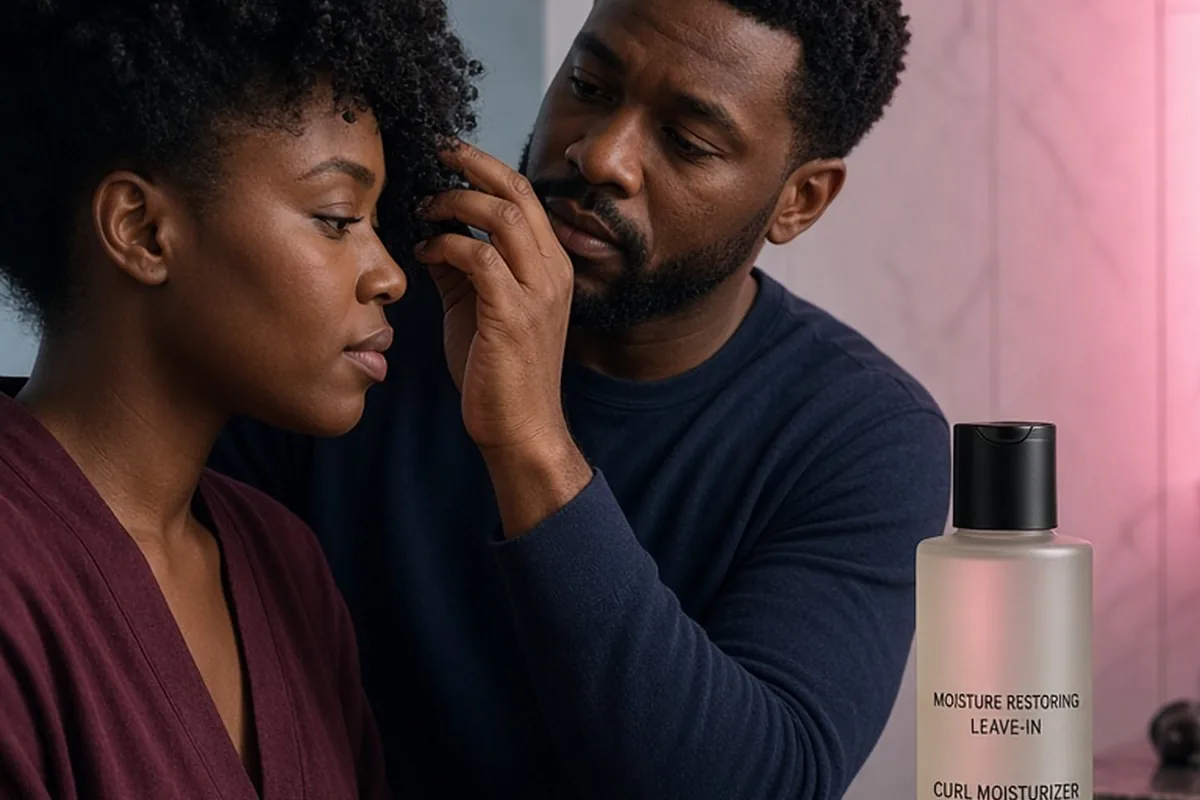
An effective moisturizer for Black hair must feature water (aqua) as its primary ingredient, paired with hydrating humectants such as glycerin, aloe vera, or panthenol to draw moisture into the strand. To retain that hydration, the formula should contain nourishing emollients like shea butter, avocado oil, or jojoba oil, alongside conditioning fatty alcohols such as cetyl or cetearyl alcohol, which soften the cuticle and prevent moisture from evaporating quickly.
Because Afro-textured and coily hair features tight curl patterns that make it difficult for natural scalp oils to travel down the shaft, selecting products with the right chemical foundation is essential for preventing chronic dryness, breakage, and dullness.
Water and Water-Soluble Humectants That Attract True Hydration
The fundamental rule of hair hydration is that only water can truly moisturize the hair fiber. When evaluating product labels, water, often listed as aqua, purified water, or aloe vera juice, should always appear as the very first ingredient. Products that list heavy oils, mineral waxes, or silicones as their primary base are sealants or stylers rather than true moisturizers, meaning they lubricate the outer surface without delivering internal hydration.
To maximize water absorption, effective formulations include water-soluble humectants. Humectants are specialized compounds that attract water molecules from the surrounding environment and pull them directly into the hair shaft. Common and reliable humectants include vegetable glycerin, aloe barbadensis leaf juice, panthenol (Pro-Vitamin B5), sodium PCA, and honey extract. Glycerin is particularly potent for coily textures because it creates temporary hydrogen bonds with water molecules, significantly improving strand suppleness and elasticity.
However, the performance of humectants depends heavily on environmental humidity. In extremely arid or dry winter conditions, humectants can pull moisture out of the hair cortex toward the drier surrounding air if they are not paired with proper emollients and occlusive sealants. For this reason, a well-formulated moisturizer balances high-humectant concentrations with rich lipid carriers to ensure hydration remains stabilized inside the hair shaft.
Rich Emollients and Plant Butters That Soften Afro-Coily Textures
While water supplies hydration, emollients are responsible for smoothing, softening, and improving the flexibility of textured strands. Afro-textured hair features numerous bends, twists, and raised cuticle edges along each strand, which can create friction and cause snagging during manipulation. Emollients work by filling in microscopic gaps along the damaged or lifted cuticle layer, creating a uniform, pliable surface that resists mechanical damage.
Plant-derived butters are among the most effective emollients for thick, coarse, or high-density Black hair. Unrefined shea butter (Butyrospermum parkii) is widely favored because it contains a rich blend of stearic, oleic, and linoleic fatty acids that lubricate the hair fiber without dissolving away rapidly. Mango seed butter (Mangifera indica) and cupuacu butter offer lighter yet deeply softening alternatives, providing exceptional slip and moisture retention for textures that might be weighed down by heavier lipids.
Cocoa butter (Theobroma cacao) and murumuru butter also serve as powerful softening agents, particularly for styles that require long-lasting shape retention and reduced frizz. When inspecting an ingredient list, look for these natural butters within the first three to six ingredients, which indicates a concentration sufficient to provide genuine softening rather than just cosmetic claim support.
Sealing Oils and Occlusives That Lock Moisture into the Cortex
Moisturizers for Black hair must contain occlusives or semi-occlusive carrier oils to prevent trans-follicular water loss. Without a lipid barrier to seal the hair shaft, water introduced during washing or moisturizing evaporates rapidly into the air, leaving hair feeling brittle within hours. It is helpful to distinguish between penetrating plant oils, which absorb partially past the cuticle into the cortex, and coating oils, which form a protective film over the exterior surface.
Penetrating oils include avocado oil, coconut oil, and extra virgin olive oil. These oils possess fatty acid chains compact enough to slip underneath the cuticle scales, providing internal lipid support and increasing the strand's tensile strength against stretching and combing stress. Avocado oil is particularly rich in monounsaturated fatty acids, making it deeply conditioning without leaving a greasy residue.
Coating or sealing oils, such as Jamaican black castor oil, jojoba oil, and argan oil, perform a different role. Castor oil features a high concentration of ricinoleic acid, producing a thick, viscous barrier that seals cuticles tightly and protects fragile ends from environmental wear. Jojoba oil closely mimics natural human sebum, making it an exceptional choice for sealing moisture into finer coil patterns without creating heavy buildup or clogging scalp follicles.
Beneficial Fatty Alcohols Versus Harsh Drying Alcohols on Product Labels
Seeing the word 'alcohol' on a hair product label often causes concern, but cosmetic chemistry distinguishes clearly between conditioning fatty alcohols and evaporative drying alcohols. Fatty alcohols are derived from natural plant oils, such as coconut or palm kernel oil, and contain long hydrocarbon chains that act as velvety emollients, emulsion stabilizers, and detangling agents.
Beneficial fatty alcohols that you should actively look for include cetyl alcohol, stearyl alcohol, cetearyl alcohol, behenyl alcohol, and myristyl alcohol. Cetearyl alcohol, a blend of cetyl and stearyl alcohols, gives moisturizing creams their rich, smooth texture while allowing combs and fingers to glide effortlessly through tightly coiled hair without causing mechanical breakage or mid-shaft snapping.
In contrast, short-chain drying alcohols are volatile compounds designed to speed up product dry time or thin out formulations. When present in leave-in moisturizers or daily lotions, ingredients such as alcohol denat (denatured alcohol), SD alcohol 40, ethanol, and isopropyl alcohol actively dissolve natural lipid layers and pull moisture directly out of the strand. Except when used in trace amounts as preservative solvents at the very end of an ingredient list, these drying alcohols should generally be avoided in daily moisturizers for textured hair.
Matching Ingredient Formulations to Low, Medium, and High Porosity Hair
Hair porosity—the measure of how easily your strands absorb and retain moisture—dictates which specific ingredient combinations will perform best. Low porosity hair has tightly overlapping, flat cuticle scales that resist moisture absorption. For low porosity coils, heavy butters and thick waxes tend to sit on top of the strand, causing immediate buildup and a stiff texture.
Low porosity hair benefits most from lightweight, water-based moisturizers containing penetrating humectants like aloe vera, panthenol, and agave nectar, combined with lighter oils such as grapeseed, sweet almond, or jojoba oil. Formulations designed for low porosity strands should minimize heavy proteins and thick butters, relying instead on warm water application and alkaline-balanced pH formulations that gently lift cuticles to allow moisture entry.
High porosity hair, which features raised, chipped, or missing cuticles from chemical treatments, heat styling, or natural curl formation, easily takes in water but loses it almost instantly. This hair type requires protein-rich ingredients, such as hydrolyzed wheat protein, hydrolyzed silk, or keratin, which temporarily patch structural holes in the cuticle. Following protein reinforcement, high porosity textures need dense emollients like shea butter and heavy sealing oils like castor oil to lock in hydration and prevent rapid evaporation.
Red Flags and Additives That Can Lead to Buildup or Dehydration
Certain ingredients common in conventional styling products can interfere with the hair's natural hydration cycle by creating an impermeable barrier that blocks water absorption. High concentrations of petroleum jelly (petrolatum) and heavy mineral oil in non-washable daily creams can coat the strand so thoroughly that subsequent water applications bead up and roll off rather than entering the hair shaft.
Non-water-soluble silicones, such as dimethicone, amodimethicone, and cyclopentasiloxane, present a related trade-off. While silicones provide temporary synthetic slip and glossy heat protection, non-water-soluble varieties require sulfate-based surfactants to remove completely. If you practice gentle cleansing, co-washing, or sulfate-free routines, repetitive use of non-soluble silicones creates a stubborn film that locks out genuine moisture over time, leading to gradual interior dehydration.
You should also be cautious with heavy artificial waxes like microcrystalline wax, ozokerite, or paraffin in leave-in moisturizers. While helpful in edge controls or firm-hold pomades, these ingredients have no moisturizing properties of their own and can suffocate the strand and scalp if applied consistently without frequent, thorough clarifying.
Step-by-Step Ingredient Check for Daily Moisturizers versus Leave-Ins
To determine whether a product suits your daily routine or wash-day conditioning, review the first five ingredients on the International Nomenclature of Cosmetic Ingredients (INCI) list. Ingredients are listed in descending order of concentration, meaning the top five to seven compounds make up the vast majority of the product's actual functional formula.
For a dedicated daily moisturizing lotion or cream, verify that water occupies the first position, followed immediately by one humectant (such as glycerin or aloe vera) and one to two softening fatty alcohols or light carrier oils. The texture should feel slippery and hydrating between your fingers rather than purely oily or sticky, signaling that it will absorb cleanly into damp or dry coils without requiring immediate shampooing.
For a wash-day leave-in conditioner or moisture sealant, you will want a higher concentration of protective lipids, film-forming humectants (like marshmallow root extract, flaxseed gel, or slippery elm), and structural proteins. If you use the Liquid-Oil-Cream (LOC) or Liquid-Cream-Oil (LCO) layering methods, ensure your base liquid contains primarily water and humectants, while your finishing cream or butter contains the richer sealing lipids to trap that water securely inside the strand.
Frequently asked questions
How can I tell if water is truly the primary moisturizing ingredient?
Check the ingredient list on the back of the bottle to confirm that water, aqua, or aloe vera juice appears in the very first position. If oils, butters, or waxes are listed before water, the product is an oil sealant or styler rather than an active hydrating moisturizer.
Is glycerin bad for Black hair in dry climates?
In very low humidity, pure glycerin can draw moisture out of the hair cortex toward the arid air. To avoid dryness, choose products that combine glycerin with sealing lipids like shea butter or jojoba oil, or switch to humectants like panthenol and aloe vera during winter months.
What is the difference between a daily moisturizer and a leave-in conditioner?
A daily moisturizer is formulated with water, light humectants, and emollients to rehydrate dry coils between washes without causing heavy residue. A leave-in conditioner typically contains lower pH balancers, detangling agents, and mild proteins designed specifically to prime wet hair right after shampooing.
Are all silicones harmful to coily and curly hair?
No, silicones provide effective slip, cuticle smoothing, and heat protection. However, non-water-soluble silicones like traditional dimethicone require clarifying cleansers to prevent buildup, whereas water-soluble silicones (often prefixed with PEG-) rinse out easily with gentle cleansers.
Your next step
Inspect your current hair moisturizer's label today to ensure water is listed first, followed by proven humectants and fatty alcohols, while removing any daily products that rely heavily on drying alcohols or unwashed silicone buildup.