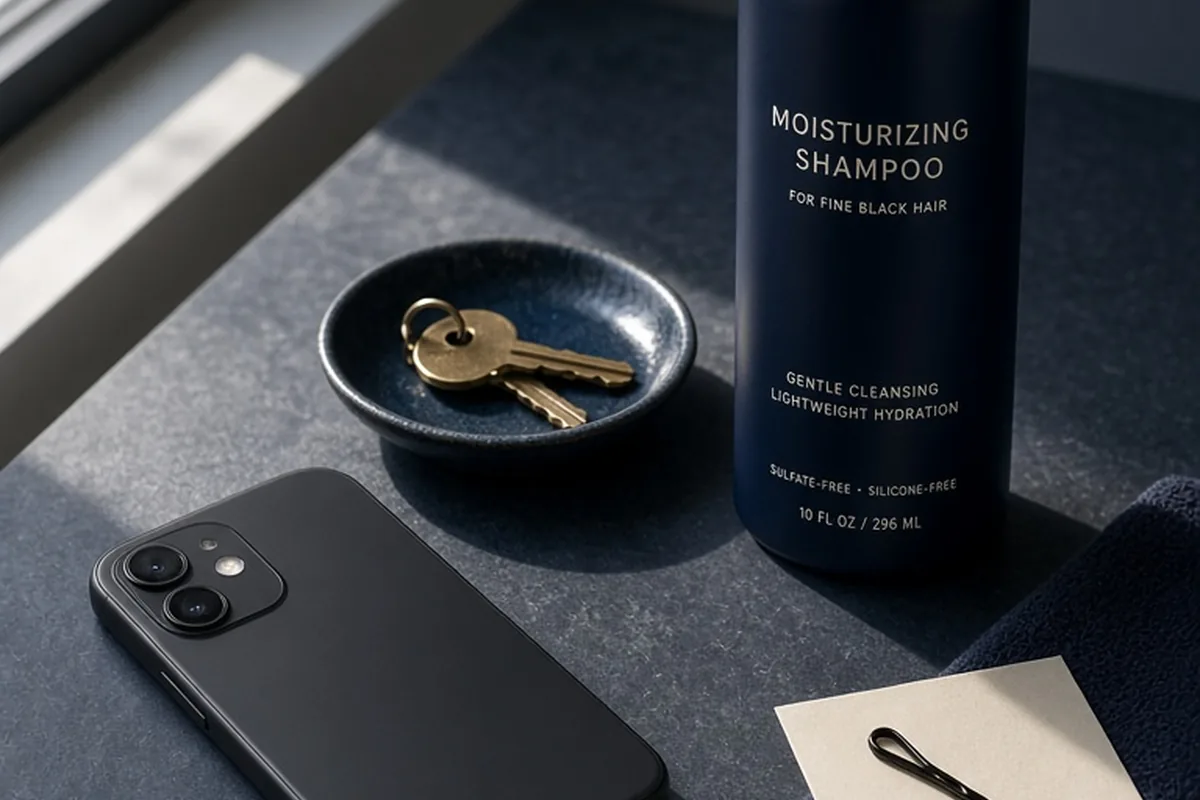
A moisturizing shampoo for fine Black hair must balance gentle cleansing agents with lightweight humectants rather than dense plant butters. Look for mild surfactants like sodium cocoyl isethionate or cocamidopropyl betaine, paired with weightless hydrators like panthenol, glycerin, and aloe vera. Avoid formulas dominated by heavy shea butter, mineral oil, or unrefined castor oil high on the ingredient list, as these coat delicate, low-diameter strands, causing flat roots, dullness, and premature product buildup.
Caring for Black hair with fine strands presents an ongoing balancing act between delivering vital moisture and maintaining strand buoyancy. While textured hair generally requires lipid replenishment to combat natural dryness, fine strand diameters collapse quickly under conventional textured-hair formulations designed for coarse textures.
The Fine Strand Dilemma in Textured Hair Care
A common point of confusion in textured hair care is the critical distinction between hair density and hair width. Density refers to the total number of individual hair follicles distributed across the scalp, whereas width or caliber describes the physical diameter of a single strand. An individual can possess dense Black hair with a high follicle count while each individual hair shaft remains exceptionally fine. Fine strands have a narrower cortex and fewer protective cuticle layers than medium or coarse fibers. Consequently, fine textured hair bends, coils, and kinks with great flexibility, but it lacks the internal structural rigidity necessary to support thick, oil-dense topical coatings.
Traditional moisturizing shampoos formulated for Black hair frequently cater to coarse, dry textures that readily absorb heavy emollients. These products routinely feature dense concentrations of unrefined shea butter, cocoa butter, petrolatum, and viscous plant oils within their primary ingredient decks. When applied to fine coils, these rich lipid layers do not simply soften the fiber; they overwhelm the strand. The excess weight drags down curl definition, compresses natural volume at the roots, and forms an occlusive barrier that attracts environmental debris. Over successive washes, this imbalance leaves fine hair feeling perpetually greasy near the scalp yet brittle and dry along the perimeter, because water cannot penetrate the residual buildup.
Surfactant Selection for Fragile Cuticles
Finding an effective cleanser begins with evaluating the primary and secondary cleansing agents. Because fine strands possess fewer overlapping cuticle cells, harsh anionic detergents can rapidly strip the delicate lipid layer, leading to raised cuticles, increased friction, and mechanical breakage during washing. High-strength surfactants such as sodium lauryl sulfate or ammonium laureth sulfate clean thoroughly but often remove too much natural sebum, creating friction that fine curls struggle to withstand. However, completely abandoning surfactants in favor of rich cleansing conditioners or co-washes frequently backfires for fine hair by accelerating sebum and residue accumulation.
The ideal middle ground utilizes gentle, amphoteric, or mild anionic surfactants that lift dirt and excess sebum without stripping the hair shaft. Look for ingredients such as sodium cocoyl isethionate, cocamidopropyl betaine, sodium methyl cocoyl taurate, and decyl or coco glucoside. These cleansers generate a stable, low-friction lather that allows fingers to glide across fine coils without dragging. They rinse cleanly away, leaving the scalp balanced and the cuticle intact without leaving behind an oily film that compromises natural strand movement.
Weightless Hydrators Versus Heavy Occlusives
Moisture in hair care refers fundamentally to water retention within the hair cortex, not the application of topical grease. Fine Black hair requires water-binding ingredients that enter the hair structure or form breathable, flexible surface matrices rather than heavy, suffocating coats. Humectants are the foundation of this lightweight hydration strategy. Ingredients such as glycerin, propanediol, hyaluronic acid, and sodium PCA draw moisture into the fiber, improving elasticity so delicate coils can stretch and recoil without snapping under tension.
In addition to simple humectants, panthenol, also known as provitamin B5, serves as an exceptional hydrator for low-diameter strands. Panthenol penetrates the cuticle and binds water inside the cortex while providing a featherweight smoothing effect on the exterior shaft. Botanical extracts like aloe vera juice and marshmallow root provide natural slip through plant mucilage, which untangles fine curls during washing without depositing heavy fats. When evaluating product labels, seek formulas where these water-soluble humectants appear near the top, while dense plant oils like castor, olive, or coconut appear near the bottom of the deck, if present at all.
The Role of Hydrolyzed Proteins in Fine Hair Care
Because fine hair has less cortical bulk than coarse hair, it is inherently more susceptible to mechanical wear, heat vulnerability, and structural fatigue. When fine coils absorb water during cleansing, the hair shaft expands; as it dries, it contracts. If the strand lacks structural integrity, this continuous expansion and contraction cycle can lead to hygral fatigue, leaving the hair feeling mushy, limp, and prone to snapping. Incorporating low-molecular-weight hydrolyzed proteins into a moisturizing shampoo formulation offers internal structural reinforcement alongside hydration.
Proteins such as hydrolyzed wheat protein, hydrolyzed silk, hydrolyzed quinoa, and keratin fragments are small enough to temporarily adhere to weak points along the damaged cuticle. This light, microscopic patching strengthens the outer perimeter of the fiber, giving fine strands enough body and resilience to hold their natural curl pattern without sagging. The key is moderation. Avoid intense protein reconstruction shampoos for everyday use, which can make fine hair feel stiff or wire-like. Instead, prioritize gentle moisturizing cleansers that list hydrolyzed proteins in the middle-to-lower portion of the ingredient deck to provide continuous, subtle tensile support.
Deciphering the Shampoo Ingredient Label
Reading a cosmetic ingredient list requires looking past front-bottle marketing terms like intensely nourishing or deeply restorative, which usually signal heavy butter content. Examine the first seven ingredients listed on the back panel, as these typically account for the vast majority of the formula. In an optimal shampoo for fine Black hair, water should be followed by mild surfactants, followed immediately by water-soluble conditioning agents or humectants. If solid butters or heavy unrefined oils occupy slots two through five, the product will almost certainly overwhelm fine curls.
Conditioning polymers require careful consideration as well. Polyquaternium compounds such as Polyquaternium-7 or Polyquaternium-10 provide exceptional slip and wet combability, which protects fine strands from snapping during finger detangling in the shower. However, some higher-weight polymers can build up on fine textures with repeated usage. Similarly, water-insoluble silicones like dimethicone form a smoothing shield that reduces friction, but they demand stronger surfactants to wash away. If you prefer formulas with silicones for frizz control, look for water-soluble alternatives like PEG-modified silicones, or ensure you plan a dedicated clarifying wash every few weeks.
Wash Day Application Techniques for Fine Curls
The way you apply shampoo directly affects both scalp cleanliness and the preservation of fine strand health. Rather than piling fine curls directly onto the crown of the head and scrubbing vigorously, which creates severe friction and matting, focus shampoo application strictly on the scalp. Part the hair into four manageable quadrants and apply the shampoo directly to the skin using your fingertips or an applicator bottle. Gently massage the scalp using small circular motions, lifting excess sebum and dead skin cells while leaving the delicate mid-lengths and ends undisturbed.
Allow the lather to cleanse the mid-lengths and ends indirectly as it rinses down the hair shaft with running water. The foam carries enough surfactant power to remove surface dust and residue from the lengths without stripping the older, more fragile areas of the strand. If your fine ends feel particularly parched before washing, apply a tiny amount of lightweight oil or a basic rinse-out conditioner to the bottom two inches before shampooing. This pre-cleansing barrier shields delicate ends from unnecessary surfactant contact while ensuring the scalp receives thorough, unhindered cleansing.
Establishing an Optimal Cleansing Schedule
A common misstep in managing fine textured hair is spacing wash days too far apart. Because coarse hair can absorb significant sebum without appearing greasy, washing once every two to three weeks is widely discussed in textured communities. However, fine hair has less surface area per strand to absorb naturally produced scalp sebum. Extending the interval between washes often leads to a congested scalp, follicle inflammation, and limp, lifeless strands clumped together by accumulated oils. Most individuals with fine Black hair benefit from cleansing their hair once every five to seven days.
Your local environment and water quality also dictate how frequently you need to adjust your wash routine. Hard municipal water containing elevated levels of calcium and magnesium binds with shampoo surfactants and natural oils, forming an insoluble curd that coats fine strands and makes them feel dry and straw-like. If you live in a hard water area or use styling mousses and setting lotions regularly, rotate in a gentle chelating or clarifying shampoo once a month. Following a clarifying wash with a light, humectant-based moisturizing shampoo restores hydration without returning heavy residues to the hair.
Frequently asked questions
Can I use co-washes instead of a moisturizing shampoo if I have fine Black hair?
Co-washing exclusively is generally not recommended for fine Black hair. Conditioning washes rely on cationic surfactants and heavy fatty alcohols that lack sufficient cleansing power to remove sebum from low-diameter strands, resulting in rapid product buildup and flat roots. A gentle, sulfate-free moisturizing shampoo provides the necessary cleansing while keeping hair buoyant.
Will protein in a moisturizing shampoo make my fine hair brittle?
High-strength protein treatments can cause stiffness if overused, but the small quantities of hydrolyzed proteins found in balanced moisturizing shampoos are safe and beneficial. These microscopic protein fragments temporarily fill structural gaps along the delicate cuticle, reinforcing fine hair fibers against breakage without hardening the strand.
How can I tell if a moisturizing shampoo is too heavy for my hair?
If your hair feels greasy within twenty-four hours of washing, lacks root volume, or feels coated and waxy when dry, the shampoo formula is likely too heavy. Healthy, appropriately hydrated fine hair should feel soft, move freely when shaken, and showcase distinct, bouncy curl definition rather than hanging limp.
Is shea butter completely bad for fine textured hair?
Shea butter is not harmful, but its physical density poses challenges for fine strands. When it is positioned high on the ingredient list, it can weigh hair down and block water absorption. It works best for fine hair when included in trace amounts near the end of the ingredient deck to provide light sealing without coating the fiber.
Your next step
Inspect your current shampoo bottle's ingredient list today and check whether heavy butters or oils occupy the top five positions; if so, swap it for a formula powered by gentle glucosides or isethionates and lightweight humectants like panthenol or aloe vera.