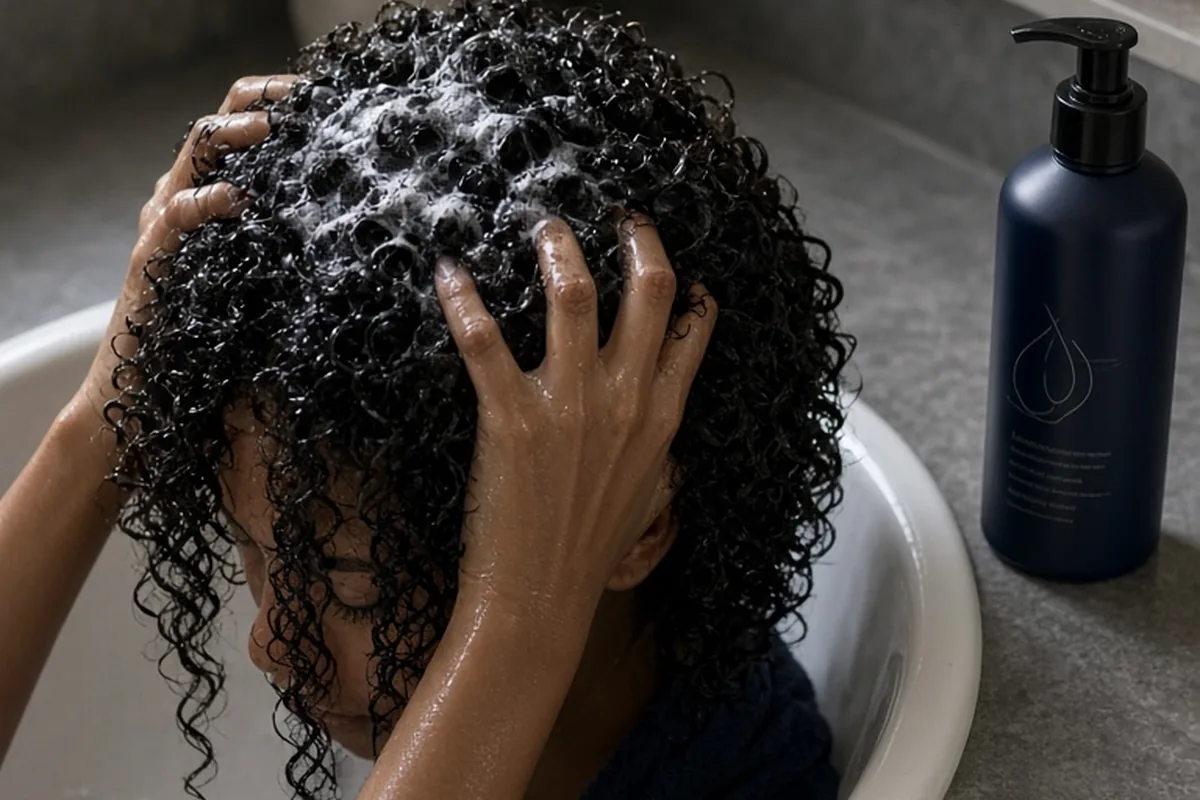
To keep curly hair healthy with a moisturizing shampoo, choose sulfate-free formulas rich in humectants like glycerin and emollients such as shea butter or argan oil. Focus the cleanser strictly on your scalp using gentle fingertip massage, letting the suds rinse down your curl lengths without rough scrubbing. Wash only one to three times weekly, always follow with a hydrating conditioner, and adjust your routine based on your curl porosity and scalp oil levels.
Curly hair naturally loses hydration faster than straight textures because scalp sebum struggles to travel down the bends and coils of the spiral strand. Selecting the right moisturizing shampoo and applying it with intention protects the delicate cuticle layer, prevents unnecessary breakage, and preserves defined, elastic curls.
Why Curly Textures Demand Moisture-Rich Scalp Cleansers
The anatomical structure of a curl creates specific vulnerabilities that straight hair fibers rarely encounter. Every bend, curve, and twist along a curly strand represents a natural point of raised cuticle scales and potential mechanical weakness. In addition, the natural lubricating oils produced by the sebaceous glands on the scalp cannot easily glide down spiral patterns. This means the ends and mid-lengths of curly hair frequently experience dryness even when the scalp produces adequate sebum.
Standard clarifying or deep-cleansing shampoos rely on harsh anionic surfactants that strip away sebum entirely, causing the already vulnerable cuticle to lift further. When cuticles lift, internal moisture evaporates rapidly, leading to immediate frizz, tangling, and brittleness. A dedicated moisturizing shampoo resolves this imbalance by using gentle, non-stripping cleansing agents paired with conditioning buffers. It lifts away environmental debris, sweat, and excess oil from the scalp while depositing a light layer of hydration that protects the hair shaft during the wash process.
Essential Ingredients to Look for in Moisturizing Shampoo
Evaluating a shampoo bottle requires looking beyond marketing claims to inspect the ingredient deck. The most effective moisturizing shampoos for curly hair combine humectants, emollients, and gentle surfactant systems. Humectants like aloe vera juice, vegetable glycerin, honey derivatives, and panthenol (provitamin B5) attract ambient water molecules directly to the outer layers of the hair fiber, restoring elasticity and suppleness while you wash.
Emollients and fatty acids serve as the critical sealants and slip-enhancing agents in a moisturizing cleanser. Ingredients such as jojoba oil, argan oil, sweet almond oil, cupuacu butter, and shea butter coat the strand, smoothing rough cuticle edges so individual curls do not snag on one another during cleansing. Look for mild cleansing agents such as cocamidopropyl betaine, sodium cocoyl isethionate, or decyl glucoside. These gentle surfactants clean without dehydrating the scalp or stripping natural moisture reserves.
Harmful Additives and Harsh Ingredients to Avoid
Certain ingredients frequently found in generic hair cleansers can actively undermine the health of curly patterns. Primary culprits include harsh sulfates like sodium lauryl sulfate and ammonium lauryl sulfate, which strip protective lipid layers aggressively. Drying short-chain alcohols, such as isopropyl alcohol and alcohol denat, also evaporate quickly while drawing out essential cellular moisture from textured strands.
Heavy, non-water-soluble silicones such as dimethicone present a different kind of problem. While they initially impart artificial shine, they can form an impermeable plastic-like barrier over the hair shaft. Over several wash cycles, this barrier prevents genuine hydration from penetrating the hair cortex, causing chronic dryness underneath a slick exterior. If your moisturizing shampoo contains non-soluble silicones, you will eventually require harsh clarifying agents to remove them, perpetuating a frustrating cycle of stripping and buildup.
Step-by-Step Cleansing Routine for Healthy, Defined Curls
Proper application technique matters just as much as product choice when washing curly hair. Begin by completely saturating your hair with lukewarm water for two full minutes. Curls are dense and naturally hydrophobic when dry; thorough saturation ensures that water penetrates the inner layers and dilutes the shampoo sufficiently across your scalp. Avoid hot water, which forces cuticles open and accelerates moisture loss.
Dispense a nickel-to-quarter-sized amount of moisturizing shampoo into wet palms, emulsify it with water, and apply it directly to your scalp rather than dumping product onto the crown or ends. Using the pads of your fingertips, massage the scalp in small circular motions to loosen sebum and shed skin cells without causing friction tangles. Allow the lather to run down the lengths of your curls as you rinse; do not pile your hair on top of your head or rub the lengths between your hands. Finish by following immediately with a nutrient-rich rinse-out conditioner or deep treatment.
Adjusting Wash Frequency Based on Porosity and Curl Type
Determining how often to use your moisturizing shampoo depends on your hair porosity, curl tightness, and daily lifestyle. Low-porosity curls have tightly bound cuticles that resist moisture absorption and accumulate surface product buildup easily. Individuals with low porosity typically benefit from washing once or twice a week, pairing their moisturizing shampoo with warm water to help gently open cuticles for cleansing and hydration.
High-porosity curls, whether from chemical processing, heat styling, or natural texture, have gaps in their cuticles that lose water rapidly. If you have high-porosity hair or fine wavy textures, you may need a gentle moisturizing wash every three to four days to replenish hydration without weighing down the strand. Meanwhile, dense coily patterns (Type 4) often thrive on a weekly or bi-weekly moisturizing wash schedule, using leave-in conditioners and sealing butters between washes to sustain long-term moisture retention.
Balancing Moisture and Protein to Prevent Hygral Fatigue
While moisture is vital for curl flexibility, an over-reliance on heavy moisturizing cleansers without structural protein can lead to a condition known as hygral fatigue. Hygral fatigue occurs when the hair fiber repeatedly swells with water and contracts during drying, weakening the internal keratin structure. Curls experiencing excessive moisture often feel mushy, overly soft, limp, and lose their natural spring and curl pattern.
To maintain structural integrity, periodically rotate in a cleanser or post-wash treatment containing hydrolyzed proteins, such as silk, wheat, quinoa, or vegetable proteins. Protein reinforces weak spots along the cuticle and maintains the necessary tension for buoyant curls. If your curls stretch excessively without bouncing back, introduce a balanced protein treatment; if they feel stiff, brittle, and snap easily, scale back protein and prioritize rich moisturizing shampoos with humectants.
Troubleshooting Common Washing Mistakes and Buildup
Using a moisturizing shampoo does not eliminate the occasional need for scalp maintenance. Because moisturizing formulas deposit conditioning agents and fatty acids, natural oils, dead skin cells, and styling polymers can gradually accumulate around the hair follicles. If your scalp begins itching, your roots look greasy shortly after washing, or your curls refuse to hold definition, residual buildup is the likely cause.
Address this issue by incorporating a gentle chelating or clarifying rinse once every three to four weeks, followed immediately by an intensive deep conditioning mask. Additionally, avoid scrubbing with fingernails, which can create micro-abrasions on the scalp and damage fragile emerging hair bulbs. Always use microfiber towels or a soft cotton t-shirt to gently blot excess water after washing, as traditional terrycloth towels create friction that disrupts curl clumps and triggers immediate frizz.
Illustrative Scenarios
Restoring Hydration Balance for Type 3B Curls
Jordan noticed that his medium-density Type 3B curls were becoming increasingly frizzy, dry, and tangled at the ends despite daily washing with a conventional clarifying shampoo. After examining his routine, he switched to a sulfate-free moisturizing shampoo formulated with aloe vera and jojoba oil, reduced his wash frequency to twice weekly, and applied cleanser solely to the scalp while using lukewarm water. Within four weeks of modifying his technique and product choice, his curls regained noticeable spring, retained moisture between washes, and showed substantially less breakage during detangling sessions.
Key point: Targeting the scalp with a sulfate-free formula and reducing wash frequency allows curls to preserve their natural moisture balance without compromising scalp hygiene.
Frequently asked questions
Can I use moisturizing shampoo every day on curly hair?
Daily shampooing is generally not recommended for curly hair because it repeatedly strips natural sebum faster than the scalp can replenish it. Most curly types achieve optimal balance by washing one to three times per week. If you exercise daily or sweat heavily, try rinsing with plain water or using a light conditioner rinse between regular wash days.
Is a moisturizing shampoo the same as a co-wash?
No, a moisturizing shampoo contains gentle surfactants designed to lift sweat, oil, and product buildup from the scalp while maintaining moisture. A co-wash is a conditioning cleanser with minimal or no surfactants that primarily conditions rather than thoroughly cleanses. Rotating a moisturizing shampoo with a co-wash works well for very dry or coarse textures.
Will a moisturizing shampoo weigh down fine curly hair?
Rich formulas heavy in thick butters like shea or cocoa butter can weigh down fine curls and reduce volume. If you have fine strands, look for lightweight moisturizing shampoos featuring humectants like glycerin, aloe vera, and lighter oils like jojoba or argan oil instead of heavy waxes.
How do I know if my moisturizing shampoo is working effectively?
A well-formulated moisturizing shampoo should leave your scalp feeling refreshed and clean without any tight or squeaky sensation. Your hair lengths should feel pliable and soft rather than straw-like or tangled before you even apply your conditioner.
Your next step
Examine your current shampoo bottle's ingredient list today, set aside any formulas with harsh sulfates or drying alcohols, and schedule your next wash with a gentle humectant-rich cleanser focused exclusively on your scalp.