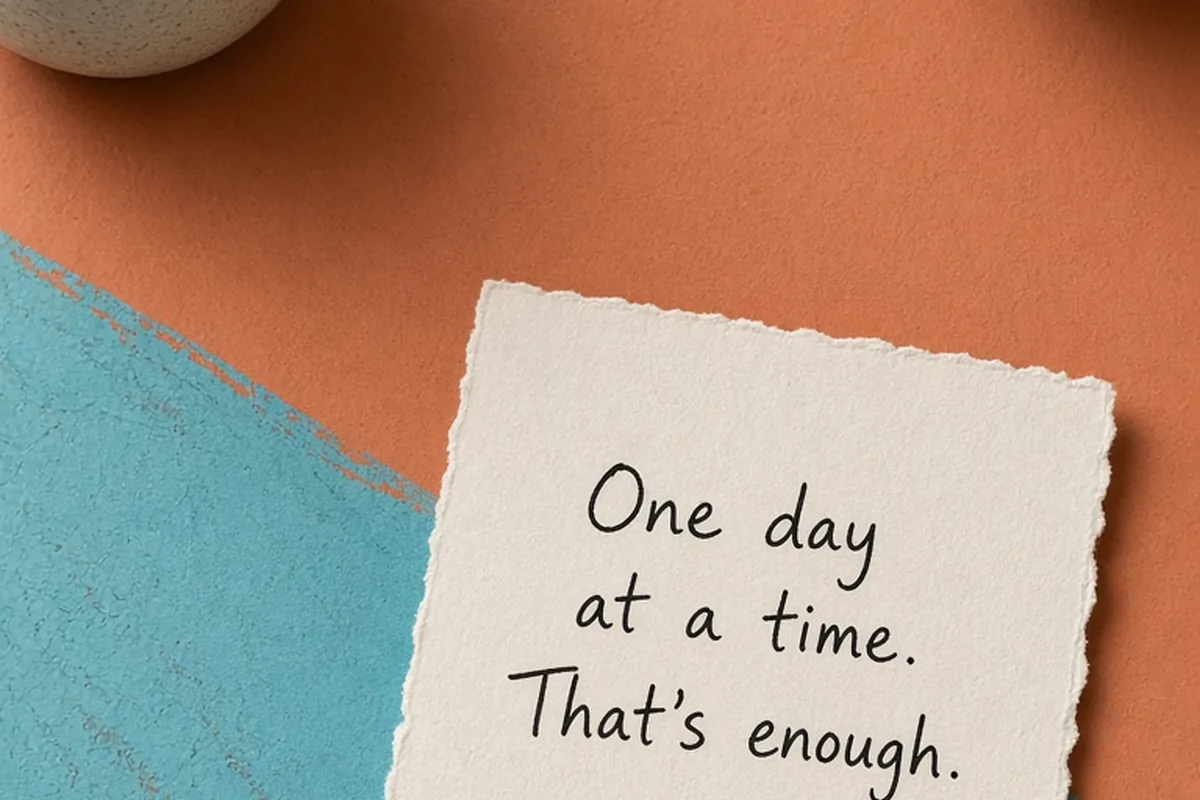
One day at a time quotes offer concise reminders to narrow your focus to the immediate twenty-four hours ahead. Rather than carrying the weight of past regrets or future uncertainties, these sayings encourage emotional grounding, consistent pacing, and self-compassion. They help shift perspective during recovery, major life transitions, stressful workloads, or personal hardship by making challenges feel manageable.
When life feels chaotic or an ambitious goal seems impossibly distant, the human mind tends to magnify the workload by anticipating months or years of struggle at once. Turning to grounded, time-tested words can interrupt this spiral and bring your awareness back to what you can realistically influence today.
Grounding Quotes for Navigating Daily Overwhelm
When demands accumulate from work, family, and personal responsibilities, looking at the entire week or month can trigger immediate paralysis. The central premise of living day by day is recognizing that endurance is only required for the present moment. Robert Louis Stevenson captured this reality when he wrote, 'Anyone can carry his burden, however hard, until nightfall. Anyone can do his work, however hard, for one day. Anyone can live sweetly, patiently, lovingly, purely, till the sun goes down. And this is all that life really means.' This framing removes the phantom weight of tomorrow from today's shoulders.
Similarly, author Dale Carnegie popularized the concept of living in 'day-tight compartments,' urging people to shut off the iron doors on the past and the future to avoid draining mental energy. When you feel buried by a massive project, remind yourself that you do not need to solve the entire puzzle before sunset. You only need to complete the next small assignment, respond to one urgent email, or prepare a single meal. Breaking your timeline into manageable units preserves stamina and prevents chronic cognitive fatigue.
The trade-off of this mindset during high-pressure periods is that it requires deliberate vigilance against forward-looking panic. It is natural for the brain to scan ahead for threats. When you notice yourself catastrophizing about next month's deadlines, repeating Stevenson's or Carnegie's words can serve as an active mental brake, returning your energy to what is directly in front of you.
Quotes to Anchor Emotional Healing and Personal Recovery
Emotional healing, whether from grief, heartbreak, burnout, or substance recovery, rarely follows a clean or linear trajectory. Expecting quick resolution often creates frustration and despair. The foundational twelve-step recovery slogan, 'One day at a time,' endures because it treats sobriety and emotional resilience not as permanent trophies to win, but as daily commitments to renew. Anne Lamott expanded on this principle in her writing advice, which applies equally to emotional recovery: 'Bird by bird, buddy. Just take it bird by bird.'
When coping with significant loss or emotional distress, thinking about surviving the rest of your life without a loved one or navigating an indefinite transition is unbearable. Writer and theologian C.S. Lewis reflected during his own grief that the present moment is the only aperture through which time touches eternity. Focusing strictly on surviving the current morning, afternoon, and evening transforms an insurmountable void into a series of survivable increments.
A practical approach to using these quotes during recovery involves setting brief temporal boundaries. If an entire day feels too daunting, shrink the container further to one hour or even ten minutes at a time. The limit of this technique is that it will not eliminate emotional discomfort entirely; instead, it prevents that pain from being multiplied by the fear of future suffering.
Perspective-Shifting Quotes for Long-Term Goals and Ambition
Major undertakings such as writing a book, retraining for a new career, saving for a home, or regaining physical fitness require persistent effort over years. When the finish line is far away, motivation frequently wanes. The classic proverb attributed to Lao Tzu, 'A journey of a thousand miles begins with a single step,' reminds us that monumental outcomes are merely the aggregation of humble daily actions. Confucius expressed a similar truth with the observation, 'It does not matter how slowly you go as long as you do not stop.'
Arthur Ashe framed this incremental mindset with direct utility: 'Start where you are. Use what you have. Do what you can.' This quote dismantles perfectionism by removing the prerequisite of ideal circumstances. Rather than waiting for an uninterrupted stretch of free time or complete certainty, taking one modest action today keeps momentum alive. For instance, writing two hundred words or exercising for fifteen minutes each morning builds an identity of consistency without demanding heroic daily output.
However, applying a single-day focus to long-range goals requires an occasional balance check. While daily action creates progress, you still need periodically scheduled check-ins to ensure your daily steps are pointed in the right direction. Use the 'one day' mindset for execution, and reserve specific, scheduled windows for strategic planning.
Quotes for Calming Anxiety and Future-Oriented Worry
Anxiety thrives on projection, constantly generating worst-case scenarios about events that have not yet occurred. The Stoic philosopher Seneca addressed this habit directly when he noted, 'We suffer more often in imagination than in reality.' By anchoring your attention to current sensory realities, you diminish the space available for hypothetical dread. Corrie ten Boom similarly observed, 'Worry does not empty tomorrow of its sorrow, it empties today of its strength.'
When anxious thoughts begin with 'What if,' a day-by-day philosophy counters with 'What is.' Marcus Aurelius advised, 'Never let the future disturb you. You will meet it, if you have to, with the same weapons of reason which today arm you against the present.' This reminder reinforces self-trust. You do not need to possess the emotional resources today for challenges that might arise next year; you will develop those resources gradually as the situation unfolds.
To practice this during spikes of worry, speak these quotes aloud or write them down, then identify one concrete fact about your current environment: you are safe right now, you have a task to complete, and tomorrow's problems cannot be solved ahead of schedule. While this practice will not cure generalized anxiety disorders on its own, it acts as a reliable cognitive grounding technique.
How to Integrate Daily Focus Quotes into Everyday Routines
Inspirational quotes lose their power if they remain passive words on a screen. Transforming a quote into a cognitive anchor requires linking it to physical triggers throughout your day. Choose one phrase that resonates with your current circumstance and place it where your eyes naturally land during moments of transition, such as on your bathroom mirror, beside your computer monitor, or as a widget on your phone home screen.
You can also use single-day quotes as prompts for morning and evening routines. In the morning, review your chosen quote and ask, 'What is the single most important contribution I can make today?' In the evening, use it to close out the day by asking, 'Did I carry my burden until nightfall?' Once the day ends, consciously release any unfinished business until the next morning rather than carrying mental residue into sleep.
The following micro-habits help weave these perspectives into real-world behavior:
Establishing these predictable contact points ensures that the wisdom becomes an automatic mental habit rather than an afterthought when stress strikes.
- Morning intention: Write down a single quote alongside your top three tasks for the day.
- Midday reset: Take three deep breaths while repeating a grounding phrase when switching between tasks.
- Digital boundary: Set your lockscreen text to a short quote to intercept mindless scrolling.
- Evening shutdown: Conclude your workday with a physical gesture, such as closing your notebook, while reciting Stevenson's words.
Navigating the Limits of the One-Day Approach
While living one day at a time provides vital relief during acute stress, applying it rigidly in every scenario can lead to practical drawbacks. Taken to an extreme, focusing solely on the immediate twenty-four hours can turn into avoidant behavior, where necessary long-term financial, logistical, or health planning is neglected under the guise of staying present. True mindfulness includes conscious preparation for the future without succumbing to emotional panic about it.
A healthy balance involves dedicating distinct, bounded intervals to long-term planning—such as monthly budgeting or quarterly project reviews—while spending the vast majority of your daily hours strictly focused on the task at hand. If you find yourself using 'taking things day by day' as an excuse to ignore necessary responsibilities or boundary-setting, treat it as a signal to reassess your structure.
Recognize also that not every difficult emotion will disappear simply because you narrow your temporal horizon. Some life events demand professional support, grief counseling, or systemic changes to your workload and environment. Quotes and grounding philosophies are tools for emotional regulation and resilience, not substitutes for practical life changes or appropriate care.
Frequently asked questions
Why is the one day at a time philosophy so effective during crises?
During crises, the brain is easily overwhelmed by trying to process complex, long-term uncertainties all at once. Narrowing your focus to the immediate twenty-four hours reduces cognitive load, lowers acute anxiety, and preserves the energy required to make clear, grounded decisions.
How can I remember these quotes when I feel overwhelmed in the moment?
The most effective method is creating physical environmental cues before stress occurs. Write your favorite quote on a sticky note for your desk, save it as your phone background, or pair it with an existing daily habit like brewing your morning coffee.
Can living one day at a time interfere with planning for the future?
It can if used as a way to avoid necessary decisions, but balanced living separates planning from execution. Set aside specific, scheduled sessions for long-term goal setting and logistics, then return to executing those plans one single day at a time.
What is the difference between taking things day by day and procrastinating?
Taking things day by day means actively engaging with today's responsibilities while letting go of tomorrow's worry. Procrastination, by contrast, involves avoiding today's necessary tasks and pushing current obligations into the future.
Your next step
Select one quote from this guide that speaks directly to your current challenge, write it down on an index card or note app, and identify the single most constructive action you can take before today ends.