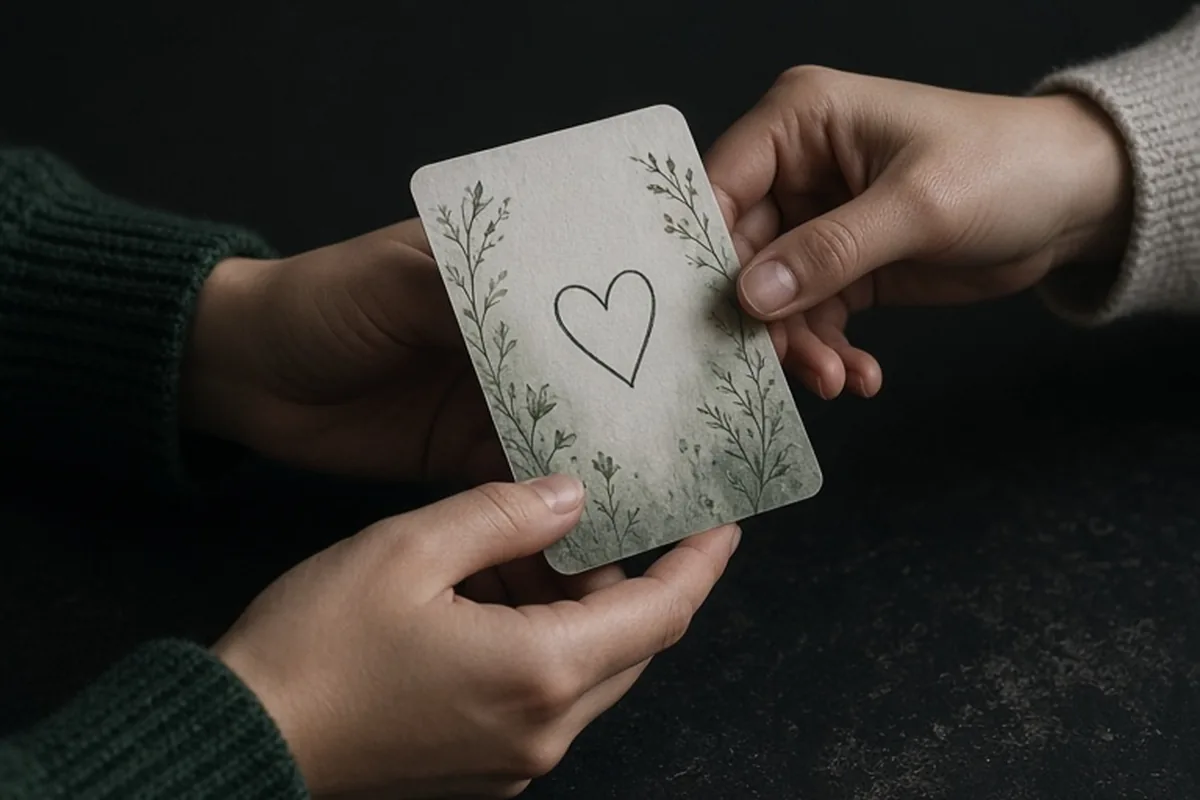
Oracle cards for love are thematic decks designed to reflect emotional states, relationship dynamics, and personal blind spots. Unlike structured tarot systems, oracle decks offer open-ended, direct messages that help you process romantic uncertainty. They do not predict a partner's future behavior or force outcomes; rather, they serve as a reflective mirror to clarify your feelings, communication style, and healthy boundaries.
When dating feels murky or a committed partnership hits an unexpected rough patch, our natural instincts often get drowned out by overthinking. Turning to an oracle deck is not about fortune-telling or surrendering agency. It is about creating a quiet, deliberate pause where you can assess what you truly want, identify where your boundaries stand, and decide how to show up with genuine self-respect.
Understanding How Oracle Cards Differ from Traditional Tarot
To get genuine utility out of oracle cards in your love life, it helps to understand how they work compared to traditional tarot. Tarot relies on a fixed structure of seventy-eight cards, divided into the Major and Minor Arcana, governed by established archetypes, suits, and historical symbolism. Deciphering a complex tarot spread during an emotional conflict often requires memorizing intricate systems, which can sometimes distract from the raw emotional reality in front of you.
Oracle decks, by contrast, have no standardized number of cards, suits, or uniform meanings. A love-focused oracle deck might contain forty cards centered entirely on relational communication, emotional processing, or personal attachment styles. Because each card typically features direct keywords or evocative concepts—such as Patience, Openness, or Boundaries—they speak directly to your intuition without requiring textbook interpretation. The trade-off is structure: while tarot provides an exacting sequential framework, oracle cards provide atmospheric clarity. They show you the emotional climate of your connection rather than a rigid timeline.
Choosing the Right Deck for Your Current Relationship Stage
Not all love oracle decks serve the same purpose, and selecting the wrong deck can increase your confusion. Some decks are designed around romantic affirmations and lighthearted encouragement, while others focus heavily on shadow work, unresolved past wounds, and attachment dynamics. If you are actively healing from a painful breakup, an overly saccharine deck that promises imminent romantic reunion can feed unhealthy denial. Conversely, a deeply psychological shadow deck might feel excessively heavy if you are simply trying to navigate playful early dates.
Before purchasing or drawing from a deck, inspect the underlying tone of the card descriptions. A constructive deck focuses on personal agency, mutual respect, and honest introspection. Be wary of decks marketed around obsessive concepts like twin flame telepathy or predetermined destiny, as these frequently encourage readers to overlook poor behavior in hopes of a fated outcome. Choose a deck that speaks to the adult reality of relationships: that healthy love requires mutual communication, emotional regulation, and clear personal choices.
Formulating Questions That Produce Agency Instead of Anxiety
The most common mistake people make with love readings is asking passive, anxiety-driven questions about other people. Inquiries such as 'Does my ex still care about me?' or 'When will this person text back?' hand over your emotional stability to external circumstances. When you ask the cards to spy on someone else's unexpressed thoughts, you are usually seeking relief from uncertainty rather than actionable guidance. The cards cannot guarantee what another sovereign adult will choose to do tomorrow.
Reframing your questions around your own behavior restores immediate dignity and control. When you shift the inquiry from what someone else feels to how you are managing your own vulnerability, the cards transform into a tool for self-mastery. Instead of asking whether a partner will change, you ask what boundary you need to hold while evaluating their current consistency. This shift keeps your self-worth intact regardless of the outcome.
Three Practical Spreads for Dating, Confusion, and Conflict
Elaborate ten-card layouts often lead to analysis paralysis, especially when your emotions are already heightened. Keeping your spreads short and focused ensures that every card provides a clear, memorable takeaway that you can apply directly to your romantic interactions. A three-card layout is typically the sweet spot for emotional diagnostics.
To address mixed signals in active dating, use the Clarity Spread: Card One represents the objective situation as it exists right now; Card Two highlights the narrative or fear your mind is projecting onto the situation; Card Three indicates the most grounded action you can take. For couples navigating a recurring disagreement, try the Alignment Spread: Card One reflects your underlying emotional need; Card Two highlights what your partner may be experiencing; Card Three represents the bridge required to move from defensiveness to mutual listening. For singles, a single-card daily pull asking 'What standard should I protect today?' is often all that is needed to stay grounded.
Interpreting Challenging Cards Without Spiraling into Dread
Drawing a card associated with distance, release, or friction can easily trigger an anxious spiral if you view the cards as absolute destiny. Many people immediately reshuffle or pull multiple clarifying cards when they receive an answer they dislike, which only deepens emotional agitation. A challenging card is rarely an omen of doom; it is simply highlighting an area where honesty or growth is currently required.
For example, pulling a card labeled 'Solitude' during a dating phase does not mean you are condemned to stay single. More practically, it suggests that your current priority should be strengthening your self-reliance rather than rushing into a connection out of loneliness. Similarly, pulling a card signifying 'Conflict' in an established relationship does not dictate an inevitable split; it invites you to stop avoiding a difficult conversation that has been brewing under the surface. Accept the discomfort of the card as useful information rather than a final verdict.
Setting Ethical Guardrails to Avoid Spiritual Fixation
Oracle cards are meant to support your life, not replace your decision-making. A major hazard in modern spiritual romance culture is using readings to justify mistreatment, breadcrumbing, or prolonged emotional ambiguity. Labeling inconsistent behavior as a mystical trial or relying on card interpretations to excuse someone's lack of commitment keeps you trapped in fantasy. If someone's daily actions do not demonstrate care, respect, and reliability, no card draw should convince you otherwise.
Establish firm personal boundaries around your practice. Limit yourself to one reading per situation to avoid compulsive querying when you feel restless. Furthermore, avoid reading on the private psychological states of casual acquaintances or uncommunicative dates without their knowledge; using cards to obsess over another person's motives usually reflects personal avoidance of uncomfortable truths. Use the cards to sharpen your own integrity, and let people reveal who they are through their real-world actions.
Illustrative Scenarios
Breaking the Post-Date Overthinking Loop
After a great third date, Marcus sent a morning message and heard nothing back for twelve hours. Anxious that he had misread the connection, he pulled out an oracle deck and drew a card representing Independence. His first impulse was to assume she was pulling away and that he should send a casual follow-up to test her interest. Instead, he paused and applied the card to himself: he recognized his own habit of putting his hobbies and routine on hold whenever he started liking someone. He left his phone in the other room, completed an intense workout, and focused on his evening chores. When she responded warmly late that night after an exhausting hospital shift, Marcus was calm, self-contained, and ready for a normal conversation.
Key point: Oracle cards are most effective when they redirect focus back to your own nervous system rather than guessing someone else's timeline.
Addressing an Unspoken Domestic Disagreement
Elena found herself increasingly resentful over household responsibilities in her two-year relationship. Rather than communicating directly, she drew cards to determine if her partner was deliberately taking her for granted. The card that appeared was Guardedness. Elena initially assumed the card described her partner's stubbornness. However, looking closer, she realized it reflected her own conversational habit: she had been using biting sarcasm and passive-aggressive sighs for two weeks instead of asking for help directly. Later that evening, she dropped the defensive posture, stated her logistical needs calmly without accusation, and her partner agreed immediately to divide the evening chores differently.
Key point: Using cards to inspect your own communication patterns produces practical relationship repairs faster than using them to assign blame.
Frequently asked questions
How often should I consult oracle cards about my relationship?
Consulting cards once a week or once per distinct relational event is plenty. Pulling cards multiple times a day about the same person or problem usually heightens anxiety and muddies your rational judgment.
Can oracle cards tell me if someone is my twin flame or true love?
No card deck can definitively determine whether someone is your soulmate or twin flame. Cards merely illuminate current dynamics and personal lessons, while genuine compatibility and commitment must be demonstrated through consistent real-world behavior over time.
What should I do if a card reading conflicts with how my partner actually treats me?
Always trust concrete behavior, consistent communication, and mutual respect over any card draw. If a reading suggests harmony and deep devotion but your partner is unreliable, emotionally unavailable, or disrespectful, your boundaries must be based on their real actions.
Do I need special intuitive gifts to read love oracle cards effectively?
You do not need esoteric training or psychic abilities to use oracle cards well. The artwork and keywords function as psychological mirrors that help you surface feelings, boundaries, and priorities you might otherwise ignore when distracted by romantic chemistry.
Your next step
Frame one specific question today about your own standards or communication style, draw a single card for reflection, and commit to one grounded real-world action based on that insight.