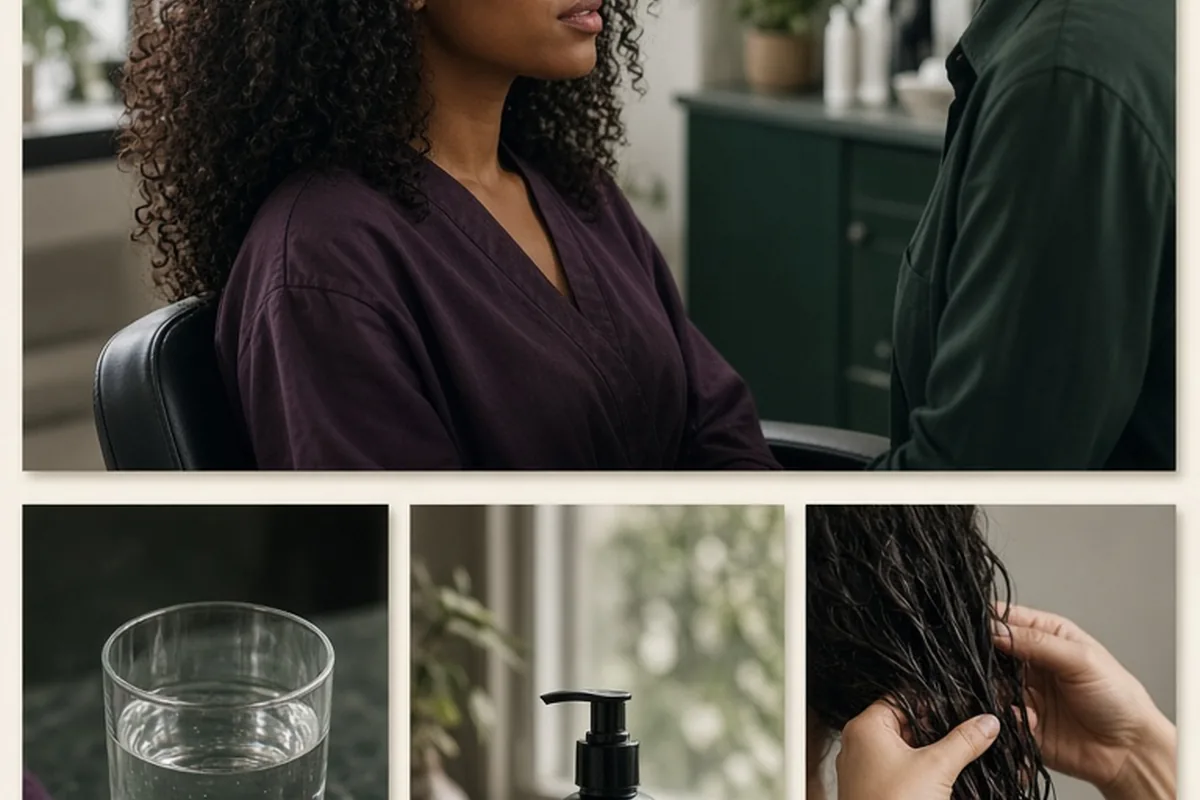
Water is the ultimate hydrator for hair strands, but water alone cannot keep hair moisturized over time. Once applied, plain water rapidly evaporates unless it is sealed within the cortex by conditioning lipids, emollients, or film-forming humectants. When consulting your stylist, ask how your hair porosity governs water absorption, whether your hair is experiencing water-induced swelling, and which combination of water-based products and sealing agents will lock in lasting suppleness without causing damage.
Stepping into a salon chair provides an ideal opportunity to demystify your hair care regimen, especially when contrasting internet advice with cosmetic chemistry. Asking targeted questions about how water interacts with your specific texture, density, and chemical history helps you build a routine that maintains elasticity and softness long after you leave the salon.
Clarifying Hydration Versus Moisture: What to Ask About Water's True Role
In everyday conversation, people frequently use hydration and moisture interchangeably, but in hair science, they represent two distinct physiological functions. Water provides hydration by infusing the internal protein structure of the hair shaft with fluid, which temporarily increases suppleness and elasticity. However, moisture in cosmetic terms refers to the retention of that water alongside lubricating lipids that smooth the outer cuticle layer. If you apply water without an emollient or lipid barrier, the ambient air will draw the moisture out, often leaving the hair fiber more brittle than it was before wetting.
To get clarity on your hair's current state, ask your stylist: 'When you assess my hair today, does it show signs of internal dehydration, surface oil depletion, or a combination of both?' Follow up by asking them to demonstrate how your strands react when saturated with plain water compared to when coated with a water-based conditioning emulsion. A knowledgeable stylist will explain whether your strands need lighter aqueous solutions that penetrate deeply or richer lipid-dense formulas that lubricate a compromised exterior.
Questions to Determine Your Hair Porosity and Water Retention Capacity
Porosity describes how readily your hair cuticles open and close, which directly dictates how water enters and exits each strand. Low-porosity hair features tightly bound, overlapping cuticle scales that resist water penetration, causing droplets to bead up on the surface during washing. Conversely, high-porosity hair has lifted, fragmented, or chemically eroded cuticles that absorb water almost instantaneously but lose it just as fast, leading to chronic dryness and tangling despite frequent wetting.
During your appointment, ask your stylist: 'Based on your tactile examination and how my hair absorbs water at the shampoo bowl, what porosity category do I fall into?' Extend the question by asking: 'Does my hair require heat or steam during conditioning to open resistant cuticles, or do I need acidic rinses and film-forming products to help close and smooth porous cuticles?' Understanding this mechanism prevents you from wasting time on at-home misting routines that either roll off the surface or evaporate within minutes.
Inquiring About Hygral Fatigue and the Risks of Excess Wetting
While water is essential to maintain strand flexibility, excessive exposure to water can weaken hair through a phenomenon known as hygral fatigue. Every time hair becomes thoroughly saturated, the inner cortex swells as it absorbs water; as it dries, the cortex contracts. Repeated cycles of intense swelling and contraction place mechanical stress on the delicate cell membrane complex and outer cuticle layers, eventually causing cuticle chipping, loss of elasticity, and spontaneous breakage.
You can evaluate your vulnerability to this process by asking your stylist: 'Do my strands show evidence of hygral fatigue or over-hydration, such as a gummy, overly stretchy texture when wet?' Ask further: 'Given my hair density and thickness, what is the safest weekly frequency for thoroughly soaking my hair, and should I incorporate pre-shampoo oil treatments to limit water absorption during wash day?' Their assessment will help you distinguish between hair that is truly dry and hair that has become limp from structural water fatigue.
Navigating Leave-Ins, Oils, and Butters: How to Ask About Sealing Techniques
A common misconception in hair care is that pure plant oils or heavy cosmetic butters moisturize the hair shaft on their own. In reality, oils are hydrophobic lipids that contain no water molecules; their primary role is occlusive, meaning they create a physical seal that slows down the rate of water evaporation. Applying pure oil to bone-dry hair effectively locks dryness in and prevents beneficial environmental humidity or water-based leave-in products from reaching the inner fiber.
To design an effective barrier system, ask your stylist: 'Which product layering technique suits my strand diameter—applying a liquid hydrator followed by an oil and then a cream, or applying the cream before the oil?' You should also ask: 'Which specific sealing agents, such as light silicones, plant oils, or fatty alcohols, will trap water inside my hair without weighing down my natural movement or suffocating my scalp?' This line of questioning ensures you select products that actively support moisture retention rather than merely creating surface buildup.
Evaluating Tap Water Quality, Hard Water Build-Up, and Cleansing Frequency
The chemical composition of the water coming out of your shower head plays a monumental role in whether water helps or hinders your hair health. Hard water contains elevated concentrations of dissolved minerals, primarily calcium, magnesium, and iron, which bind to the negatively charged surface of hair strands. Over time, these mineral deposits form an impermeable, crusty layer that blocks topical moisture from penetrating, causes color fading, and leaves strands feeling stiff and straw-like even after deep conditioning.
Discuss your domestic setup by asking your stylist: 'Do you see visual or tactile indicators of mineral accumulation, chlorine damage, or hard water residue on my hair?' Follow up with: 'Would introducing a chelating or clarifying shampoo into my monthly routine help restore my hair’s ability to absorb water, and do you recommend a filtered shower head for our local water supply?' A professional can quickly identify whether your persistent dryness stems from poor product performance or mineral interference.
Tailoring Water-Based Styling Routines for Curls, Coils, and Textured Hair
Textured hair possesses unique anatomical challenges because the natural curves, bends, and twists along the hair shaft create points of structural vulnerability where cuticles naturally lift. This architecture allows internal water to evaporate much faster than it does from straight hair strands. Furthermore, textured hair relies heavily on water during the styling process to group individual strands together into defined curl clumps, minimize surface friction, and distribute styling polymers smoothly from root to tip.
If you wear your hair in natural curls, waves, or coils, ask your stylist: 'Should I apply my styling creams and gels to soaking wet hair at the basin, or should I blot excess water with a microfiber towel first?' Ask additionally: 'How can I safely refresh my curl pattern during the week using water mists without breaking down the original styling cast or triggering midday frizz?' Their guidance will teach you how to leverage water as a mechanical styling aid rather than just a wetting agent.
Interpreting Salon Formulations and Ingredient Lists for Home Care
Understanding cosmetic ingredient terminology allows you to make informed purchases that align with what your stylist diagnoses at the chair. Water should almost always appear as the first ingredient on hydrating shampoos, rinse-out conditioners, and leave-in treatments, indicating it serves as the base vehicle. However, the ingredients following water—specifically humectants like glycerin, hyaluronic acid, aloe vera, and panthenol—dictate how that water behaves when exposed to varying indoor and outdoor humidity levels.
Before concluding your salon visit, present your product questions directly: 'How do the humectants in this recommended line interact with our local climate's dew point and seasonal changes?' Follow up by asking: 'If I look at an ingredient list at home, what key emollients or cationic polymers should I look for near the top of the label to verify that the product will effectively lock in water?' This equips you with practical criteria to evaluate marketing claims independently.
Frequently asked questions
Can misting my hair with plain water every morning replace a leave-in conditioner?
No, plain water lacks the conditioning agents, film formers, and lubricating lipids necessary to seal moisture into the hair strand. Misting without an accompanying emollient causes water to evaporate rapidly, which can lift cuticles and worsen daily dryness or tangling.
How can I tell if my hair lacks water or lacks structural protein?
Hair that lacks water typically feels rough, looks dull, and tangles easily, while hair deficient in protein feels mushy, excessively stretchy, or limp when wet. A stylist can perform a gentle wet stretch test to determine whether you need aqueous hydration or amino acid reinforcement.
Does drinking more water improve moisture levels in existing hair strands?
Drinking adequate water supports cellular activity in the living follicle beneath your scalp, but it has no direct moisturizing effect on the dead keratin fibers that make up your hair shaft. The visible length of your hair requires external topical hydration and protective sealants to stay moisturized.
Your next step
Select two or three questions from this guide that reflect your primary hair challenges and write them in your phone notes to discuss with your stylist at the start of your next appointment.