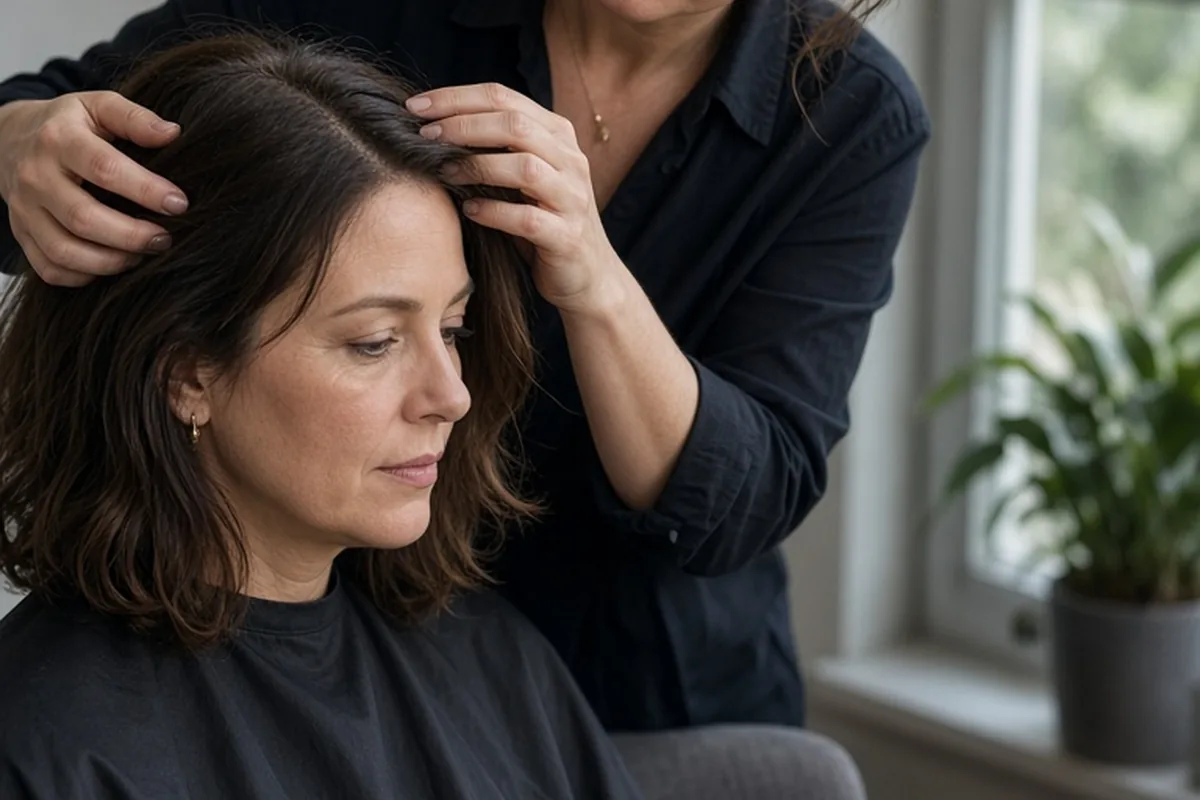
When discussing female hair thinning with your stylist, ask where they observe density changes across your crown and part, which perimeter-strengthening haircuts create natural fullness, and whether your current color or chemical services pose breakage risks. Inquire about lower-tension styling routines, lightweight volumizing products that avoid pore-clogging buildup, and whether your visible scalp patterns warrant an evaluation by a board-certified dermatologist.
A regular hair appointment offers a practical setting to assess cosmetic changes in your hair density, texture, and overall scalp condition with a trained professional who works with your strands closely.
Questions to Assess Baseline Density, Parting, and Crown Patterns
Because stylists view your scalp from angles you cannot easily monitor in a bathroom mirror, they are uniquely positioned to give you an objective perspective on structural changes. Begin your consultation by asking where they notice the most significant shifts in thickness or individual strand diameter. Female pattern thinning frequently presents as diffuse shedding across the central part line or a subtle widening of the crown, while other concerns might appear as localized receding near the temples or nape. Asking your stylist to describe what they see helps you understand whether the change is widespread across the entire scalp or concentrated in specific zones.
You should also ask your stylist whether they notice uneven miniaturization, which occurs when individual hair strands emerge finer and shorter than surrounding hairs. Inquire whether your shedding appears to stem from root loss or mechanical mid-shaft breakage. Mechanical breakage leaves short, jagged ends throughout the mid-lengths, whereas hair shedding from the follicle usually leaves an intact bulb at the root end. Distinguishing between breakage caused by handling and true follicular thinning changes your immediate styling plan and clarifies what home adjustments you should prioritize.
Haircut and Perimeter Questions for Female Hair Thinning
The architecture of your haircut determines how light passes through your strands and how dense your hair appears to the eye. Ask your stylist which baseline shape will maximize fullness without compromising your existing length unnecessarily. Heavily feathered ends and excessive texturizing with thinning shears can make thinning hair look sparse, stringy, or transparent at the bottom. A blunt perimeter, such as a structured bob, a blunt lob, or a precision one-length cut, gathers the ends into a clean, solid boundary that creates the visual illusion of thicker hair.
Ask how internal layering can be customized to your specific hair texture and density. While over-layering removes critical bulk from the lower perimeter, strategic, subtle interior layering can remove dead weight from the crown, allowing finer strands to lift away from the scalp naturally. For wavy, curly, and coily hair types, ask how the silhouette can be shaped in its natural dry state to preserve clump formation and prevent the scalp from showing through separated curls. Discuss whether shifting your habitual parting line by half an inch can instantly disguise widened areas while protecting frequently exposed scalp skin from daily environmental stress.
Questions on Color Chemistry, Bleach Safety, and Optical Depth
Chemical processing can either support your hair aesthetic or contribute to significant strand fragility if executed without clear safeguards. Ask your stylist how your current color formulation affects strand integrity and whether adjustments should be made to preserve hair health. Applying high-volume developer or aggressive all-over lighteners to thinning or fine strands can strip the hair cuticle, increasing porosity and leaving fragile hair prone to snap under routine brushing. Ask your stylist if lower-volume developers, ammonia-free options, or deposit-only glosses can achieve your aesthetic goals with less structural disruption.
Inquire about specialized placement techniques designed to create the illusion of density through optical depth. A technique known as root shadowing or reverse balayage, which keeps the base color slightly deeper than the mid-lengths and ends, creates visual contrast that makes hair near the scalp appear denser and fuller. Conversely, high-contrast highlights placed directly over a thinning crown can draw visual attention directly to exposed skin. Ask your colorist how subtle, multi-tonal dimensional color can soften the transition between your scalp and hair without exposing your roots to harsh overlapping bleach applications.
Questions About Heat Styling, Tension, and Daily Handling
Daily manipulation and heat exposure play a major role in whether thinning hair remains intact or suffers avoidable structural loss. Ask your stylist to evaluate your blow-drying and thermal styling routine to determine if your current tools are causing unnecessary thermal degradation. Inquire about the maximum temperature setting recommended for your specific strand diameter and whether your heat protectant provides adequate thermal shielding without weighing your hair down. Stylists can demonstrate correct brush tension, showing you how to lift at the root with a round brush without pulling violently against weakened follicles.
Tension management is equally critical, particularly for women who frequently wear protective styles, ponytails, or sleek updos. For individuals with textured, coily, or braided hair, ask your stylist to evaluate the tightness of your protective installations to prevent traction stress around delicate hairline edges. Ask what gentle alternatives they recommend for securing hair during workouts, sleep, and busy workdays, such as silk scrunchies, loose claw clips, or satin-lined wraps that minimize friction and distributed mechanical stress across vulnerable sections.
In-Salon Scalp Treatments and Buildup Clarification Inquiries
Healthy hair emergence requires a balanced scalp environment free from persistent sebum buildup, dead skin cells, and product residue. Ask your stylist to examine your scalp skin for signs of dryness, flaking, redness, or oil accumulation. Inquire whether their salon offers gentle clarifying scalp treatments, exfoliating cleansers, or peptide-based conditioning rinses that decongest follicle openings without stripping natural lipids. Knowing how often your hair type should receive professional clarification helps prevent chronic buildup from weighing down new growth.
Make sure to ask about the specific ingredients and functional mechanisms of any salon treatment presented as a thickening or volumizing service. Some treatments work topically by coating the cuticle with hydrolyzed proteins or panthenol to temporarily increase the diameter of each strand, while others focus purely on scalp circulation and balanced hydration. Ask your stylist to clarify whether a recommended in-salon treatment delivers cosmetic, wash-out thickening benefits or longer-lasting strand fortification, allowing you to set realistic expectations for your investment.
Inquiring About At-Home Styling Products and Weightless Volume
The selection of styling products you use at home directly determines how long your salon-crafted volume lasts throughout the day. Ask your stylist which formulation categories are best suited for your strand density, as rich butters, heavy silicones, and dense oil treatments can cause fine or thinning strands to clump together and expose the scalp. Inquire about lightweight mousses, root-lifting sprays, dry texture sprays, and texturizing powders that provide structural hold at the root base without leaving greasy or tacky residues.
Ask for a step-by-step demonstration of product application during your styling service. Many people inadvertently apply volumizing products too close to the scalp or use excessive quantities, leading to premature limpness and midday collapse. Ask how much product to dispense, how to distribute it evenly from mid-shaft to ends, and how to use cool air bursts from your dryer to lock in fullness. Additionally, ask whether root-concealing powders or tinted cosmetic fibers are safe to use alongside your regular styling products without clogging follicles between washes.
Questions That Separate Cosmetic Advice From Medical Referrals
While an experienced stylist is an invaluable partner for cosmetic management, haircuts, and product guidance, it is essential to recognize the clear boundary between salon care and medical diagnosis. Ask your stylist if they notice any unusual redness, patchy circular bald spots, scaling, tenderness, or sudden rapid shedding patterns that diverge from standard cosmetic thinning. Stylists are trained to identify abnormal scalp presentations and can confirm when a pattern looks irregular, but they cannot legally or clinically diagnose underlying medical conditions.
If your stylist identifies rapid shedding, inflammation, or focal patches, ask them for notes or descriptions of what they observed so you can share those details with a physician. Conditions such as androgenetic alopecia, telogen effluvium, autoimmune alopecia areata, thyroid imbalances, and nutritional deficiencies require clinical diagnostic tools, such as blood work, trichoscopy, or scalp biopsies. Using your stylist's observations as an early alerting mechanism allows you to seek timely, evidence-based care from a board-certified dermatologist while keeping your salon visits focused on safe, flattering aesthetic maintenance.
Frequently asked questions
Can a hair stylist diagnose the medical cause of my hair thinning?
No, a hair stylist cannot diagnose medical conditions or prescribe clinical treatments. They can identify visual changes in density, strand breakage, and scalp buildup, and they can suggest when you should consult a board-certified dermatologist for a medical evaluation.
Is it safe to dye or highlight thinning hair?
Hair coloring is generally safe for thinning hair when performed with gentle techniques, such as low-volume developers, glosses, or root shadows. However, you should ask your colorist to avoid aggressive high-lift bleaches and overlapping chemical processes that weaken delicate strands.
What haircut style works best for women experiencing thinning at the crown?
Blunt cuts, structured bobs, and medium-length lobs with subtle, interior crown layering generally provide the best visual density. These cuts eliminate wispy, transparent ends while allowing lighter layers at the top to achieve natural lift without exposing the scalp.
Your next step
Schedule a dedicated 15-minute consultation with your stylist prior to your next haircut to review your scalp health, density patterns, and lower-tension styling options together.