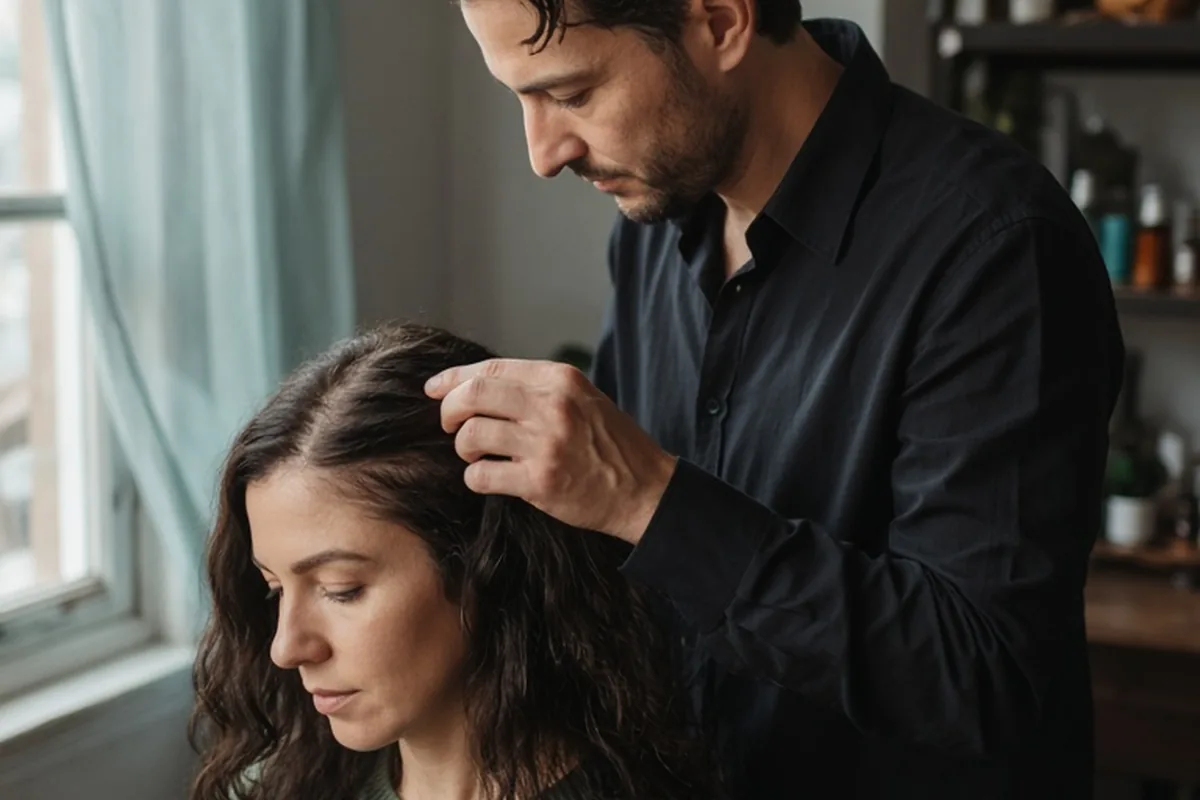
When speaking to a hair stylist about hair loss, focus on styling mechanics, visual density, and gentle maintenance. Ask what haircut creates the illusion of fuller hair without excessive layering, whether your current color or chemical services are compromising your hair shaft, if your everyday styling habits cause unnecessary tension, and what changes they notice along your scalp or parting compared to previous appointments.
Sitting in a salon chair while experiencing hair shedding or thinning can feel deeply vulnerable. A professional stylist cannot diagnose medical conditions, but their close-up view of your scalp and mastery of hair architecture make them an invaluable partner in managing how your hair looks, feels, and recovers.
Setting Clear Boundaries Between Salon Observations and Medical Care
Before asking your stylist for input on thinning hair, it is helpful to establish what a licensed cosmetologist can and cannot do. A stylist works with the hair fiber and the superficial surface of the scalp. They possess trained eyes that track subtle shifts in hair texture, localized breakage, miniaturization along the crown, and changes in follicle grouping over several months. However, styling professionals are not medical doctors or trichologists. They cannot order blood panels, perform scalp biopsies, or prescribe pharmaceutical treatments for systemic conditions like androgenetic alopecia, telogen effluvium, or autoimmune disorders.
Begin the conversation by asking about objective physical observations rather than a diagnosis. Useful prompts include asking if they notice specific patches of scalp exposure, whether shedding appears concentrated in one area or distributed evenly, and if your hair strands feel finer in diameter than they did during earlier visits. A skilled stylist can point out whether shorter hairs around your hairline are new regrowth with tapered ends or snapped fibers with blunt, fractured edges. When a stylist identifies redness, scaling, or persistent patchy loss, use their visual notes to prepare for an appointment with a board-certified dermatologist.
Evaluating Tension and Mechanical Stress in Protective or Daily Styling
Mechanical stress is an underappreciated contributor to hair thinning, particularly along the perimeter and temples. If you wear frequent updos, tight ponytails, or protective styles like braids, weaves, or extensions, your stylist needs to know. Prolonged pulling forces on the hair follicle can cause traction alopecia, a condition that begins as mild inflammation and tenderness but can progress to permanent follicle scarring if left unaddressed. Different curl types and hair textures carry distinct structural thresholds, making tailored mechanical care essential.
Ask your stylist direct questions about the weight and tension of your preferred hairstyles. For example, inquire whether your current braiding pattern or extension method pulls too hard on delicate perimeter zones. Ask if they can demonstrate looser, knotless installation methods or suggest alternative protective techniques that distribute weight evenly across a wider base. If you style your hair at home with round brushes and high-heat blow dryers, ask them to check your crown for mechanical friction damage. A responsible stylist will gladly show you how to reduce tension, recommend silk or satin scrunchies, and advise on lower-torque brushing methods to preserve fragile roots.
Selecting Haircuts That Build Structural Density Without Over-Layering
A common instinct when hair begins to thin is to request short layers in hopes of creating volume. In practice, excessive layering can backfire by removing much-needed perimeter weight, leaving the ends looking stringy, transparent, and sparse. The shape of your haircut determines how light passes through your silhouette; when too much light travels through the perimeter, the hair automatically appears thinner than it actually is. The right haircut balances soft movement at the surface with solid structural lines at the base.
Ask your stylist how adjusting the perimeter line can create an appearance of thickness. Questions such as whether a blunt baseline, a structured bob, or an internal texturizing cut would better support your hair density help steer the discussion toward geometry rather than quick fixes. Inquire about where your natural parting falls and whether shifting it slightly to one side can instantly conceal widening areas along the central vertex. If your hair is diffuse-thinning throughout the mid-lengths, ask whether taking two or three inches off the overall length will eliminate weak ends and produce a denser, more cohesive visual edge.
Balancing Hair Color, Chemical Processing, and Follicle Comfort
Coloring thinning hair requires a strategic approach. On one hand, permanent hair dye slightly plumps the outer cuticle layer of the hair shaft, which can make individual strands feel temporarily thicker and provide noticeable grip. Strategic placement of dimensional color, such as soft highlights or lowlights, can also trick the eye by masking the visible contrast between dark strands and a pale scalp. On the other hand, aggressive bleaching agents, high-volume peroxide developers, and harsh chemical relaxers can weaken the hair shaft, leading to severe chemical breakage that mimics genuine hair loss.
Ask your stylist whether your current chemical schedule matches the fragility of your hair fiber. Inquire if switching to a demi-permanent gloss, an ammonia-free formulation, or a lower-volume developer would achieve your color goals while reducing oxidative stress on the cuticle. If you color gray roots frequently, ask about root-shadowing techniques that leave a tiny buffer zone near the scalp or blending methods that extend the time between appointments. Make sure to discuss any scalp sensitivity, burning, or itchiness you feel during or after color applications, as persistent contact irritation can compromise hair health.
Navigating Salon Services When Managing Female Pattern Thinning
Navigating regular salon appointments while dealing with visible female pattern thinning can create significant emotional friction. Many women worry about harsh salon lighting, mirrors positioned directly under bright spotlights, or having their thinning areas exposed in an open, bustling styling floor. Communicating your preferences ahead of time allows the salon to accommodate your comfort, turning an anxiety-inducing chore into a supportive, restorative experience.
When booking, ask if the salon offers private or semi-private consultation spaces, or whether you can reserve an appointment during quieter, off-peak morning hours. Ask your stylist how they handle sensitive scalp areas during shampooing, specifically requesting gentle scalp manipulation, lukewarm water, and wide-tooth detangling rather than vigorous towel-drying. If you are exploring cosmetic hair toppers, halo pieces, or blended extensions to supplement low-density zones, ask whether your stylist has specialized training in custom-cutting and blending alternative hair to integrate seamlessly with your natural texture.
Evaluating At-Home Maintenance and Product Buildup Risks
The products and routines you use between salon appointments play a major role in preserving existing hair and keeping the scalp receptive to growth. Many individuals experiencing thinning reach for heavy leave-in conditioners, root-volumizing sprays, and excessive dry shampoo to stretch styles and artificially boost lift. Unfortunately, relying heavily on starch-based dry shampoos and heavy silicones without regular, thorough cleansing can create stubborn follicular buildup, leading to scalp inflammation, clogged follicles, and dull, weighed-down strands.
Ask your stylist to assess your scalp for visible buildup and recommend a targeted washing frequency for your specific lifestyle and sebum production. Practical inquiries include whether your current shampoo is too clarifying or too heavy, whether you should incorporate an occasional scalp-exfoliating treatment, and how to apply styling foams without coating the scalp surface directly. Ask them to demonstrate exactly where and how much product to deposit. Often, concentrating lightweight volume mousses along the mid-shaft rather than directly on the roots yields optimal lift without suffocating the scalp environment.
Illustrative Scenarios
Adjusting Cut Geometry for Crown Thinning
A professional in her late forties noticed diffuse thinning across her crown and attempted to hide it by growing her hair past her shoulder blades and layering it heavily. During a salon appointment, she felt embarrassed by how transparent her ends looked in the mirror. Instead of asking for another heavy layering session, she asked her stylist what cut would make her baseline look compact and full. The stylist recommended removing four inches to create a blunt, collarbone-length bob with very light surface movement. The shorter length immediately redistributed the visual weight, eliminating the stringy look and giving her crown a lifted, deliberate shape.
Key point: Cutting away compromised length often creates the visual impact of denser hair far better than hanging onto long, depleted ends.
Rethinking Protective Tension on Fragile Edges
A woman with tightly textured hair noticed gradual thinning around her front hairline after several years of wearing snug micro-braids and sleek high buns. She initially believed her hairline loss was unavoidable shedding. At her next salon consultation, she directly asked her braider whether the perimeter sections were carrying too much mechanical weight. The stylist confirmed that the tight parting and heavy synthetic attachments were stressing her edges. They agreed to switch to larger, knotless partings with lighter human hair bundles and leave her baby hairs entirely free of tension.
Key point: Asking specific questions about installation tension allows stylists to adapt protective methods before follicle damage becomes irreversible.
Frequently asked questions
Can my hair stylist tell if my hair loss is temporary or permanent?
A stylist can identify visual patterns like uniform breakage or patchy thinning, but they cannot definitively diagnose whether hair loss is temporary telogen effluvium or permanent scarring alopecia. They can monitor changes over time and advise you when scalp conditions warrant clinical evaluation by a medical doctor.
Should I wash my hair before visiting the salon to discuss thinning?
Arrive with hair that was washed one or two days prior, styled in your normal everyday manner. This allows your stylist to inspect your natural parting, observe where oil collects or products build up, and see how your hair sits in daily life before washing and cutting.
Are hair extensions safe if my hair is actively shedding?
In most cases of active shedding, traditional bonded, sewn-in, or taped extensions add unnecessary weight and friction to vulnerable roots, potentially worsening loss. Ask your stylist about low-impact, temporary alternatives such as clip-in halo pieces that rest on the head without anchoring directly to fragile follicles.
How often should I trim my hair if I am trying to preserve density?
Scheduling light maintenance trims every eight to ten weeks is generally ideal. Regular micro-trims prevent split ends from traveling upward and fracturing, which preserves the thickness and integrity of your perimeter line without sacrificing noticeable length.
Your next step
Schedule a dedicated fifteen-minute consultation with your stylist before your next service to evaluate your cut architecture and tension levels without the pressure of an immediate haircut.