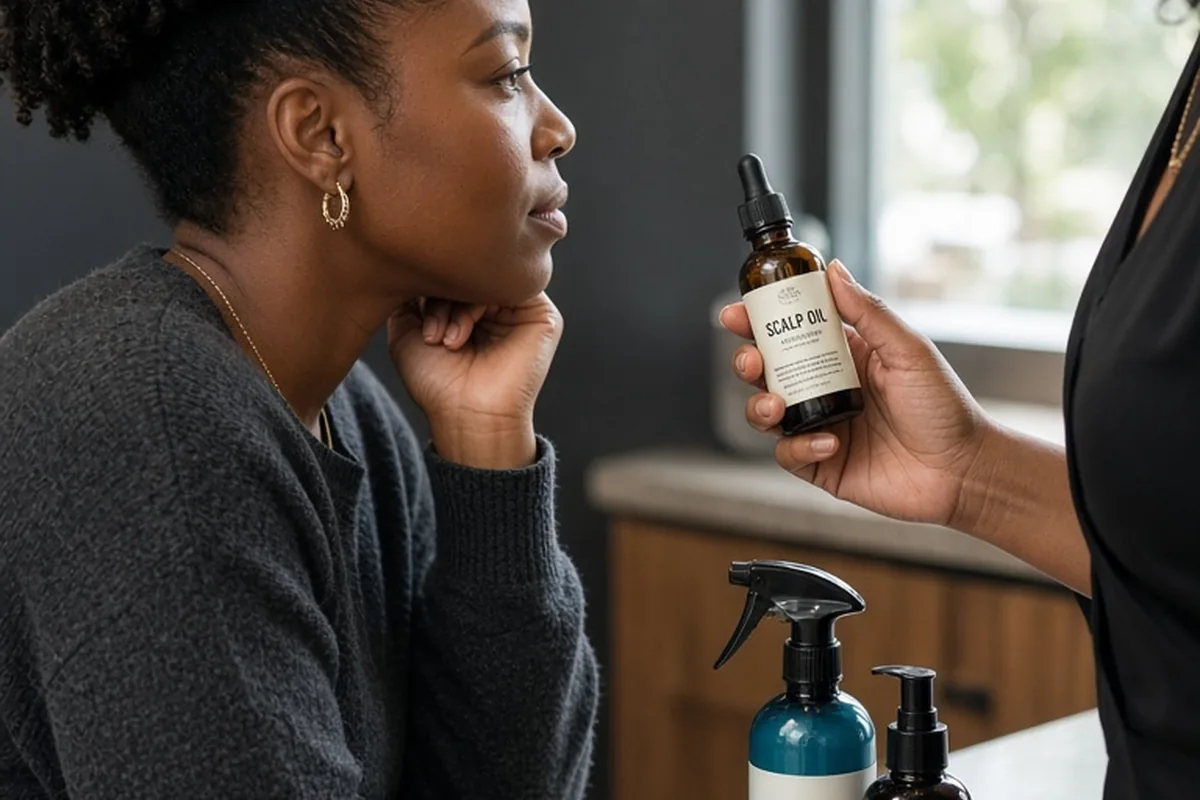
When consulting a stylist about moisturizer for Black hair, ask how your hair porosity affects product absorption, whether your current dryness requires water-based humectants or heavier occlusives, and how frequently to moisturize between wash days. Inquire about the difference between scalp oils and hair fiber hydration, how your styling routine alters moisture retention, and which specific ingredients to avoid based on your hair's unique density, texture pattern, and chemical history.
Navigating hair hydration for Afro-textured hair requires moving beyond generic product labels and understanding how water, humectants, and oils interact with your unique strand structure. A professional salon consultation provides an opportunity to evaluate your hair's health, porosity, and daily environmental exposure so you can select products that keep your hair resilient, pliable, and properly hydrated.
How to Ask Your Stylist About Hair Porosity and Moisture Retention
Hair porosity refers to how easily your hair cuticle layer opens, absorbs moisture, and seals that moisture inside the cortex. Because Black hair encompasses a wide range of curl patterns from loose coils to tight zig-zag textures, porosity varies widely and directly dictates the consistency of moisturizer your hair needs. When you sit in the stylist's chair, ask directly: 'Based on how my hair responds to water at the shampoo bowl, is my hair low, medium, or high porosity, and what moisturizer weight matches that baseline?'
A stylist can observe how quickly water saturates your hair and how quickly it dries under ambient air. If your hair is low porosity, cuticles lie flat and tightly packed, meaning heavy butters will simply sit on the surface, create build-up, and block water from entering. For low porosity hair, you can ask your stylist: 'Should I be using lightweight, liquid leave-ins with heat or steam to help open the cuticle, rather than thick creams?' Conversely, if chemical processing, heat styling, or genetics have left you with high porosity hair, moisture enters quickly but evaporates just as fast through raised cuticles. In that case, ask your stylist what multi-step layering technique or lipid-rich cream will effectively patch those structural gaps and lock moisture into the strand.
Distinguishing True Hydrating Ingredients from Heavy Sealants in the Salon Chair
A common point of confusion in textured hair care is the fundamental difference between hydrating a hair strand and sealing it. True hydration requires water or a water-based liquid to penetrate the inner cortex of the hair fiber, while sealants are oils and butters that form a protective hydrophobic barrier on the cuticle to slow down water loss. Many people apply pure oils or raw shea butter to dry hair expecting it to moisturize, only to find their hair becoming brittle and coated.
To get clarity on your own regimen, bring up the formulations of your products with your stylist. Ask: 'Looking at my hair's current elasticity, do I need more water-soluble humectants like aloe vera and glycerin, or does my hair need emollient butter to seal existing moisture?' A knowledgeable stylist can look at the ingredient deck of your favorite products and explain where they belong in your sequence. You can also ask: 'When I use an oil or butter, is it sealing in moisture, or am I accidentally repelling water on my next wash day?' This distinction ensures you spend money on products that address your hair's actual structural dehydration rather than masking it with surface shine.
Consulting on Scalp Health Versus Hair Fiber Hydration Needs
The biological needs of your scalp skin are distinctly different from the needs of dead keratin fibers that make up your hair shaft. The scalp produces its own natural lipid mixture, known as sebum, whereas the tightly coiled geometry of Black hair prevents sebum from traveling down the full length of the strand. Many clients mistakenly apply thick hair moisturizers or heavy pomades directly to their scalp to treat flaking, which can clog follicles and worsen scalp inflammation.
During your appointment, ask your stylist to inspect your scalp under good lighting: 'Is the dryness I am noticing coming from a dehydrated scalp barrier, product build-up, or true flaking that requires a targeted scalp rinse rather than hair moisturizer?' Your stylist can differentiate between an itchy, suffocated scalp that needs regular clarifying and a dry hair shaft that needs concentrated leave-in conditioning. Follow up by asking: 'How far down the hair shaft should I begin applying my daily or weekly leave-in moisturizer to ensure my scalp stays clear while my ends remain protected?'
Tailoring Moisturizer Selection to Protective Styles and Wash Day Cadence
Protective styles such as box braids, twists, cornrows, and sewn-in weaves change the way moisture should be delivered to Black hair. Heavy creams and thick pomades applied to braided extensions can become trapped within the synthetic hair fiber, attracting lint and forming stubborn residue at the root that is difficult to wash out without causing friction and frizz. Liquid mist formulations and lightweight leave-in sprays are often far more functional for reaching natural hair tucked inside a protective installation.
Ask your stylist: 'What formulation of moisturizer should I use while my hair is in this protective style to prevent build-up along the parts and at the base of the braids?' You should also discuss your wash frequency: 'If I wash my hair every two weeks while in this style, how many times a week should I apply a water-based refresher spray to keep the natural hair underneath elastic without loosening the style?' A good stylist will recommend water-based, sprayable formulas enriched with botanical extracts or light oils that hydrate without leaving a sticky or gunky residue.
Addressing Moisture for Chemically Treated, Relaxed, or Heat-Styled Strands
Chemical relaxers, permanent hair color, bleaching, and routine blow-drying or flat ironing fundamentally alter the protein structure and lipid layer of textured hair. When the internal disulfide bonds or outer cuticle scales are compromised, hair loses its natural ability to retain water, leading to rapid moisture loss, split ends, and breakage. In these situations, simply applying standard moisturizing lotions may not be enough to prevent fiber failure.
Ask your stylist: 'Given the chemical or thermal services my hair has undergone, how should I balance pure moisture with protein or bond-repair treatments?' Hydrolyzed proteins and bond-building additives help reconstruct the internal lattice so that water molecules have a stable framework to bind with inside the cortex. Ask your professional: 'Will using a heavy moisture-only regimen lead to hygral fatigue and mushy hair, or does my current strand strength require a balanced moisture-protein leave-in cream?' This line of questioning helps you avoid over-softening weakened hair while still maintaining crucial hydration.
Questions About Problematic Ingredients, Silicones, and Build-Up
Not all hair ingredients behave the same way on textured hair, and the way ingredients interact depends heavily on your cleansing routine. For example, non-water-soluble silicones create a smooth slip and lock in surface moisture, but if you only use gentle sulfate-free cleansers or co-washes, those silicones will accumulate on the strand over several weeks, eventually repelling the very water your hair needs during subsequent washes. Similarly, certain short-chain drying alcohols can strip natural lipids.
Bring a list or take photos of the ingredients on the back of your current home products and ask your stylist: 'Are any of the ingredients in my regular leave-in creating stubborn build-up that blocks moisture between appointments?' You can also ask: 'Do I need to incorporate a monthly clarifying shampoo to reset my hair fiber before applying deep moisture treatments?' By auditing your current product lineup with a professional, you can eliminate ingredients that cause chronic dryness and ensure that your hydrating products can actually reach the interior of your hair fibers.
Aligning In-Salon Treatments with Your At-Home Moisturizing Regimen
In-salon treatments like professional hair steaming, deep conditioning baths, and specialized hydration infusions provide an intensive moisture reset that at-home routines are designed to maintain. However, if you do not understand how to preserve that salon-grade hydration after leaving the appointment, the benefits can dissipate within a matter of days due to friction, dry indoor air, or improper home maintenance.
Before finishing your appointment, ask your stylist: 'How long should the moisture from today's in-salon treatment last, and on what day of the week should I start reintroducing my home leave-in moisturizer?' Ask for concrete maintenance instructions: 'Should I sleep in a silk or satin bonnet, use a satin pillowcase, or pineapple my curls to keep this moisture from evaporating onto cotton fabrics overnight?' Aligning your home care with the salon treatment guarantees that you get the maximum value and longevity out of every professional visit.
Frequently asked questions
How often should I moisturize my Black hair between salon visits?
Moisturizing frequency depends on your hair's porosity, current style, and climate, ranging from daily light misting for high-porosity curls to every three to four days for low-porosity or styled hair. Ask your stylist to evaluate how quickly your hair loses suppleness between washes so you can establish a consistent schedule without causing product overload.
Can I use hair oil as a standalone moisturizer for Black hair?
No, pure hair oils do not contain water and therefore cannot hydrate dry hair on their own. Oils function primarily as emollients and sealants that trap existing moisture, meaning they should always be applied over a water-based leave-in conditioner or damp hair rather than used alone on parched strands.
What is the best way to prepare my hair questions before a salon appointment?
Take clear photos of the ingredient labels of your daily leave-ins, creams, and oils, and note down how your hair feels two days after washing. Bringing this specific information allows your stylist to quickly diagnose whether your routine lacks water-based humectants, uses overly heavy sealants, or requires clarifying to clear build-up.
Your next step
Take photos of the ingredient lists on your current hair moisturizers and leave-ins today, and bring them to your next salon visit to ask your stylist directly which formulas match your hair's porosity and wash frequency.