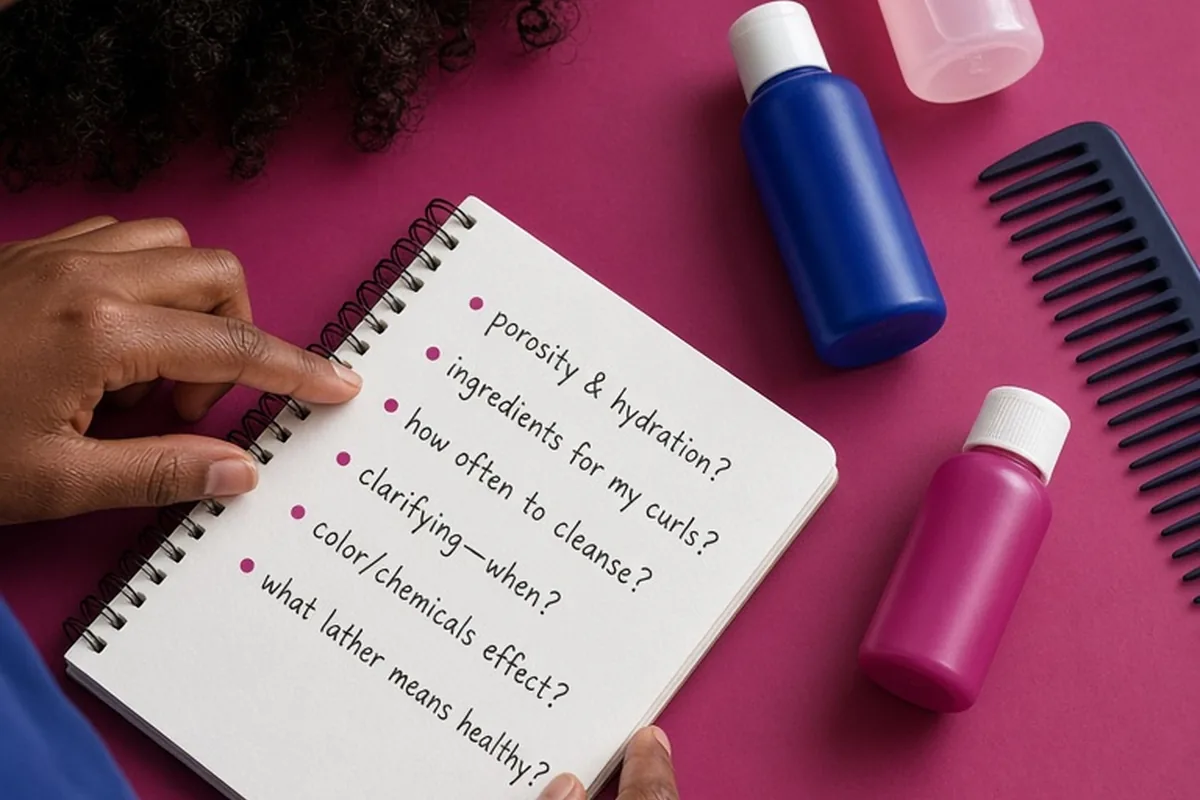
When consulting a stylist about moisturizing shampoo for curly hair, ask how your curl porosity affects hydration, which balance of humectants and oils suits your texture, and how often you should cleanse without stripping natural oils. You should also ask whether your hair needs occasional clarifying, how color or chemical treatments alter your moisture needs, and what lathering behavior indicates a healthy, clean scalp.
A professional hair consultation offers an ideal opportunity to diagnose what your curls actually require rather than relying on generic product labels. Bringing clear, focused questions to your stylist helps you choose a cleansing routine that supports your curl pattern, scalp condition, and daily styling habits.
Evaluating Curl Porosity and Cuticle Health Before Choosing a Formula
Curl pattern alone does not determine how your hair responds to moisture; cuticle integrity and porosity play a far more decisive role. When speaking with your stylist, ask them to evaluate whether your hair has low, medium, or high porosity. Low-porosity curls have tightly bound cuticles that resist water absorption, meaning heavy, butter-rich moisturizing shampoos often sit on the surface and create dull buildup. High-porosity curls, frequently caused by heat styling, coloring, or natural structure, absorb moisture quickly but lose it just as fast, requiring formulas with film-forming humectants and conditioning agents that help seal the cuticle layer.
Ask your stylist to demonstrate how your wet hair behaves during the shampoo service. You can ask specific diagnostic questions such as: Does my hair feel rough or smooth when wet? How quickly does it saturate under the spray nozzle? Does it take an unusually long time to dry? A stylist can physically feel the strand elasticity and resistance at the shampoo bowl, giving you personalized insight into whether you need lightweight hydration from ingredients like aloe vera and panthenol or richer emollients such as jojoba or argan oil to prevent moisture loss.
Pinpointing the Right Balance of Humectants, Oils, and Proteins in Moisturizing Shampoos
Moisturizing shampoos rely on diverse ingredient categories to hydrate, soften, and strengthen curls, but the proportion of these ingredients determines how your hair looks and feels. Humectants like glycerin, hyaluronic acid, and propylene glycol draw ambient moisture into the hair shaft, while emollients and plant oils lubricate the outer layer to reduce friction. Proteins and amino acids temporarily patch structural gaps along the hair fiber to maintain elasticity. Ask your stylist how your hair responds to these distinct components so you avoid purchasing formulas that leave your curls either brittle or overly soft.
Inquire directly about moisture-protein balance by asking if your curls show signs of hygral fatigue or protein deficiency. Hygral fatigue occurs when hair expands and contracts excessively from water intake without sufficient structural reinforcement, leading to limp, undefined curls. Conversely, excessive protein in a daily moisturizing cleanser can cause textured strands to feel stiff and prone to snapping. Your stylist can examine your curl rebound to tell you whether your daily cleanser should prioritize fatty alcohols and smoothing emollients or include light hydrolyzed vegetable proteins to support structural bounce.
Determining Wash Frequency and Clarifying Schedules for Textured Hair
A common challenge with moisturizing shampoos for curly hair is balancing gentle cleansing with effective buildup removal. Because hydrating cleansers contain higher concentrations of conditioning agents, oils, and mild surfactants, using them exclusively over extended periods can leave conditioning residues on the scalp and roots. Ask your stylist how frequently you should wash your hair based on your scalp sebum production, workout habits, and styling product usage.
Ask your stylist how to integrate a clarifying or chelating shampoo into your routine alongside your moisturizing cleanser. Inquire about how many weeks to wait between deep-cleansing sessions and what warning signs indicate your curls need a reset, such as lack of volume at the root, reduced curl clumping, or products suddenly failing to absorb. A knowledgeable stylist can recommend a rotational schedule that keeps your scalp clear and receptive to moisturizing agents without drying out your delicate ends.
Assessing the Impact of Water Hardness and Climate on Cleanser Performance
The water coming out of your showerhead can dramatically alter how any moisturizing shampoo performs. Hard water contains dissolved minerals like calcium and magnesium that bond with surfactants and leave a chalky film on curly strands, preventing moisture from penetrating and making hair feel brittle regardless of shampoo quality. Ask your stylist if the local municipal water in your area is known to be hard and whether your hair shows signs of mineral buildup.
You should also ask how seasonal humidity shifts in your region should influence your shampoo choices. In dry winter air or arid climates, certain humectants can pull moisture out of the hair shaft if there is insufficient ambient moisture, whereas in humid summers, excess moisture absorption can cause frizz and curl swelling. Ask your stylist whether you should adjust your cleansing formula between seasons or pair your moisturizing shampoo with specific leave-in barriers to stabilize your curl hydration year-round.
Navigating Cleanser Ingredients for Chemically Treated or Color-Treated Curls
If you highlight, bleach, tint, or chemically alter your curls, your hair shaft requires specialized cleansing care. Chemical processes raise the cuticle and deplete the internal lipid matrix, making strands exceptionally vulnerable to moisture depletion and mechanical friction during washing. Ask your stylist how your specific color service alters your cleansing needs and whether standard moisturizing shampoos might strip toner or fade vibrant pigments.
Ask for recommendations on gentle, sulfate-free surfactant blends that provide adequate slip during application. Surfactants such as sodium cocoyl isethionate, decyl glucoside, and cocamidopropyl betaine clean without aggressively removing the protective lipid layer. Request that your stylist check the pH level of the formulas they recommend; slightly acidic shampoos (around pH 4.5 to 5.5) help contract the cuticle scales, which locks in moisture, reduces color bleed, and enhances shine across textured hair.
Distinguishing Between True Moisture and Superficial Silicones or Heavy Coatings
Not all slip and softness represent true strand hydration. Many consumer cleansers rely on heavy insoluble silicones or thick mineral waxes to create an immediate feeling of smoothness, which can mask underlying dryness while blocking water absorption during subsequent washes. Ask your stylist to help you read ingredient labels to identify whether a shampoo delivers internal hydration through humectants and lightweight lipids or simply coats the exterior.
Inquire about water-soluble silicones versus non-soluble varieties, and ask if your current styling routine requires silicones for heat protection or if your curls thrive better with silicone-free conditioning agents like behentrimonium methosulfate and natural plant esters. By asking your stylist to explain the trade-offs between instant cosmetic slip and long-term hair hydration, you can select cleansers that keep your curl pattern defined, lightweight, and capable of absorbing regular moisture.
Structuring Your Salon Consultation for Practical, Actionable Advice
To get the most precise answers from your stylist, prepare before you sit in the chair. Take clear photos of your hair on wash day, mid-week, and when it feels at its dryest, and bring a list or photos of the shampoos, conditioners, and stylers you currently use. This gives your stylist a complete baseline of your routine rather than relying on general descriptions.
During the consultation, frame your questions around observable symptoms rather than abstract goals. Instead of asking for 'something that moisturizes,' ask how to address specific issues such as midday frizz, scalp tightness, tangling during the shampoo process, or curls that feel straw-like at the ends. Pay close attention while they wash your hair at the backbar, asking how much water they use to emulsify the product, how they massage the scalp without disturbing the curl formation, and how thoroughly they rinse.
Frequently asked questions
Can a moisturizing shampoo weigh down fine curly hair?
Yes, moisturizing shampoos containing heavy plant butters or mineral oils can easily weigh down fine curls, causing them to lose spring and volume. If you have fine strands, ask your stylist for lightweight, humectant-focused cleansers that hydrate without depositing thick residues.
How do I know if my moisturizing shampoo is causing product buildup?
Signs of buildup include curls that look dull, feel coated or waxy when dry, take longer to absorb water, or resist holding their natural pattern. If your hair feels dry despite regular washing, ask your stylist whether product residues are blocking moisture penetration.
Is a co-wash better than a moisturizing shampoo for curls?
A co-wash uses conditioning agents to soften hair but provides minimal cleansing power, which can allow sweat, dead skin cells, and stylers to accumulate on the scalp. Most stylists suggest alternating a gentle moisturizing shampoo with occasional co-washing to maintain both scalp hygiene and strand softness.
Should my moisturizing shampoo produce a rich lather?
Moisturizing shampoos formulated for curls often use gentle, non-sulfate surfactants that create a low, creamy lather rather than massive bubbles. A lack of heavy foam does not mean the shampoo is ineffective; focus on scalp cleanliness and strand slip rather than lather volume.
Your next step
List the three primary challenges you experience on wash day, photograph your current product labels, and bring both to your next salon visit to ask your stylist for a porosity-matched cleanser recommendation.