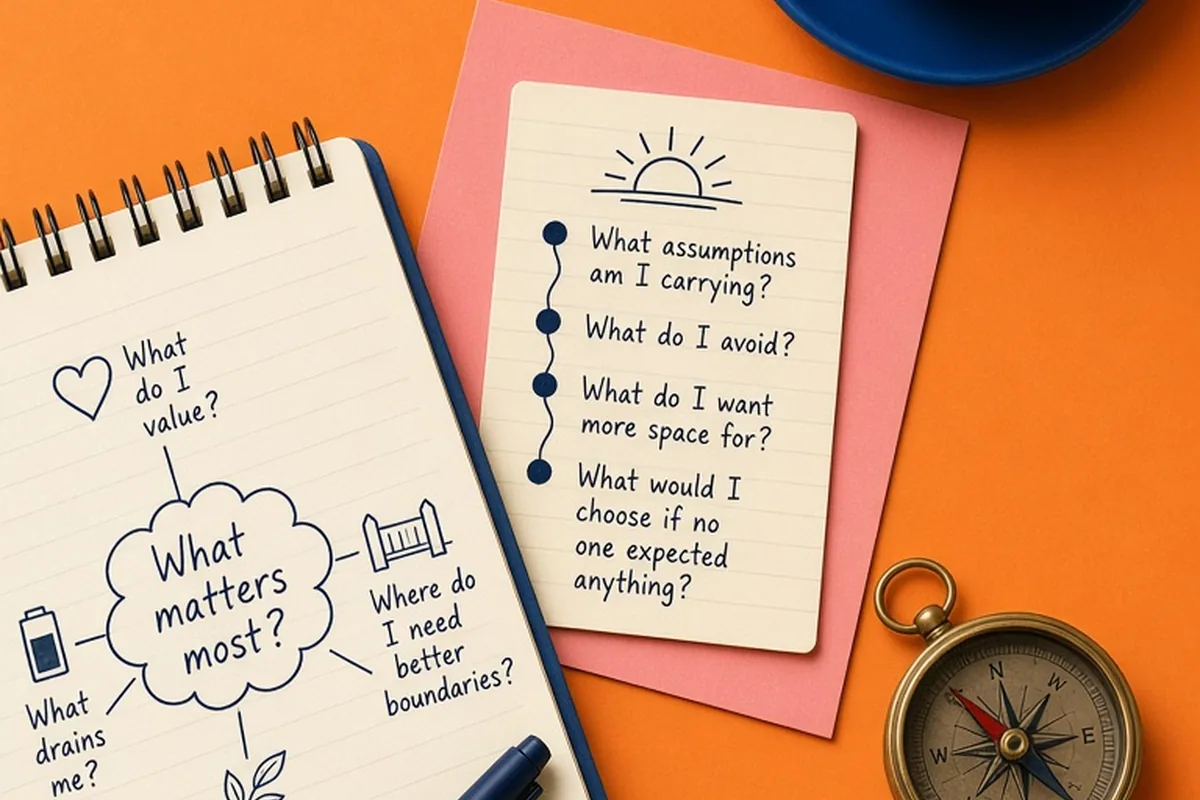
Self-discovery questions are targeted prompts designed to help you inspect your values, emotional patterns, motivations, and boundaries with honesty. Rather than delivering instant life makeovers, effective prompts uncover the assumptions driving your everyday choices. By writing down uncensored answers to questions about what drains you, what fulfills you, and what you avoid, you build self-awareness that informs clearer personal, relational, and career decisions.
Most people live according to unspoken assumptions gathered from family upbringing, workplace culture, and social expectations, rarely pausing to assess whether those rules still serve them. Thoughtful reflection offers a deliberate pause, giving you a structured way to separate genuine personal desires from external pressures before burnout or dissatisfaction forces a change.
Examining Core Values Beyond Inherited Expectations
A foundational step in self-discovery is distinguishing between what you personally value and what you were taught to prioritize. Many adults spend years chasing milestones—such as specific job titles, homeownership benchmarks, or social roles—only to realize upon reaching them that the achievement brings little genuine contentment. This disconnection usually happens when your guiding principles are inherited from parents, mentors, or peer groups rather than intentionally chosen. When you identify the values that truly resonate with your temperament, your daily decisions require far less mental friction and second-guessing.
To unpack your core values, prompt yourself with targeted questions that expose your true motivations. Ask: Which accomplishments in the past three years made me feel deeply satisfied, regardless of whether anyone else applauded them? Whose approval am I still subconsciously trying to earn, and what would happen if I stopped seeking it? What personal principle would I defend even if it cost me prestige or convenience? Answering these prompts honestly often exposes uncomfortable contradictions, such as valuing autonomy while remaining in an overly rigid commitment, but spotting the discrepancy is the prerequisite for realignment.
- What three qualities do I admire most in others, and do I actively practice them myself?
- When did I last feel genuine pride in a choice that nobody else noticed?
- Which inherited family beliefs about success no longer match my reality?
Uncovering What Truly Energizes and Drains Your Daily Energy
Theoretical values mean very little if your day-to-day calendar leaves you perpetually depleted. Paying close attention to your energy fluctuations is one of the most reliable ways to understand your personal wiring. While some people recharge through social engagement and spontaneous projects, others require solitude, structured tasks, or physical movement to restore their equilibrium. Ignoring these natural rhythms in favor of an idealized productivity template usually leads to quiet resentment, chronic fatigue, and decreased focus.
You can map your operational reality by examining recurring patterns in your week. Ask: What regular commitment leaves me feeling completely empty, and why do I continue agreeing to it? Which activities make time pass effortlessly, leaving me feeling more alert afterward rather than exhausted? If I had an entire open afternoon with zero obligations, what would I naturally gravitate toward doing? Tracking your answers across several weeks highlights where your effort produces meaningful returns and where it simply leaks into low-value obligations.
- Which conversations or social interactions consistently leave me feeling drained?
- What simple physical or mental activities reliably restore my sense of calm?
- How much of my current exhaustion is physical versus emotional avoidance?
Evaluating Boundaries and Interpersonal Relationship Dynamics
Your closest relationships reflect your underlying beliefs about worth, safety, and reciprocity. Many people maintain dynamics that feel lopsided because they confuse self-sacrifice with loyalty, or because they fear that speaking up will provoke conflict or abandonment. Examining how you show up with friends, family members, and partners helps you understand whether your connections are built on mutual respect or on repetitive patterns of people-pleasing and silence.
Self-inquiry into boundaries requires looking at where you consistently feel taken advantage of or misunderstood. Useful questions include: Where do I habitually say yes when my body and mind want to say no? What topics or feelings do I keep hidden from the people closest to me out of fear of their reaction? Am I trying to fix or manage someone else's emotional state instead of tending to my own needs? Recognizing that establishing boundaries may cause short-term friction helps you accept that healthy relationships withstand honest limits.
- Who in my life receives my best energy, and who receives only my leftovers?
- What unspoken expectation am I holding against someone who never agreed to it?
- What boundary have I repeatedly postponed setting out of guilt?
Confronting Hidden Fears and Avoidance Patterns
Procrastination, perfectionism, and persistent indecision are rarely problems of poor time management; more often, they are protective defense mechanisms against vulnerability and failure. When you avoid initiating a difficult conversation, applying for a new role, or ending an unproductive routine, your mind is often shielding you from an underlying fear, such as being judged, facing rejection, or confronting your own limitations. Exploring these emotional tripwires directly reduces their subconscious power over your daily behavior.
To illuminate your avoidance habits, bring direct scrutiny to the projects and decisions you keep postponing. Ask yourself: What uncomfortable truth am I currently pretending not to see? If I knew with certainty that a major initiative would fail publicly, would I still consider the experience worth attempting? What worst-case scenario am I quietly rehearsing in my mind, and how realistic is that outcome? Naming your fears openly strips them of their vague, paralyzing intensity and turns them into specific, manageable challenges that you can systematically address.
- What recurring excuse do I use to delay taking a necessary risk?
- How does my desire to appear competent prevent me from learning new skills?
- What am I afraid will happen if I express anger or disappointment directly?
Reassessing Your Relationship with Work, Ambition, and Success
Professional ambition often consumes a disproportionate share of personal identity, especially in fast-paced environments where busyness is equated with moral worth. When career achievement becomes your sole measurement of validation, any professional setback feels like an existential crisis, and personal milestones outside of work begin to seem secondary. A healthy process of self-discovery invites you to decouple your fundamental self-esteem from your output, compensation, or job title.
You can evaluate your professional trajectory by asking questions that prioritize long-term wellbeing over short-term prestige. Prompt your thinking with: What does enough look like for me financially, socially, and professionally? Am I pursuing my current career trajectory because it brings intellectual and financial fulfillment, or because I simply do not know who I would be without it? What kind of daily lifestyle do I actually want my work to support? These questions help prevent the common regret of climbing a professional ladder only to find it leaning against the wrong wall.
- What skills do I genuinely enjoy using, independent of my current job title?
- How much of my work stress is driven by internal perfectionism rather than external demands?
- If external status were completely removed from the equation, how would my goals change?
Making Space for Unmet Creative and Personal Desires
As adult responsibilities multiply, playful curiosity and creative expression are often the first elements sacrificed to practical demands. Over time, eliminating non-utilitarian interests can produce a sense of emotional flatness, where life feels like an endless series of logistical chores. Reconnecting with dormant interests is not an indulgence or a frivolous distraction; it is a vital method for maintaining curiosity, mental flexibility, and a well-rounded sense of self.
Exploring your personal interests requires looking backward at what once captivated you without the expectation of monetization or mastery. Ask: What did I love doing between the ages of seven and twelve before I started worrying about how good I was at it? What creative or physical project do I secretly admire in others while telling myself I do not have the talent or time to try it? What topic could I read about for hours simply out of curiosity? Giving yourself permission to be an awkward beginner in a new pursuit revitalizes your perspective.
- What hobby or activity would I explore if I were guaranteed nobody would ever judge the result?
- Where in my weekly schedule can I reclaim thirty minutes for pure exploration?
- What creative impulse have I suppressed because it does not generate income?
Structuring a Sustainable Routine for Ongoing Reflection
Self-discovery is not a one-time project completed in a single weekend; it is an ongoing maintenance practice that evolves as your circumstances, ages, and relationships shift. Trying to tackle dozens of heavy introspective prompts in a single marathon sitting frequently leads to cognitive fatigue, self-criticism, or abrupt conclusions that do not stand up to daily life. A much more reliable strategy is establishing a steady, low-pressure cadence that allows insights to settle into practical habits over time.
To make reflection sustainable, select one or two prompts each week and spend ten uninterrupted minutes writing your uncensored answers by hand. Avoid editing your thoughts for grammar or political correctness while writing, as unfiltered expression reveals the most accurate data about your emotional state. Pair this writing practice with a quarterly review where you re-read past entries, notice persistent themes, and adjust your goals accordingly. Consistency matters far more than volume when turning reflective insights into lived boundaries.
- Choose one consistent time each week, such as Sunday morning, for brief journaling.
- Focus on answering one specific prompt deeply rather than skimming several questions.
- Review your responses after thirty days to spot recurring behavioral patterns.
Frequently asked questions
How often should I work through self-discovery questions?
Engaging with one or two targeted prompts once a week is usually sufficient to build self-awareness without becoming overwhelmed. Setting aside ten to fifteen quiet minutes on a consistent day allows your answers to integrate with your everyday choices.
What should I do if my answers reveal uncomfortable truths about my life?
Acknowledge the discomfort without rushing into impulsive or drastic decisions. Give yourself several weeks to observe whether those feelings persist in daily situations, and consider discussing them with a trusted friend or counselor before making significant changes.
Is it better to write down answers or just think about them?
Writing your answers down is significantly more effective because the physical act of journaling slows your thinking and prevents mental rationalizations. Having written notes also creates an objective record you can revisit to measure personal growth over time.
Can self-discovery questions help with career burnout?
Yes, prompts focusing on daily energy, personal boundaries, and professional motivations can help pinpoint the exact sources of your exhaustion. Clarifying whether your burnout stems from unaligned values, overcommitment, or lack of autonomy gives you a concrete starting point for adjustments.
Your next step
Choose a single prompt from this guide today, set a timer for ten minutes, and write your honest answer without editing yourself.