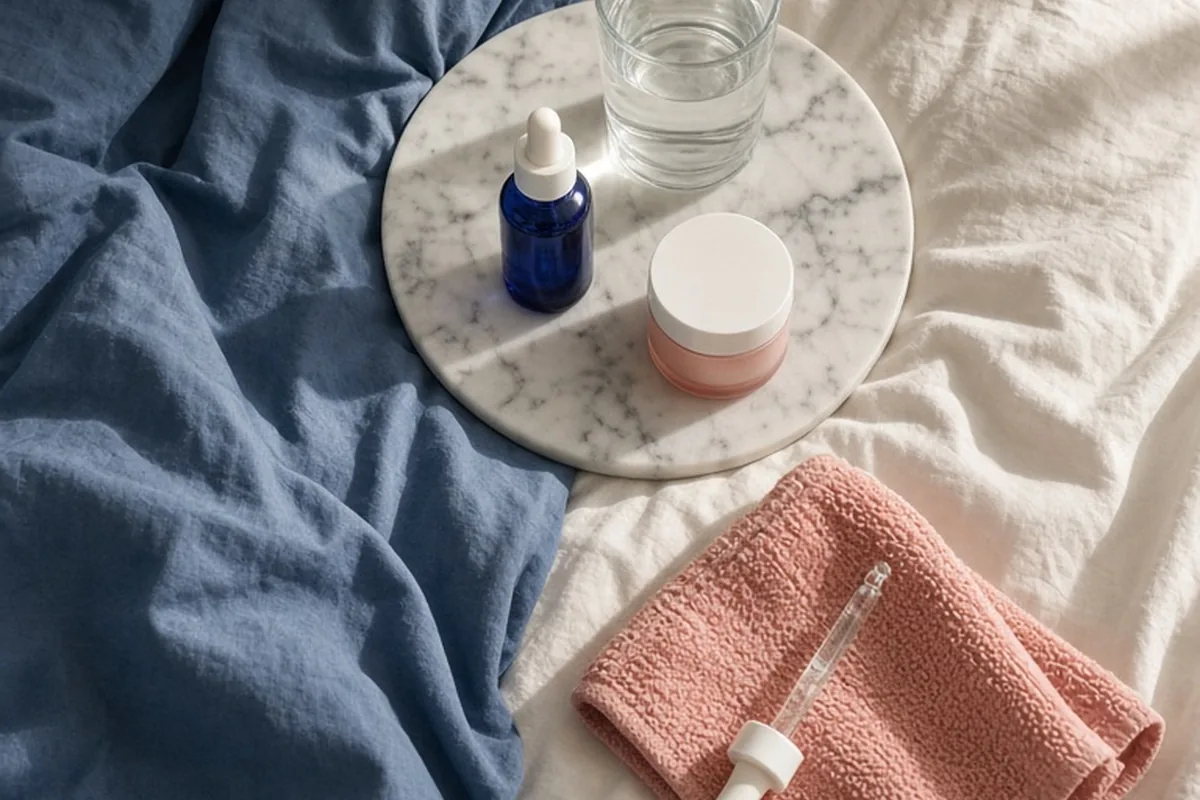
Beginners should apply serum before moisturizer. Serums have smaller molecules and lightweight, water-based textures designed to deliver concentrated active ingredients directly onto clean skin. Applying moisturizer afterward creates a protective barrier with heavier oils and emollients, sealing those active ingredients inside while preventing moisture loss. Reversing the order blocks the serum from penetrating properly, which reduces its overall effectiveness.
Starting a skincare routine often feels confusing when faced with multiple bottles, dropper vials, and creams. Knowing the correct sequence ensures your skin absorbs each product effectively without irritation or wasted formulas.
The Core Rule of Skincare Layering: From Thinnest to Thickest Consistency
A reliable way to remember your routine sequence is the universal skincare guideline: apply products in order of consistency, moving from the thinnest texture to the thickest. Facial serums are typically formulated as watery liquids, fluid gels, or lightweight solutions. Because they contain high concentrations of active ingredients suspended in low-viscosity bases, their small molecular size allows them to absorb quickly into the outer layers of your epidermis. Applying them directly to freshly washed skin ensures nothing stands between those targeted actives and your skin cells.
In contrast, moisturizers are structured emulsions made from water, lipids, and emollient oils. Their primary role is twofold: delivering surface hydration and establishing a protective lipid barrier that prevents transepidermal water loss throughout the day or night. If you apply a dense moisturizer first, its oils and occlusive agents create a physical film over the skin surface. When you spread a water-based serum over that film, the water-based formula cannot break through the lipid barrier, leaving your expensive serum sitting uselessly on the surface where it will likely evaporate or rub off onto your pillowcase.
There is one notable exception to keep in mind regarding product formats: facial oils. While some brands label facial oils as serums, pure oils are occlusives rather than humectants. An oil-based formula should always go after your water-based serum, and in most routines, it works best either patted directly over your cream moisturizer or blended into it. As a general rule for standard routines, keep your watery treatments first, followed by your creams.
Step-by-Step Application Technique for Daily Skincare
To get the most out of your products, start by thoroughly washing your face with a gentle, non-stripping cleanser and lukewarm water. Gently pat your face with a clean towel, leaving your skin slightly damp if you plan to use a humectant serum such as hyaluronic acid or glycerin. Humectants work by drawing water molecules into the skin, so having residual moisture on the surface gives them instant hydration to absorb. If your serum contains strong active acids or pure retinoids, however, apply it to completely dry skin instead to minimize potential stinging and irritation.
Dispense approximately three to four drops of serum into the palms of your clean hands or directly onto your fingertips using the dropper, being careful not to let the glass dropper tip touch your face. Gently press and pat the serum across your forehead, cheeks, chin, and neck using upward motions rather than vigorously dragging your palms back and forth. Allow the serum to settle for thirty to sixty seconds until your skin feels soft and slightly tacky, but not completely bone-dry.
Next, scoop a nickel-sized amount of moisturizer onto your fingers. Warm the cream slightly between your hands and smooth it evenly over your face and neck, pressing it gently over the areas where you just applied your serum. This creates an immediate seal that locks in the humectants and active compounds. Rushing this step while your serum is still dripping wet can cause the formulas to slide around and pill, whereas waiting several minutes in a dry room can cause the surface hydration to evaporate before you have a chance to trap it.
Coordinating Active Serums with Your Moisturizer
Different serums target specific skin concerns, and coordinating them with the right moisturizer maximizes their comfort and stability. For morning routines, antioxidant serums—such as those featuring vitamin C, green tea extract, or ferulic acid—protect your skin against daytime environmental stressors and oxidative damage. Pairing a daytime antioxidant serum with a lightweight, non-comedogenic lotion prepares your skin for broad-spectrum sunscreen without adding greasy weight or interfering with makeup application.
Evening routines generally focus on repair, cellular turnover, and moisture restoration. If you are using a nighttime serum formulated with retinol, gentle exfoliating acids, or firming peptides, your skin requires extra structural support. Retinoids and chemical exfoliants can temporarily compromise the skin barrier and cause mild flaking as your skin adjusts. Choosing an evening moisturizer fortified with ceramides, squalane, fatty acids, or soothing colloidal oatmeal helps cushion the skin and counteracts potential dryness without hindering the serum's rejuvenating effects.
Beginners often fall into the trap of using too many strong ingredients simultaneously. If your serum already contains a concentrated active like salicylic acid or glycolic acid, pair it with a plain, fragrance-free moisturizer rather than a cream that also contains exfoliating acids. Overloading the skin with multiple competing actives across your serum and cream stages can overwhelm your moisture barrier, leading to redness, sensitivity, and sudden breakouts. Keeping your moisturizer straightforward allows your serum to do its intended work safely.
Customizing Your Sequence for Different Skin Types
Your skin type plays a significant role in how your products feel and perform together. If you have oily or acne-prone skin, you might feel tempted to skip moisturizer altogether after applying a serum, fearing that adding a cream will clog pores or cause midday shine. However, omitting moisturizer can backfire: dehydrated skin often compensates by producing excess sebum. Instead of skipping this step, apply a lightweight water-based serum—such as one containing niacinamide or zinc—followed by an oil-free gel moisturizer that hydrates through water-binding humectants without adding heavy pore-clogging oils.
For dry or flaky skin, layering requires a focus on sustained barrier replenishment. Dry skin lacks natural lipids, while dehydrated skin lacks water content. A smart approach involves layering a hydrating serum rich in multi-weight hyaluronic acid or panthenol onto damp skin, followed immediately by a nourishing, rich barrier cream containing shea butter or botanical ceramides. This combination provides both the moisture your skin cells crave and the lipid barrier necessary to prevent that moisture from escaping into dry indoor air.
Individuals with sensitive, reactive, or rosacea-prone skin need to be especially mindful of application friction and formula strength. When introducing a new active serum to delicate skin, you can utilize the buffering technique: apply a very thin layer of gentle moisturizer first, wait one minute, apply your active serum, and finish with a second thin layer of moisturizer. This gentle sandwich method softens the absorption rate of potent actives, dramatically reducing the risk of irritation while allowing your skin to build tolerance over time.
Morning Versus Evening Layering Routines
The physiological demands on your skin shift between daytime and nighttime, making it helpful to adjust your layering approach accordingly. During the day, your skincare serves as a shield against ultraviolet radiation, urban pollution, and dry air conditioning. A morning sequence should remain light and breathable: a brief cleanse, a fast-absorbing antioxidant or hydrating serum, a light fluid moisturizer, and a generous coat of broad-spectrum sunscreen. Using overly heavy creams or slow-absorbing oils in the morning can cause facial sunscreen to break down or slide off during normal wear.
Nighttime represents your skin's natural repair cycle, during which transepidermal water loss typically peaks while you sleep. Because you do not need to worry about sun exposure or cosmetic wear at night, you can layer more intensive, restorative products. After evening cleansing, apply your targeted treatment serum—such as a retinoid, peptide complex, or calming centella formula—and lock it down with a richer, more occlusive night cream. This nighttime seal ensures your skin remains deeply hydrated throughout the sleep cycle.
Consistency matters far more than complexity when establishing these routines. Beginners do not need to use an active treatment serum twice a day. In fact, applying potent corrective serums morning and evening can quickly lead to sensitization. Using a gentle hydrating serum in the morning and reserving stronger corrective treatments for two or three evenings a week allows your skin to adapt gradually while maintaining a healthy, resilient barrier.
Troubleshooting Pilling and Common Application Errors
One of the most frustrating experiences in skincare is product pilling, which occurs when formulas fail to absorb and instead ball up into tiny, rubbery flakes as you touch your face. Pilling almost always stems from incompatibility between product textures or improper layering times. If you apply a silicone-heavy serum directly under an oil-rich moisturizer, or if you apply a water-based gel over an oily residue, the formulations cannot blend or adhere to the skin, causing the top layer to roll off.
Another common cause of pilling is simply applying too much product at once. Skincare formulas are formulated to be effective in small doses; dousing your face in multiple droppers of serum creates an excess film that cannot penetrate the skin. Sticking to three or four drops of serum and a modest dollop of moisturizer prevents excess buildup. Additionally, switch your application technique from vigorous circular rubbing to firm, gentle pressing and smoothing motions, which helps each layer settle without shearing the underlying emulsion.
If you consistently experience pilling despite using proper amounts and waiting thirty seconds between steps, examine the ingredient labels of your products. High concentrations of cross-linked polymers, silicones like dimethicone, and heavy carbomers frequently clash with one another. To resolve this issue, consider using your silicone-heavy product as the very last step before sunscreen, or simplify your daytime routine by pairing a water-based serum directly with a moisturizing sunscreen that combines both hydration and sun defense.
Illustrative Scenarios
Illustrative Scenario: Adjusting Application Order for Dry Skin
A beginner with dry, flaky cheeks noticed their hydrating hyaluronic acid serum seemed to sit on the surface without easing tightness. They had been smoothing a heavy face cream first to relieve immediate dryness, then patting serum on top. After switching the sequence to apply the water-based serum directly to damp, clean skin and following immediately with the cream, their skin retained moisture throughout the day without greasy residue.
Key point: Applying lightweight hydrators to freshly cleansed skin before heavier barrier creams allows humectants to bind moisture effectively.
Frequently asked questions
How long should you wait between applying serum and moisturizer?
For most hydrating serums, waiting thirty to sixty seconds allows the product to absorb into the upper layers of the skin. If you are using strong exfoliating acids or pure retinol, waiting two to three minutes can help prevent dilution and reduce the chance of irritation. The goal is for your skin to feel soft and slightly tacky, rather than dripping wet or completely dry.
Can you mix your serum and moisturizer together to save time?
Mixing them in your palm is generally not recommended because it can disrupt the formulation chemistry and reduce the penetration of active ingredients. Serums are engineered with specific pH levels and molecular weights to absorb first, while moisturizers are formulated to seal the surface. Layering them sequentially ensures each product performs as intended without destabilizing either emulsion.
Should you apply serum twice a day or only once?
Gentle hydrating serums containing ingredients like hyaluronic acid or glycerin can be applied both morning and evening to support skin hydration. However, targeted treatment serums with potent actives like retinol, glycolic acid, or concentrated vitamin C are typically best used once daily or every other day to prevent sensitivity. Always assess how your skin feels and reduce frequency if you notice dryness or irritation.
What happens if you accidentally put moisturizer on before your serum?
If you apply moisturizer first, your skin will still stay hydrated, but the serum will struggle to penetrate the cream's occlusive barrier. The beneficial actives in the serum will mostly sit on top of the moisturizer or wash away, diminishing their effectiveness. It will not harm your skin, but you can simply return to the correct order during your next routine.
Your next step
Take a close look at your current skincare products tonight, arrange them on your counter from thinnest liquid to richest cream, and apply your serum directly to clean skin before sealing it in with your moisturizer.