A divorce ceremony is an intentional gathering or personal ritual designed to mark the legal, emotional, or spiritual end of a marriage. Unlike court proceedings, which focus strictly on the legal dissolution of assets and contracts, a divorce ceremony provides emotional closure, allows participants to release marital vows, acknowledge shared history, reset interpersonal boundaries, or formally transition into healthy co-parenting relationships.
Major life transitions such as weddings, graduations, and retirements have long been anchored by formal public milestones. In contrast, the end of a marriage has traditionally taken place behind closed doors, often reduced to administrative paperwork and private grief. A growing number of people are choosing to create deliberate ceremonies that mark the conclusion of their partnership with clarity, respect, and emotional finality.
Choosing Between a Solo Ritual, Joint Gathering, or Support Circle
The first step in planning a divorce ceremony is deciding on the format that best matches your emotional reality and current relationship dynamics. There is no single template for this milestone. For couples parting amicably with mutual appreciation, a joint ceremony can celebrate what was built while formally ending the romantic partnership. However, joint ceremonies require both participants to be on similar emotional footing and mutually committed to goodwill. If one person feels coerced, resentful, or hopeful that the ceremony will spark a reconciliation, a joint gathering can easily become counterproductive.
A solo ritual is often the healthier and more empowering choice when the divorce was high-conflict, one-sided, or characterized by broken trust. A solo ceremony centers entirely on personal healing, the reclamation of individual identity, and the release of lingering guilt or sorrow. In this setting, you do not need the cooperation or presence of your former spouse to establish psychological closure. You can conduct a solo ritual alone in a private natural setting or in your home, focusing your attention on self-compassion and setting intentions for your independent future.
A third alternative is a support-circle gathering, where you assemble a small group of trusted friends and family members. Rather than focusing on the former spouse, this format serves to rally your community around your new life chapter. Guests offer spoken affirmations, witness your transition, and express their continued support. This structure is particularly helpful for individuals who feel isolated after losing a shared social network during the separation.
Designing Meaningful Divorce Ceremony Rituals and Vows of Release
Wedding ceremonies center on binding promises, whereas divorce ceremonies center on conscious unbinding. The most resonant ceremonies include tangible symbolic acts that externalize internal shifts. One common ritual involves returning, altering, or releasing wedding rings. Some people choose to melt down their ring to forge a new piece of jewelry representing self-reliance, while others place the band in a keepsake box, bury it in a meaningful location, or sell it to fund a restorative trip. In a joint ceremony, former partners might place their rings on an altar or hand them back with an expression of gratitude for the years shared.
Exchanging vows of release provides explicit verbal clarity on how the relationship is changing. Rather than promising lifelong fidelity, participants speak words that dissolve past obligations, forgive human shortcomings, and grant mutual freedom. For example, a spoken release might sound like: 'I release you from the promises made on our wedding day. I honor the lessons we learned together, I let go of expectations that no longer serve us, and I wish you genuine peace as we walk separate paths.'
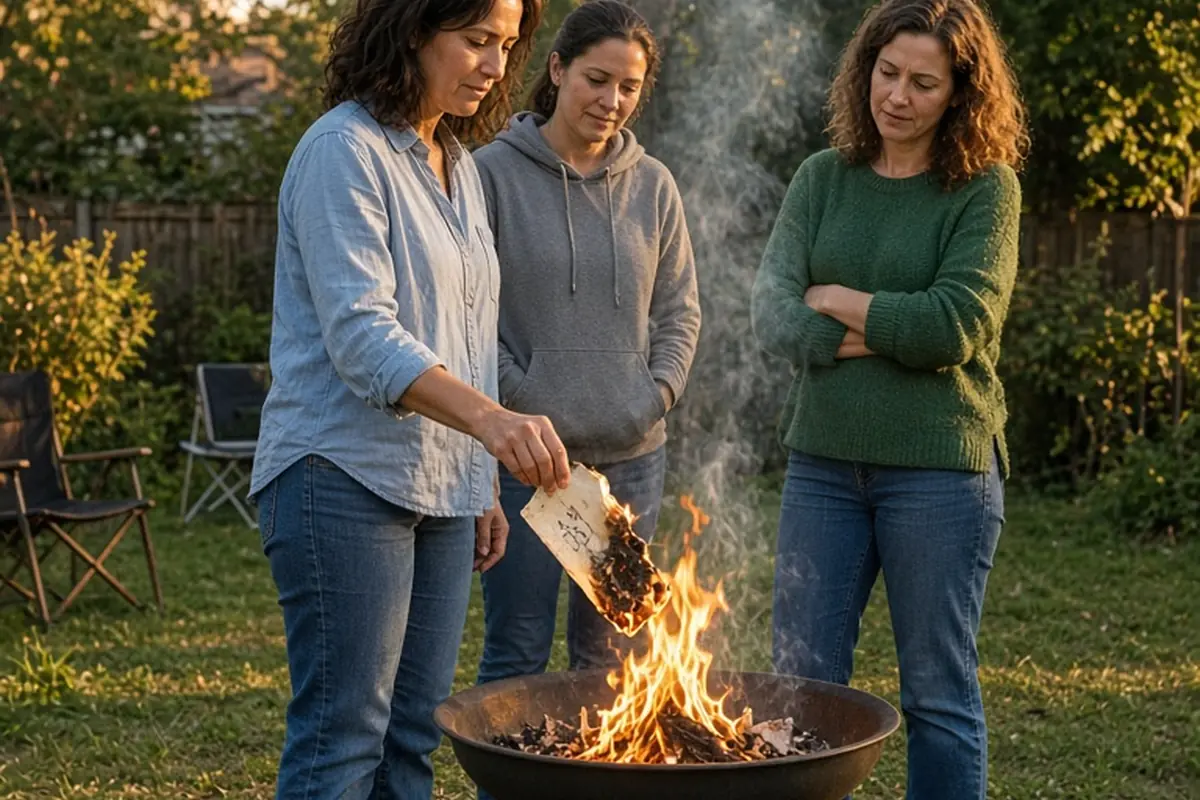
Symbolic burning or cord-cutting is another widely used ritual. Participants write down unfulfilled hopes, resentments, or painful memories on pieces of paper and safely burn them in a fire pit or chiminea. Cord-cutting rituals involve holding a braided ribbon or string that connected the partners or symbolized past ties, and cutting it in half to represent autonomy. These physical gestures give the mind a concrete marker that a boundary has been established.
Navigating Co-Parenting Commitments and Protecting Children
When children are involved, a divorce ceremony can serve as an opportunity to reinforce emotional security, provided it is approached with extreme care. Children should never be placed in a position where they feel responsible for consoling their parents, nor should they be subjected to adult grief, bitterness, or complex relationship analysis. The priority must always be reassuring children that parental love remains unconditional and that the family structure is reorganizing rather than disappearing.
In collaborative separations, parents can create a dedicated family transition ceremony. This ceremony focuses entirely on shared commitments to the children. Parents can stand together and recite promises such as: 'Our marriage has ended, but our commitment to raising you with teamwork, respect, and love will never end. You will always have two parents who support you, and you will never have to choose between us.' Presenting the children with a small token, such as a family photo album or matching pendants, can reinforce the message that their foundation remains sturdy.
If there is any underlying hostility or tension between parents, children should not attend the event. In such cases, parents should conduct their own private reflections separately. Forcing children into an artificial performance of harmony when real tension exists can increase their anxiety. When done well and in low-conflict environments, an age-appropriate family transition gives young people a clear narrative of stability during a period of upheaval.
Setting Guest Boundaries and Managing Social Expectations
Determining who to invite to a divorce ceremony requires clear discernment. Unlike weddings, which often have expansive guest lists, divorce rituals thrive on intimacy and emotional safety. Every person in attendance should be genuinely supportive of your healing and capable of holding space without fueling anger, gossiping, or taking dramatic sides. If a friend or family member is prone to disparaging your ex-partner or questioning your choices, it is best to leave them off the guest list.
Set clear expectations in your invitation regarding the tone of the event. A divorce ceremony is distinct from an anti-marriage party or a venting session. Inform your guests about the structure of the day and how you would like them to participate. For instance, you might write: 'I am gathering a small circle of loved ones to mark the end of this chapter and celebrate a thoughtful transition forward. Please come ready to share positive intentions, warmth, and supportive presence.'
Alcohol management is another critical practical consideration. While a celebratory toast may feel natural, heavy alcohol consumption can easily trigger unfiltered remarks, latent anger, or uncomfortable emotional displays. Keeping the focus on reflective activities, shared meals, outdoor walks, or quiet music helps maintain a grounded, peaceful atmosphere throughout the gathering.
Selecting Officiants, Venues, and Managing Logistics
Deciding who leads the ceremony depends on your personal beliefs and comfort level. Many people hire a professional celebrant or interfaith officiant experienced in life-cycle transitions. Celebrants can provide an objective, calming presence, help curate custom vows, and ensure the event adheres to a respectful cadence. Alternatively, you may ask an emotionally mature, neutral friend to act as a facilitator, or you can self-lead the ritual if you prefer total privacy.
Venue selection should align with the desired tone. Natural outdoor environments such as beaches, parks, botanical gardens, or private backyards are popular because open spaces evoke themes of renewal, growth, and natural life cycles. Renting a quiet studio or meeting room can also work well. It is usually best to avoid venues tied heavily to past marital anniversaries or the original wedding ceremony, as strong historical associations can distract from the present intention of moving forward.
Keep financial investments proportional and grounded. There is no need to recreate the excessive commercial spending often associated with traditional weddings. Modest expenses might include hiring a celebrant, purchasing candles or symbolic keepsakes, renting a modest venue space, or catering a simple lunch for close supporters. The emotional value of the event comes from personal honesty and presence, not elaborate production.
Recognizing When a Divorce Ceremony Is Not Appropriate
While divorce ceremonies can offer profound healing, they are not suitable for every situation. A joint ceremony should never be attempted in relationships with a history of domestic abuse, emotional manipulation, intimidation, or severe substance misuse. In high-conflict divorces, attempting to bring former partners together under the guise of closure often re-opens wounds and exposes vulnerable parties to continued mistreatment. In these contexts, legal boundaries and complete physical separation are essential for safety.
Similarly, joint ceremonies are ineffective if one partner is not genuinely ready to let go. If one person uses the ceremony as a platform to plead for reconciliation, extract apologies, or induce guilt, the gathering will fail to achieve closure. Emotional readiness cannot be rushed or forced. When one party remains deeply hurt or resistant, the person seeking closure should pivot to a private solo ritual or work through their transition with a licensed mental health professional.
Even a solo ceremony can feel counterproductive if scheduled too early in the grieving process. If you feel intense shock or overwhelming distress immediately following a separation, your immediate priority should be basic emotional regulation, establishing physical routines, and securing legal clarity. You can hold a ceremony weeks, months, or even years later, whenever your nervous system feels stable enough to reflect calmly on the transition.
Illustrative Scenarios
Maya's Solo Backyard Release
Maya finalized her divorce after a seven-year marriage that ended abruptly when her partner moved out. Feeling unresolved grief and an absence of formal closure, she initially considered asking her ex-husband for a final joint conversation to say goodbye. Recognizing that past conversations had resulted in defensiveness, she decided instead to hold a private solo ritual in her backyard. Maya invited two close friends, set up a small fire bowl, read a written letter expressing her gratitude for the good years and releasing her resentment, and burned the letter. Afterward, she and her friends planted a native dogwood tree to symbolize her independent future.
Key point: You do not need the active participation or approval of an ex-partner to achieve personal closure and emotional resolution.
David and Elena's Co-Parenting Transition
After months of mediation, David and Elena reached a peaceful agreement to dissolve their twelve-year marriage. They shared two children, ages eight and eleven, and wanted to demonstrate that their co-parenting relationship remained solid. They hosted a simple dinner at home with their children and both sets of grandparents. During the meal, David and Elena read a brief joint statement thanking each other for their shared history and affirming their united dedication to raising their children together with respect and open communication.
Key point: A structured, calm transition ceremony focused on shared parenting promises helps give children emotional certainty during household changes.
Frequently asked questions
Do both former spouses need to participate in a divorce ceremony?
No, both partners do not need to participate. While joint ceremonies can be effective for amicable splits, solo rituals and support-circle gatherings conducted independently are equally common and allow individuals to achieve meaningful personal closure on their own terms.
What is the best way to handle wedding rings during the ceremony?
Rings can be repurposed into new jewelry, returned to the former partner, placed in a keepsake box, buried, or sold to support a new personal goal. Choose the option that brings you a sense of emotional release rather than lingering attachment.
Is it a good idea to invite children to a divorce ceremony?
Children should only be included if the split is low-conflict, the parents are completely collaborative, and the ceremony focuses entirely on reassuring the children of continuous parental love and stability. If there is unresolved tension, adult grief, or resentment, children should not participate.
How long after a divorce should you hold a ceremony?
There is no required timeline for holding a ceremony. Some people plan their ritual on the day their legal paperwork is finalized, while others wait several months or even a year until their acute emotional grief has settled and they feel ready for intentional reflection.
Your next step
Take fifteen minutes this week to write down three personal intentions for your post-divorce life to clarify whether a solo ritual, support circle, or collaborative ceremony best fits your emotional needs.