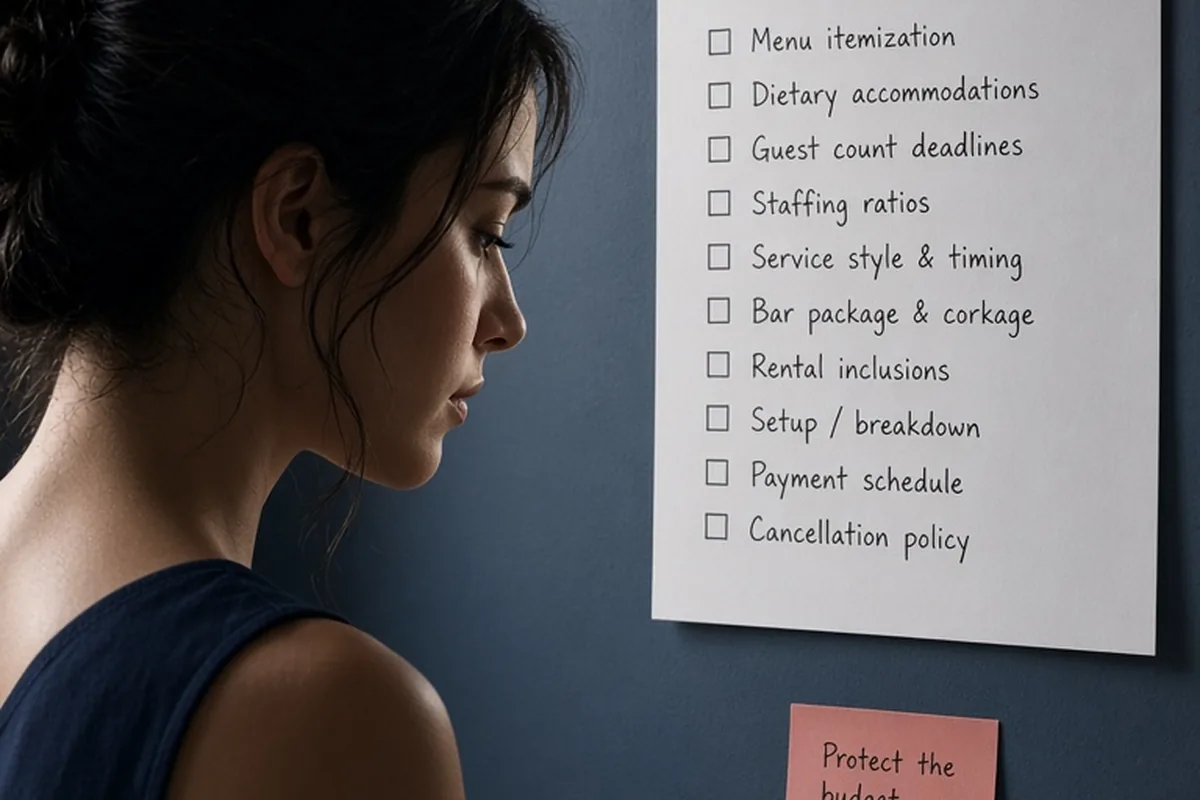
A complete wedding caterer contract checklist must verify menu itemization, dietary accommodations, guest count confirmation deadlines, staffing ratios, service style logistics, bar and corkage terms, rental item inclusions, setup and breakdown responsibilities, payment schedules, and clear cancellation policies. Reviewing these clauses protects wedding budgets against unexpected surcharges for staffing overtime, trash removal, cake cutting, or mandatory equipment rentals.
Securing food and beverage service represents one of the largest single investments in a wedding reception budget, making a legally binding agreement crucial for both fiscal protection and guest experience. A well-constructed contract converts verbal tastings and informal quotes into enforceable operational standards on the event day.
Menu Specifics, Tasting Approvals, and Dietary Accommodations
A wedding catering agreement must clearly detail every food item scheduled for preparation and service throughout the entire event. Rather than accepting broad category descriptions such as seasonal appetizers or chicken entrees, the contract should explicitly state the exact cuts of meat, specific sauces, side accompaniments, passed hors d oeuvre quantities, and late-night snack selections. Couples should confirm that the contract documents the approved recipes, presentation standards, and portion sizes established during the initial tasting. If seasonal variations might require ingredient adjustments closer to the event date, the agreement should outline a clear notification protocol and require mutual approval before substitutions occur.
Dietary restrictions and severe food allergies demand rigorous contractual language to prevent guest health risks and operational delays. The document must define how alternative plates for vegan, vegetarian, celiac, dairy-free, kosher, or halal diets are handled, tracked, and served during the meal. Couples should verify whether the caterer utilizes separate preparation areas to avoid allergen cross-contamination, how those specialized meals are visually identified by waitstaff, and whether additional preparation surcharges apply to customized orders. Setting these parameters in writing ensures that guests with medical dietary requirements receive safe, prompt service without unexpected additions to the final invoice.
Service Styles, Dining Timelines, and Course Pacing Obligations
The contract must document the specific meal service format chosen for the wedding, as different formats carry distinct labor requirements, equipment needs, and room layout implications. Whether the event features a multi-course plated dinner, family-style shared platters, standard buffet lines, interactive chef stations, or cocktail-style heavy appetizers, the operational mechanics should be stated clearly. For plated meals, the agreement should establish whether salads and bread baskets are pre-set at tables prior to guest arrival. For buffet or station styles, it must clarify whether stations are self-serve or managed by dedicated culinary staff to regulate portion control and maintain food sanitation.
Pacing obligations linked directly to the master reception timeline must be incorporated to keep the evening running on schedule. The contract should outline specific start and finish times for cocktail hour food service, dinner course distribution, champagne toasts, cake cutting, and late-night station openings. Incorporating agreed-upon service windows prevents the kitchen from serving meals before the wedding party arrives or rushing courses while speeches and special dances are underway. Establishing dining duration limits also ensures the front-of-house team can complete clearing plates before the dance floor opens.
Staffing Ratios, Overtime Rates, and Vendor Meal Clauses
Sufficient on-site staffing directly dictates the speed, attentiveness, and quality of food service throughout the reception. The contract should state the guaranteed staffing numbers categorized by role, including the on-site banquet captain, lead chef, prep cooks, table servers, and dedicated busers. For a standard plated dinner, a customary guideline is often one server per ten to twelve guests, whereas buffet services might require fewer table servers but additional station attendants and clearing staff. The agreement should confirm that the caterer will not reduce staff counts without proportional adjustments to the labor fees charged.
Overtime billing rates, gratuity rules, and vendor meal provisions require clear documentation to prevent end-of-night billing disputes. Couples must review the exact hourly or half-hourly billing rate assessed if dinner service or reception activities run past the contracted conclusion time. The contract must also define how the caterer handles meals for working event professionals such as photographers, planners, and musicians. It should specify the number of vendor meals provided, the scheduled time these meals are served, whether they mirror the guest entree or consist of a simplified hot meal, and the discounted per-person price charged for those plates.
Bar Service, Glassware Allocations, and Alcohol Permitting Rules
When catering companies manage beverage service, the contract must differentiate between full-service open bar packages, consumption billing, and client-supplied alcohol arrangements. For comprehensive packages, the agreement should list the exact liquor, beer, wine, and non-alcoholic mixer brands included, rather than vague tier descriptions. If the venue permits couples to source their own alcohol, the contract must outline corkage fees, chilling protocols, handling logistics, ice supply, garnish preparation, and the inventory process for returning unopened bottles at the conclusion of the evening.
Alcohol liability and bartender-to-guest ratios must be explicitly addressed within the beverage clauses. A standard operational benchmark is at least one certified bartender per fifty to seventy-five guests to avoid lengthy queues at the bar. The agreement should verify that the caterer maintains active liquor liability insurance, possesses valid regional service permits, and requires all pouring staff to hold certified alcohol service credentials. Furthermore, the contract should outline house policies regarding mandatory identification checks, last-call procedures, and the staff's legal authority to refuse service to intoxicated patrons.
Kitchen Equipment Rentals, Trash Removal, and Venue Breakdown
Reception venues vary significantly in their kitchen amenities, with some providing fully equipped commercial culinary facilities and others offering only empty prep rooms with basic utility access. The contract must delineate whether the caterer supplies all necessary heating boxes, portable ovens, refrigeration units, prep tables, and serving equipment, or if these components must be rented separately. Couples should verify whether the caterer handles all rental coordination for dinnerware, flatware, glassware, and table linens, and ensure the contract lists replacement costs for accidental item breakage.
Post-event breakdown obligations and sanitation responsibilities must align directly with the venue's rental policies. Venues often assess severe damage and cleaning penalties against couples if kitchens, prep stations, or dining areas are left dirty. The catering contract must state that the caterer's staff is responsible for scraping and packing rental dishware, cleaning food preparation surfaces, sweeping and mopping kitchen floors, bagging all organic and packaging waste, and hauling garbage off-site if the venue lacks dedicated commercial dumpsters.
Guest Count Deadlines, Minimum Spends, and Overage Policies
Catering contracts structure their pricing models around guaranteed guest minimums and strict deadline schedules. The document must define the exact date by which the couple must submit their final, non-negotiable guest count, which typically falls fourteen to thirty days prior to the wedding. If the final RSVP tally drops below the initial estimate, couples remain responsible for the agreed-upon food and beverage minimum spend. The contract should clarify whether couples can apply the difference in unspent minimum funds toward menu upgrades, premium wine selections, or enhanced cocktail hour stations.
A reliable contract also addresses unexpected attendee overages and culinary buffer allowances. Professional caterers routinely prepare a slight overage of food—often three to five percent above the guaranteed headcount—to account for unexpected vendor needs, dropped plates, or unannounced guests. The agreement should outline the per-person charge assessed if the actual number of attendees exceeds the final submitted guest list, and define how quickly those overage charges must be settled after the event concludes.
Wedding Catering Payment Schedules, Retainers, and Cancellation Terms
Financial clauses must provide a transparent breakdown of all costs, avoiding bundled figures that obscure administrative fees, local sales taxes, and staff gratuities. The contract should outline the payment schedule, beginning with the initial non-refundable deposit required to hold the calendar date, followed by scheduled milestone installments, and concluding with the cleared final payment deadline. Couples should examine whether administrative or service fees represent a direct gratuity distributed entirely to the floor staff or an operational markup used to cover company overhead, which determines if additional tipping is appropriate.
A clear cancellation, postponement, and force majeure clause protects both parties against unforeseen disruptions such as extreme weather, natural disasters, or venue closures. The contract must specify the conditions under which deposits are forfeited or credited toward a rescheduled date, the mandatory notice periods required for formal cancellation, and how non-recoverable expenses incurred by the caterer are calculated. Reviewing these refund thresholds and rescheduling restrictions ensures that couples understand their exact financial exposure if wedding plans must change unexpectedly.
Frequently asked questions
How far in advance should a wedding caterer contract be finalized?
Most couples sign an initial catering contract six to twelve months before the wedding to secure their date and basic package terms. Final menu selections, confirmed guest counts, and detailed timeline adjustments are typically finalized thirty to sixty days prior to the event date.
What is the difference between an administrative fee and a server gratuity in a catering contract?
An administrative or service fee is an operational charge retained by the catering company to cover logistics, planning, insurance, and administrative overhead. A gratuity is a tip intended directly for the waitstaff and bartenders. The contract should clearly state whether the service fee includes staff tips or if separate gratuities are expected.
Can a wedding caterer increase menu prices after the contract is signed?
Price increases are only permitted if the contract contains an explicit market fluctuation or price adjustment clause tied to food inflation. Couples should negotiate a price-lock guarantee or set an agreed-upon percentage cap on potential food cost increases when signing the initial agreement.
What happens to leftover food at the end of the wedding reception?
Health department regulations and caterer liability policies often dictate whether unserved food can be packaged for the couple or donated to local charities. The contract should outline the exact leftover policy, including whether the kitchen provides take-away containers or if all unconsumed items must be disposed of on-site.
Your next step
Cross-reference every clause in your draft catering agreement against your wedding venue's kitchen rules, waste disposal policies, and vendor insurance requirements before submitting your initial retainer.