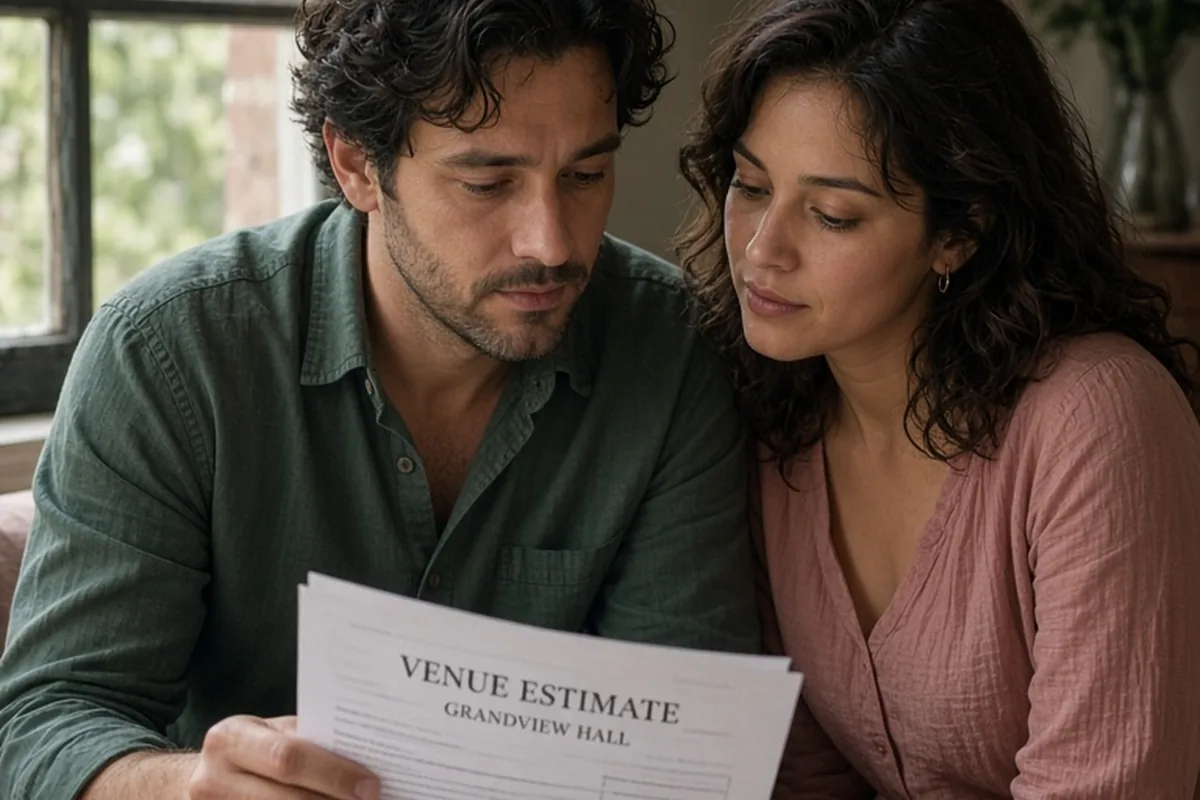
A wedding venue hidden fees checklist uncovers unlisted contract charges before signing. Common hidden costs include service charges that are not gratuities, mandatory in-house vendor buyout fees, setup and teardown labor surcharges, corkage and cake-cutting fees, security or cleaning deposits, overtime penalties, audio-visual power patch fees, and parking minimums. To avoid surprise expenses, always request a fully itemized, all-inclusive mock invoice reflecting local sales tax and all administrative fees before submitting a nonrefundable deposit.
Touring wedding venues often begins with an initial estimate that looks manageable on a glossy marketing brochure, only for the final quote to balloon dramatically once operational fees, taxes, and contract clauses are applied. Venue pricing rarely operates as a simple flat rate. Understanding where unadvertised costs sit within legal contracts and facility policies allows couples to negotiate transparent terms and protect their total wedding budget before signing.
Unbundling the Headline Rental Rate: Taxes, Service Charges, and Administrative Fees
The base rental rate promoted by a venue frequently represents only the bare access fee for the physical structure during designated hours. In many commercial wedding agreements, this base fee is immediately subject to mandatory operational markups that significantly alter the actual payable balance. The most common source of confusion is the facility service charge, often listed as an administrative fee, management surcharge, or house fee. Many couples assume this charge acts as a built-in tip for serving and event staff, but in most hospitality contracts, administrative fees are retained directly by the venue to cover overhead, insurance, and administrative management.
To make matters more complex, service charges and administrative surcharges are frequently subject to state and municipal sales taxes. In jurisdictions where service labor is taxable, the tax calculation is applied to the combined total of the venue fee and the administrative charge, compounding the final amount due. Before evaluating whether a venue falls within your spending parameters, insist that the sales director provide a sample contract schedule that illustrates the exact cascading formula used to compute taxes, surcharges, and gratuities on top of the base fee.
- Ask whether administrative or facility service charges are distributed directly to working staff as gratuities or retained by venue management for operating overhead.
- Clarify whether local and state sales taxes apply solely to goods like food and rentals or also apply directly to labor, service charges, and space rental fees.
- Request the exact formula used to calculate the compounded total of base fees, administrative charges, and applicable municipal taxes.
Food, Beverage, and Service Penalties: Corkage, Cake Cutting, and Bartender Minimums
Catering and beverage operations represent the largest potential category for unexpected bill inflation. Even when venues provide full-service in-house catering menus, supplementary handling fees can rapidly accumulate across the event timeline. Standard menu pricing routinely excludes per-person charges for basic service tasks, such as cake-cutting fees, dessert station replenishment surcharges, champagne pouring charges, and dishware rental upgrades required to serve specific courses.
Beverage programs introduce additional financial thresholds that require strict contractual review. Many venues mandate food and beverage spending minimums that must be met before taxes and service charges are calculated. If your guest count drops, you remain legally obligated to pay the contracted minimum threshold. Furthermore, bringing outside wine, specialty spirits, or craft beers frequently incurs steep per-bottle corkage fees, while hiring outside bartenders can trigger flat licensing, liability insurance, or bar-station setup penalties.
- Inquire if outside alcohol is permitted and obtain written documentation of per-bottle corkage fees, storage charges, and glass-chilling fees.
- Verify whether cake-cutting, plating, and dessert servicing fees apply if you source your wedding cake from an independent bakery.
- Determine whether staffing ratios dictate a mandatory minimum number of bartenders or servers based on total guest count regardless of menu simplicity.
- Check how food and beverage minimums are enforced if final RSVP numbers fall short of initial guest count estimates.
Vendor Exclusivity Restrictions and Outside Vendor Buyout Penalties
Venues routinely manage preferred or exclusive vendor lists covering catering, floral design, photography, entertainment, and event coordination. While exclusive vendor models ensure that working professionals understand the building layout, load-in docks, and safety protocols, they eliminate your ability to shop around for competitive pricing in the broader local market. In exclusive arrangements, the selected vendor must be used, regardless of whether their personal style or pricing tier aligns with your plans.
When a venue permits outside vendors on an approved basis, they often attach substantial buyout fees to offset their lost internal commissions. Outside vendor fees can take the form of flat surcharges per unapproved company, mandatory percentage cuts of the vendor's total invoice, or mandatory secondary liability insurance policies naming the venue as an additional insured party. If you have non-negotiable vendor relationships established prior to booking the venue, verifying these buyout clauses is an essential pre-signing step.
- Request the venue's complete approved vendor list and ask if working with an unlisted vendor is permitted under any circumstances.
- Confirm whether outside vendor buyout fees apply per company, as a flat percentage of vendor contracts, or as a single overall fee.
- Review insurance requirements, including minimum general liability coverage limits and specific indemnity language required for outside contractors.
Wedding Venue Hidden Fees Checklist for Logistics, Setup, and Teardown
Access windows represent a major area where logistical realities conflict with contract allowances. A standard venue contract may state a twelve-hour block of rental access, but a granular review often reveals that this window includes all setup, vendor deliveries, rehearsal run-throughs, post-event breakdown, and complete trash removal. If your floral installation, lighting rigs, or customized staging require four hours of preparatory assembly, your actual event and photography time becomes severely compressed unless you purchase additional access blocks.
Labor and logistical equipment fees often operate outside standard rental inclusions. Basic tables and standard banquet chairs may be included, but labor to arrange, transition, or flip the room between the ceremony and reception can carry dedicated staffing fees. Furthermore, venues operating in urban centers or historic properties frequently charge delivery access fees, elevator usage fees, or loading-dock staging surcharges during peak weekend hours.
- Confirm the exact start and end times for vendor load-in and post-reception load-out, noting whether cleanup must finish within the contracted rental window.
- Ask whether the venue charges a dedicated room turnover fee if your ceremony and reception take place in the same physical space.
- Verify who is responsible for post-event trash removal and whether facility janitorial fees cover breakdown or require separate third-party hauling.
- Check if rehearsal access the day before is guaranteed in the rental contract or subject to booking availability and additional hourly rates.
Audio-Visual, Lighting, and Facility Power Surcharges
Modern wedding entertainment and production setups require significant electrical infrastructure, particularly when incorporating live bands, extensive uplighting packages, photo booths, and multimedia projection displays. Venues frequently regulate access to their primary electrical panels, requiring outside production teams to hire on-site facility engineers or pay heavy power patch fees to tie into dedicated high-voltage circuits.
In addition to power allocation charges, facility management may assess audio-visual patch fees for utilizing in-house sound systems, architectural pin-spot lighting, or built-in drop-down projector screens. Some public and historic venues also pass along mandatory music licensing fees associated with commercial public performance rights, which are rarely highlighted in initial marketing discussions but appear as discrete line items on final billing statements.
- Ask your entertainment provider what electrical amperage they require, and confirm with the venue whether connecting to primary power boards incurs patch fees.
- Verify whether using in-house microphones, ambient ceiling speakers, or house lighting controls triggers equipment rental or technician supervision charges.
- Clarify whether public performance licensing fees or sound engineering monitor fees are charged to couples hosting live musical acts.
Overtime Penalty Structures, Security Staffing, and Cleaning Deposits
Wedding timelines can experience unplanned delays, making overtime clauses one of the most volatile cost categories in venue contracting. Overtime penalties are rarely billed at a pro-rated fraction of the base hourly rental fee. Instead, venues frequently enforce steep punitive rates for every fractional fifteen or thirty minutes that guests, vendors, or personal decor remain on the premises after the contracted curfew. These surcharges often double if staff members enter statutory overtime hours under local labor regulations.
Operational safety mandates introduce mandatory secondary line items that must be planned for in advance. Venues holding liquor licenses often contractually require dedicated security guards based on total guest thresholds, with the bill charged directly to the client. Similarly, refundable damage and cleaning deposits require liquid funds upfront, and venue management can make deductions for minor infractions such as unauthorized confetti, loose glitter, wax drips on historic flooring, or uncollected floral wire.
- Examine the specific contract rate charged for facility overtime and determine whether late fees apply on a 15-minute, 30-minute, or hourly increment.
- Ask if mandatory security guards or event marshals are required for events serving alcohol, and confirm whether their hourly wage is billed to your final invoice.
- Review the prohibited decor list to identify fines associated with open flames, sparklers, smoke machines, glitter, tape, or floral hanging hardware.
- Confirm the exact conditions, timeline, and inspection criteria required to receive a full refund of your security deposit after the event.
Contract Negotiation Strategies to Lock In an All-Inclusive Estimate
Protecting your finances requires shifting from accepting standardized brochure estimates to demanding binding, all-inclusive documentation before exchanging earnest money. When evaluating prospective locations, formally request an itemized mock invoice that models your exact guest count, intended timeline, preferred catering setup, and expected rental equipment. This exercise forces venue coordinators to disclose administrative markups, required staffing ratios, and mandatory facility fees in writing.
During negotiations, prioritize contract amendments that cap variable expenses and eliminate duplicate fees. If a venue charges an administrative service fee alongside individual setup, teardown, and staffing charges, request that specific labor line items be bundled into the master rate. Ensure that every verbal promise made during physical walkthroughs—such as early vendor arrival windows, complimentary rehearsal access, or complimentary day-of bridal suite usage—is explicitly incorporated into the contract's written addenda.
- Submit a formal request for a complete mock bill itemizing all base rates, facility fees, staffing line items, and projected taxes prior to deposit payment.
- Negotiate the removal or reduction of redundant line items, such as simultaneous cake-cutting and administrative coordination surcharges.
- Ensure all verbal agreements regarding storage access, setup windows, and dressing suite access are formally written into the binding contract.
Frequently asked questions
What is the difference between a venue service charge and a gratuity?
A service charge is a mandatory administrative fee retained by the venue to cover operational overhead, facility maintenance, and business costs. A gratuity is a tip paid directly to banquet captains, bartenders, and servers for personal service. You should always ask whether the service charge includes staff gratuity or if tips must be budgeted separately.
Can you negotiate wedding venue hidden fees out of a contract?
Yes, many operational fees can be negotiated before you sign the contract and pay a deposit. Line items such as cake-cutting fees, outside vendor buyout penalties, rehearsal access fees, and bar setup charges can often be waived or reduced, especially when booking during off-peak seasons or non-Saturday dates.
How much should we budget for unexpected venue fees and taxes?
Because sales tax, administrative fees, and service charges vary widely by state and municipality, they can easily add 20 to 35 percent or more to your baseline venue and catering total. The most reliable approach is to request a fully calculated, itemized mock quote based on local rates before establishing your final budget cap.
Are security deposits refundable if no physical damage occurs?
Yes, standard security deposits are fully refundable if the property is left in good condition and all contractual rules are respected. However, deductions may still occur for non-physical breaches, such as leaving trash behind, using prohibited items like glitter or open-flame candles, or exceeding your contracted load-out time.
Your next step
Request a comprehensive, itemized mock invoice reflecting all mandatory service charges, taxes, and vendor access rules from your top-choice venue before paying any nonrefundable deposit.