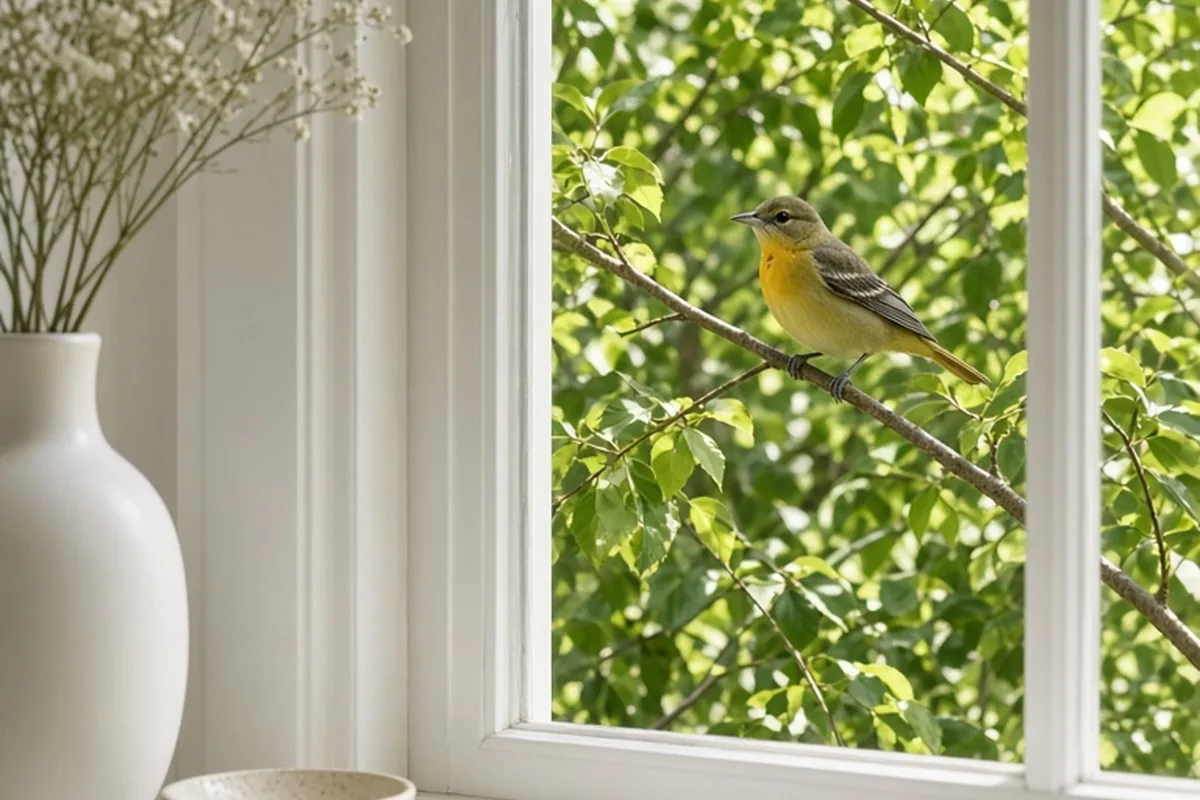
A female Baltimore Oriole features olive-brown or yellowish-brown upperparts, a warm golden-yellow to dull orange-yellow breast and belly, and grayish-brown wings marked by two distinct white wing bars. Unlike the stark black hood of the male, her head is olive-gray or brownish-olive, sometimes developing patchy dark mottling as she matures. Her sharply pointed, silvery-gray bill helps distinguish her from tanagers and finches.
While adult male Baltimore Orioles command attention with their brilliant flame-orange and jet-black plumage, females display a subtler, intricate palette designed for concealment among leafy deciduous canopies. Accurately recognizing a female requires close attention to color gradients, wing markings, structural proportions, and seasonal plumage variations.
Primary Plumage Colors and Overall Color Palette
The overall body coloration of a female Baltimore Oriole blends warm ochre tones with subdued earthy greens. Her underparts range from a soft, luminous golden-yellow to a rich, muted saffron-orange across the chest and upper belly, which gradually softens toward a paler, creamier yellow near the undertail coverts. Her upperparts, including the back, nape, and crown, are typically an olive-brown or olive-gray shade. This muted coloration allows her to blend seamlessly into sunlit foliage while foraging or sitting on an open nest, offering crucial protection against aerial predators.
Color intensity varies substantially from one individual to another based on age, nutritional intake, and genetic factors. First-year breeding females often appear significantly paler and more olive-toned, sometimes showing only a gentle wash of lemon-yellow across the breast. In contrast, older, fully mature females frequently develop deeper, rich orange-gold hues across their chest, throat, and face. This variability means observers should evaluate the combination of color placement, undertail shades, and back coloration rather than relying solely on finding an identical shade of yellow.
Wing Patterns, Bill Structure, and Facial Markings
A closer look at specific physical features reveals reliable field marks that confirm the bird is a female Baltimore Oriole rather than another songbird. The wings are dusky grayish-brown to charcoal, bordered by crisp, pale feather edges. Across each wing run two distinct, horizontal white or off-white wing bars. The upper bar, located along the median secondary coverts, is generally broader and more prominent, while the lower bar along the greater coverts is narrower and more delicate.
The head and bill structure offer essential structural markers that prevent misidentification in poor lighting:
The bill is medium-length, straight, sharply pointed, and colored a clean silvery blue-gray, tapering evenly from a sturdy base to a needle-like tip suited for piercing fruit and catching insects.
The face lacks the solid, deep black hood found on mature males, displaying instead a soft olive or brownish-gray cheek and crown.
A faint, pale eye-ring or delicate lighter eyeline is sometimes visible, subtly accentuating dark, dark-brown eyes.
Older females may display scattered, dark smudges or a dusky mottled wash across the crown, throat, and nape, which is a natural sign of maturity rather than hybrid plumage.
Age-Related Variations and Seasonal Plumage Changes
Birders often find female Baltimore Orioles challenging because their appearance evolves noticeably over their lifespan. Young females in their first spring and summer display the dullest plumage, dominated by grayish-olive tones on the back and a pale, watery yellow wash on the breast. Their wing feathers may also show a slightly faded brown cast retained from their juvenile molt. As females progress through successive annual molts, carotenoid pigments accumulate in their feathers, shifting their underparts toward vibrant shades of burnt gold, deep apricot, or dull orange.
Seasonal feather wear also alters their appearance between spring arrival and late summer departure. When arriving on breeding grounds in May, their fresh feathers appear smooth, crisp, and richly colored. By late July and August, after weeks of feeding nestlings and moving through abrasive tree branches, the feather tips wear down. The white wing bars may appear narrower or slightly broken, and the olive tones on the back can take on a grayer, weathered cast before they undergo their complete post-breeding molt.
Distinguishing Female Baltimore Orioles from Similar Species
Several North American songbirds share overlapping ranges, habitats, and color schemes with the female Baltimore Oriole. Female Orchard Orioles, for instance, share similar trees but are noticeably smaller, more compact, and exhibit a uniform, bright greenish-yellow body without the warm golden or orange-yellow chest tones of a Baltimore Oriole. Female Scarlet Tanagers also feature olive and yellow tones but possess thicker, swollen, yellowish bills and lack distinct white wing bars.
Distinguishing female Baltimore Orioles from related and co-occurring species requires checking specific contrasting field marks:
Female Bullock's Oriole: Displays a grayish-white belly contrasting sharply with a bright yellow throat and chest, a more distinct pale eyebrow stripe, and broader white patches on the wings.
Female Orchard Oriole: Smaller in overall size with a decidedly greenish cast throughout the entire upperparts and belly, rather than warm yellow-orange.
Female Western Tanager: Possesses a thicker, blunt bill and yellow-and-white wing bars, but exhibits a yellower back rather than olive-brown.
Immature Male Baltimore Oriole: Looks very similar to a female in his first spring but typically shows brighter, more uniform orange tones and begins molting solid black feathers into the face and throat.
Behavioral Clues and Feeding Habits for Field Confirmation
Visual appearance is easiest to confirm when paired with behavioral observation. Female Baltimore Orioles are agile, acrobatic foragers that spend most of their time in the upper canopy of broadleaf trees like elms, maples, sycamores, and cottonwoods. They frequently hang upside down from slender outer twigs to inspect the undersides of leaves for caterpillars, beetles, and spiders. Their movements are deliberate yet nimble, combining short hops along branches with direct, rapid flights between trees.
Their feeding habits at backyard stations provide excellent, close-up viewing opportunities. During spring migration, females readily visit nectar feeders, halved oranges, and grape jelly dishes alongside males. While feeding, they use their sharply pointed bill to pierce the skin of fruit and lap up juices using specialized tongue structures. Listening for their voice can also aid visual detection; females produce a sharp, dry chatter call to communicate with their mates and defend feeding territories, as well as a short, melodious whistling response to male songs.
Nesting Appearance and Clues During the Breeding Season
Observing nest construction offers one of the most definitive ways to identify a female Baltimore Oriole, as she performs nearly all the intricate weaving of their pendulous pouch nest. During late May and early June, you may spot a female gathering long plant fibers, grapevine bark, horsehair, twine, or fine grasses from meadows and garden borders. She carries these strands high into the canopy, typically selecting the drooping fork of a deciduous tree branch.
Seeing an olive-and-yellow bird actively weaving a suspended nest confirms both the species and the sex. The male may accompany her, sing from nearby perches, or defend the surrounding territory, but he rarely assists with the actual construction. During this period, the female may also show temporary physiological field marks, such as a bare brood patch on her lower abdomen, which helps transfer body heat efficiently to her eggs during incubation.
Field Identification Tips and Backyard Viewing Strategies
To get clear, reliable looks at female Baltimore Orioles, position yourself where canopy light illuminates the bird from behind your shoulder. Because these birds frequent high foliage, looking upward into bright backlighting can easily wash out their subtle yellow and olive tones, making them appear uniformly dark or gray. Using binoculars with good light transmission and focusing on the wing pattern and bill profile will help you verify species identity even when colors seem muted by deep shade.
You can encourage females to descend to eye level by maintaining targeted feeding and water stations in early spring. Place fresh orange halves, shallow dishes of grape jelly, and specialized oriole nectar feeders near open edges adjacent to mature trees. Adding a birdbath with moving water, such as a dripper or mister, is especially effective, as orioles are strongly drawn to the sound of running water for drinking and feather maintenance after long migratory flights.
Frequently asked questions
Can a female Baltimore Oriole have black feathers on her head?
Yes, older mature females often develop patchy, mottled black or dusky gray feathers across their crown, nape, and throat. While they never develop the solid, seamless black hood of an adult male, these dark markings are a normal characteristic of aging.
How do you tell a female Baltimore Oriole from a young male?
First-spring males often look similar to females but usually show a brighter, more even orange tint across the breast and face. Immature males also begin growing patches of solid jet-black feathers on their face, lores, and throat during their first breeding season.
Do female Baltimore Orioles sing like the males?
Yes, female Baltimore Orioles do sing, producing a shorter, simpler version of the male's rich, flutelike whistle. They frequently sing from the nest or while foraging to communicate their location and territory boundaries to their mate.
What is the best way to tell a female Baltimore Oriole from a female tanager?
Look closely at the bill shape and wing markings. A female Baltimore Oriole has a sharply pointed, silvery-gray bill and two distinct white wing bars, whereas a female Scarlet Tanager has a thicker, blunt bill and completely plain, unbarred dusky wings.
Your next step
To identify a female Baltimore Oriole accurately, look for an olive-brown back, a warm golden-yellow to soft orange breast, two clear white wing bars, and a sharply pointed silvery bill.