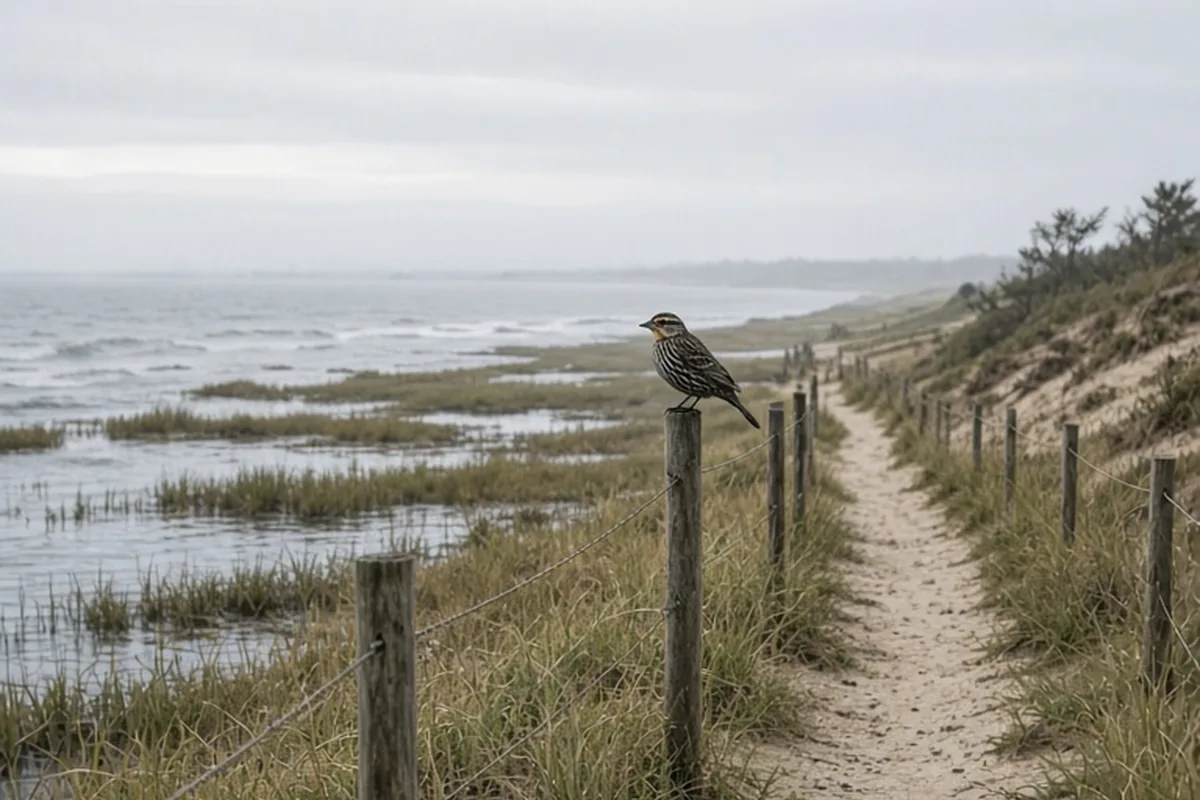
A female red-winged blackbird looks distinctly different from the glossy black male, resembling a large, heavily streaked sparrow. She features dark brown and buff upperparts, dense vertical brown streaking across a whitish underside, a sharp, conical black bill, and a pale eyebrow stripe. Many females also display a subtle peach, buff, or warm yellow wash across their throat and face during breeding season.
Birdwatchers frequently overlook or misidentify female red-winged blackbirds because their cryptic patterning bears little resemblance to the striking black-and-scarlet plumage of their mates. Recognizing their subtle field marks, bill profile, and behavioral tendencies allows you to spot these capable wetland birds with confidence.
Core Plumage and Streaking Patterns
At first glance, a female red-winged blackbird presents an overall dark, dusky brown appearance that blends smoothly into marsh vegetation. Her back and wings are layered in dark charcoal and chocolate brown feathers, each outlined with pale buff, cream, or rufous edges. This patterning creates a textured, mottled appearance across her upper body that breaks up her silhouette against dead reeds, grasses, and brush.
The underparts provide the most distinctive visual marker for this species. Starting at the upper chest and extending all the way down through the belly and flanks, the female displays thick, dark brown streaks over a pale grayish-white or creamy background. These vertical streaks are notably dense, dark, and crisp compared to the softer, diffused markings found on many smaller songbirds. The underside often appears almost checkered or striped from a distance, giving the bird a heavy, robust visual texture.
- Densely streaked breast, belly, and flanks with dark brown vertical markings
- Mottled upperparts with brown feathers edged in warm buff and tan
- Pale undercoat showing through the heavy streaking on the chest
Head Markings and Facial Details
The head of a female red-winged blackbird carries several reliable field marks that separate her from other streaked species. She typically shows a prominent, pale cream or buff eyebrow stripe, known as a supercilium, running from the base of the bill backward over the eye. Below this, a dark brown eye line extends across the side of the head, contrasting with a lighter cheek patch and giving the face an alert, striped expression.
One of the most distinctive yet variable features is the warm wash of color on the lower face and chin. Many adult females display a noticeable salmon, peach, buff, or pale yellow tint on their throat, lores, and eyebrow area, especially during the spring and summer breeding season. The intensity of this wash varies based on age, diet, and region, ranging from a faint buffy glow to an intense yellowish-apricot patch that stands out clearly in bright sunlight.
Bill Shape and Structural Characteristics
While plumage patterns can sometimes cause confusion, the bill structure of a female red-winged blackbird is one of the most reliable identification tools available. As a member of the icterid family, her bill is sharply pointed, dagger-like, and conical with a straight upper edge, or culmen. The bill is uniformly dark slate, charcoal, or black, meeting the forehead at an even, flat angle without the curved profile typical of finches and sparrows.
Understanding this bill shape helps rule out lookalikes almost immediately. Seed-eating sparrows possess shorter, stout, rounded bills adapted for crushing tough hulls, whereas the red-winged blackbird's sharp, straight bill is built for an omnivorous diet of insects, aquatic invertebrates, seeds, and grain. When viewing a silhouette against the sky or deep in reed beds, focusing on this sharp, tapered bill provides immediate clarity.
Size, Silhouette, and Proportions in the Field
Female red-winged blackbirds are noticeably smaller than males, measuring roughly seven to eight inches in length with a wingspan of approximately twelve to fourteen inches. Even with this size difference, they are substantially larger, longer-bodied, and heavier than standard backyard sparrows. Their overall shape features a flat-crowned head, broad shoulders, a relatively long, slightly rounded tail, and sturdy black legs built for perching on vertical plant stalks.
In the field, their posture often reveals their identity before coloration can be seen clearly. When perched on a cattail, bulrush, or fence line, females tend to sit upright with their tail held slightly downward or flicked rhythmically when agitated. Their gait on the ground is a purposeful, confident walk or slight waddle rather than the light hopping motion seen in most true sparrows.
Why Females Look Radically Different from Males
The dramatic visual contrast between male and female red-winged blackbirds is a textbook example of sexual dimorphism driven by evolutionary pressure. Male blackbirds must secure and defend territories in open, exposed marshes, relying on their glossy black feathers and vibrant red-and-yellow shoulder patches, called epaulets, to intimidate rivals and attract mates across long distances.
Females, on the other hand, carry the primary responsibility for building the nest, incubating eggs, and brooding young in low, exposed wetland cover. Bright colors would attract predators such as hawks, crows, raccoons, and snakes directly to the nest site. The female's heavily streaked brown and buff plumage serves as camouflage, allowing her to disappear entirely into the dead grasses, dried reed stems, and dappled shadows of her nesting habitat.
Distinguishing Female Red-Winged Blackbirds from Lookalikes
Because of their brown, streaked appearance, female red-winged blackbirds are frequently confused with several other species that share similar habitats or feeding grounds. The most common point of confusion is the song sparrow. While song sparrows also feature brown streaks, they are considerably smaller, possess a rounded bill, and generally exhibit a distinct dark central spot on the breast where their streaks converge, a feature absent in blackbirds.
Other potential lookalikes include female brown-headed cowbirds, bobolinks, and purple or house finches. A female cowbird has completely unstreaked, uniform grayish-brown plumage and a shorter, thicker bill. Bobolinks have a buffy, yellowish breast without dense dark streaks and show distinct dark stripes along the top of the crown. Finches are much smaller, have short, curved bills, and lack the sharp dagger-bill and flat-headed profile of the blackbird.
- Song Sparrow: Smaller body, curved conical bill, rounded tail, and a central chest spot
- Female Brown-Headed Cowbird: Plain, unstreaked gray-brown plumage with no eyebrow stripe
- Female Purple Finch: Smaller size, notched tail, white facial arc, and a short seed-eating bill
- Bobolink: Straw-yellow wash overall, distinct crown stripes, and unstreaked lower underparts
Habitat Clues, Posture, and Behavioral Habits
Observing the setting and behavior of an unfamiliar brown bird offers immediate context. During the spring and summer breeding seasons, female red-winged blackbirds are almost always tied to freshwater marshes, cattail stands, lakeside margins, wet meadows, and agricultural ditches. If you spot a heavily streaked bird weaving deep within marsh foliage while male blackbirds sing overhead, you are almost certainly observing a female of the species.
Their foraging methods are equally telling. Females actively probe mud, pick through wet leaf litter, and use a technique called gaping, where they insert their bill into plant stems or curled leaves and open it forcefully to expose hidden insects. They frequently give a sharp, dry 'chack' or 'chet' call note when moving through cover or alerting mates to nearby intruders, providing an audible confirmation of their presence.
Seasonal Plumage Changes and Regional Variations
The appearance of a female red-winged blackbird changes across the seasons due to feather wear and molting cycles. In the fall, after their late-summer molt, fresh feathers have broad, pale buff fringes that make the bird look softer, lighter, and more brownish overall. By the following spring and summer, these pale edges wear away, exposing the darker feather centers and making the bird look significantly darker and more sharply streaked.
Geographic variation also plays a role across North America. In the western United States, particularly in parts of California, certain subspecies known as the bicolored blackbird produce females that are noticeably darker and sootier, sometimes appearing almost entirely dark brown with fainter, less distinct streaking underneath. Immature females and older mature females may also occasionally show a tiny wash of rust or pale crimson on the shoulder bend, though it is never as bright or extensive as the male's epaulet.
Frequently asked questions
Do female red-winged blackbirds ever have red patches on their wings?
Most females have no red on their wings at all, displaying only brown and buff tones. However, some older, mature females develop a subtle rust, orange, or dull crimson tint on the shoulder bend, though it remains far smaller and less vibrant than the bright epaulets of a male.
How can you tell a female red-winged blackbird from a juvenile male?
Juvenile males in their first year often look like dark, mottled females with heavier sooty-black patches mixed into their plumage. They usually show distinct orange or yellowish epaulets on their shoulders and have a larger overall body size and darker bill than adult females.
What sounds or calls does a female red-winged blackbird make?
Unlike the male's loud, musical 'conk-la-ree' song, the female produces a series of short, sharp 'chack' or 'chet' alarm notes. When defending a nest or interacting with a mate, she may also give a rapid, chattering series of descending notes.
Why do female red-winged blackbirds gather in mixed flocks during winter?
During the non-breeding season, females join large winter foraging flocks alongside males, starlings, grackles, and cowbirds in agricultural fields. Grouping together offers protection from predators and helps birds locate abundant food supplies in open terrain.
Your next step
Next time you visit a marsh or wetland, scan the mid-height cattails for heavily streaked brown birds foraging near singing males to practice identifying their sharp bill and facial markings.