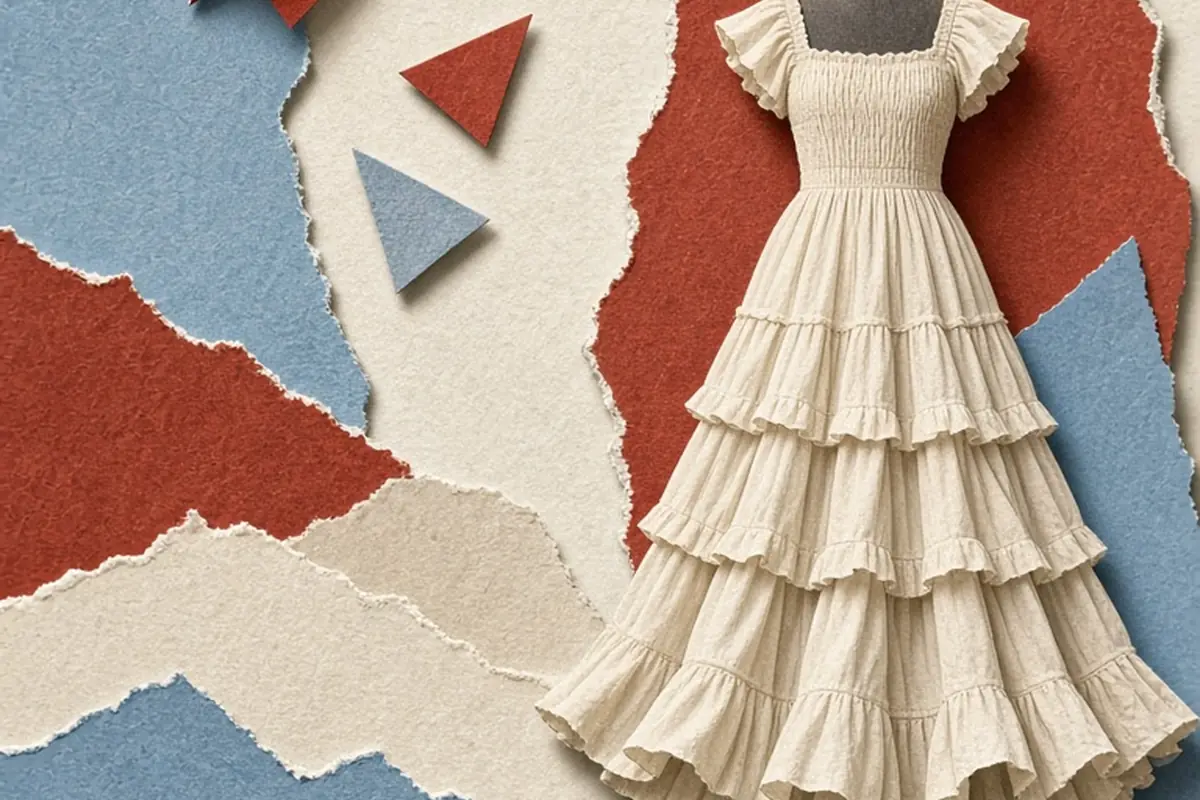
A layered woman's dress is most commonly called a tiered dress, featuring horizontal panels sewn together down the skirt. Depending on construction and volume, it may also be classified as a ruffled dress, a flounce dress, a smocked prairie dress, or an asymmetrical layered slip dress. Each variation differs based on whether fabric panels overlap completely or gather sequentially.
Identifying garment cuts simplifies shopping, pattern drafting, and personal styling by replacing vague visual descriptions with precise terminology. When an outfit features multiple horizontal bands, cascading panels, or overlapping folds of fabric, knowing the exact structural name helps you assess volume, movement, and tailoring feasibility before you buy.
Tiered Construction Versus Surface Ruffles and Flounces
The standard layered dress is built through tiered construction, where horizontal segments of fabric are joined together sequentially from the bodice or waist down to the hemline. In a genuine tiered dress, each panel is usually cut wider than the one above it and gathered along the joining seam. This technique creates incremental volume without requiring multiple complete under-layers, keeping the garment lightweight while establishing an expansive silhouette. The seam lines run horizontally across the body, functioning as visible structural divisions that define the overall shape.
In contrast, a ruffled or flounced dress achieves a layered look through decorative strips applied onto a base foundation garment rather than serving as the foundational skirt itself. Ruffles involve gathered strips of fabric sewn along their top edges, allowing the loose edge to ripple outwards. Flounces achieve a similar wavy effect through circular pattern drafting without gathers, producing smoother, sweeping waves rather than dense crinkles. While a tiered dress relies on segmented structural blocks, ruffled and flounced dresses rely on surface ornamentation. Choosing between them comes down to bulk preferences: tiered garments distribute weight evenly across circumference lines, whereas dense surface ruffles concentrate bulk near the attaching stitch.
Historical Origins and Evolution of the Multi-Layer Silhouette
The presence of stacked layers in women's fashion reflects centuries of functional and aesthetic evolution. In nineteenth-century Western dressmaking, tiered skirts appeared prominently during the Victorian crinoline era, where flounced layers rested over rigid cage petticoats to display elaborate lace, printed silks, and trim work. These historic applications required substantial yardage and domestic labor to maintain, symbolizing wealth and leisure through the sheer consumption of textiles.
Over the twentieth century, tiered garments transitioned into functional sportswear and countercultural fashion. Mid-century patio dresses and square-dance skirts utilized gathered tiers to allow uninhibited leg movement for social dance, popularized through Southwest regional aesthetics. By the late 1960s and 1970s, bohemian styling adopted loose peasant dresses with unlined cotton tiers, rejecting rigid corsetry in favor of relaxed draping. Contemporary fashion retains elements from each era: modern interpretations range from structured poplin day dresses with architectural gathers to minimalist slip dresses featuring bias-cut chiffon overlays.
Specific Styles Featuring Layered Design Elements
Beyond the general term tiered dress, several niche garment styles incorporate prominent layering into their defining patterns. Recognizing these distinct categories helps you pinpoint specific cuts when browsing collections or describing an aesthetic:
Each design variant manages fabric weight and structure differently. For instance, a handkerchief dress eliminates the horizontal breaks found in tiered garments, creating movement along the vertical axis instead. Conversely, smocked prairie dresses accentuate horizontal divisions, making them visually grounding. When deciding between these cuts, consider whether you prefer vertical elongation through loose points or horizontal definition through structured gathers.
- Babydoll Tiered Dress: Features an empire bust seam followed immediately by two or three short, voluminous tiers that fall above the knee.
- Prairie or Cottage Dress: Incorporates a high neckline, long sleeves, and a multi-tiered midi or maxi skirt, often accented with smocking or pintucks.
- Tiered Slip Dress: Utilizes lightweight fabrics like silk, satin, or rayon cut on the bias, with subtle horizontal seams or overlapping panels that drape closely against the body.
- Handkerchief Hem Dress: Composed of layered triangular or asymmetrical panels where the points hang lower than the midpoints, creating fluttering hems.
- Flamenco or Rumba Silhouette: Employs dramatic, closely spaced cascading flounces starting around the mid-thigh or knee, designed to flare dramatically during movement.
Fabric Selection and Its Effect on Drape and Volume
The textile chosen for a layered dress dictates how prominently the tiers project outward from the body. Crisp, tightly woven fabrics like cotton poplin, linen, and taffeta hold their shape along the gathered seams. When cut into tiers, these materials produce structured, architectural volume that stands away from the hips and legs. This crispness provides strong visual impact and air circulation in warm weather, though it introduces substantial body width that some wearers may find overwhelming.
Conversely, fluid fabrics such as viscose, silk crepe de chine, modal, and georgette drape downward toward the floor rather than expanding horizontally. In these fluid textiles, gathered seams introduce texture and subtle motion without ballooning outward. The trade-off lies in weight: dresses made with multiple tiers of heavier rayon can become physically heavy when hung from thin shoulder straps, occasionally causing the bodice to stretch out over prolonged wear. Evaluating the fabric weight relative to the number of gathered seams prevents buying a dress that feels either excessively stiff or unexpectedly heavy.
Proportion and Fit Considerations Across Body Frames
Because horizontal seams act as focal points, the height and placement of each tier influence visual body proportions. Tiers that cut directly across the widest point of the hips create a horizontal visual line that emphasizes width in that area. For individuals seeking vertical length, dresses with an elongated drop-waist torso followed by tiers starting near the mid-thigh can minimize torso visual breaks, while dresses featuring progressively wider tiers toward the ankle draw the eye downward in a smooth progression.
Scale also plays an essential role in how harmonious a layered dress appears. Petite individuals often find that micro-tiers or two gentle, proportional tiers avoid overwhelming a shorter frame, whereas five or six dense, contrasting tiers can visually segment the body into small, disjointed blocks. Conversely, taller frames easily support bold, wide-spaced tiers that match their natural scale. Paying attention to where the gathering begins—whether directly beneath the bust, at the natural waist, or lower along the pelvis—ensures the volume supports your preferred silhouette.
Practical Styling Strategies for Layered Silhouettes
Styling a dress with extensive horizontal volume requires balancing proportions across the rest of the outfit. Because a tiered or ruffled skirt naturally draws attention downward and outward, outer layers should complement the widest point rather than competing with it. Cropped jackets, structured denim, or tailored blazers that hit precisely at the waistline help anchor the top half of the garment, defining the torso before the gathered skirt begins its flare.
Footwear choices similarly influence whether the dress reads as casual, bohemian, or formal. Streamlined shoes, such as minimalist leather sandals, pointed-toe flats, or fitted ankle boots, ground the silhouette without adding visual chaos near the hem. Chunky footwear, such as platform lug boots or heavy clogs, balances wider tiers by providing visual counterbalance at floor level. When adding accessories, keeping jewelry simple prevents the overall ensemble from feeling cluttered alongside the multiple seams and gathers inherent to the dress.
Care, Pressing, and Alteration Realities
Maintaining a multi-tiered garment requires specific care methods because gathered seam allowances trap moisture and collect lint during regular washing cycles. Machine washing on a gentle cycle inside a mesh laundry bag protects the numerous delicate seams from snagging or pulling under tension. When drying, hanging the dress rather than tumble-drying preserves the elasticity of gathered threads and prevents the horizontal seams from puckering unevenly.
Alterations present a distinct logistical challenge with tiered garments. Hemming a standard single-panel skirt is simple, but shortening a tiered dress often requires either trimming only the bottom tier—which can disrupt the balanced ratio between tiers—or dismantling and re-gathering several panels from the waist down. Before purchasing a tiered dress that runs too long, inspect the proportion of the bottom panel to determine whether removing two to three inches will leave it noticeably narrower than the tiers above it.
Frequently asked questions
What is the difference between a tiered dress and a layered dress?
A layered dress is an umbrella term describing any garment with overlapping fabric, ruffles, or structural tiers. A tiered dress is a specific category where horizontal sections of fabric are stitched together sequentially from top to bottom.
Can you hem a tiered dress without ruining the proportions?
Yes, but it depends on the design. If the bottom tier is sufficiently wide, trimming a few inches will maintain the overall balance. If the bottom tier is already narrow, shortening it may require a tailor to shorten multiple tiers evenly to maintain proportion.
Are tiered dresses flattering on all body shapes?
Tiered dresses work across all body shapes when the seam placement and tier volume match individual preferences. Choosing fluid fabrics like rayon reduces outward bulk, while structured cottons add deliberate architectural shape.
What is a cascading dress called?
A dress with cascading fabric is typically called a waterfall dress, a flounce dress, or a ruffle-front dress. These garments feature flowing fabric edges that drape vertically or diagonally rather than in strict horizontal tiers.
Your next step
To find your ideal layered dress, search specifically for tiered dress, flounce dress, or smocked prairie dress depending on whether you want gathered panels, sweeping waves, or fitted bodice details.