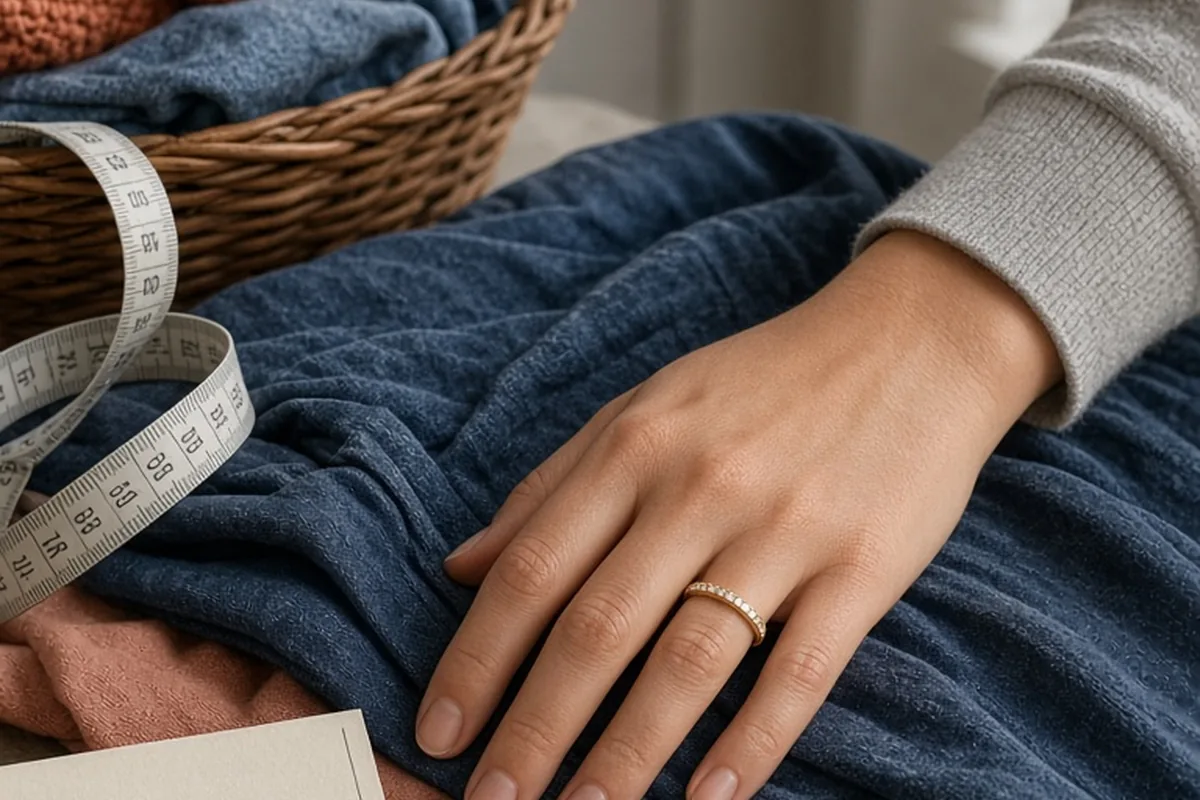
The average pinky ring size for women falls between US size 3 and size 4, with size 3.5 and size 4 being the most common. Depending on hand structure, knuckle width, and dominant hand usage, women's pinky fingers typically range from size 2.5 on smaller frames to size 5 on wider hands. For wider bands, sizing up by a half size is recommended.
Wearing a pinky ring has long served as a subtle yet distinct expression of personal style, self-celebration, and independence. Finding the correct fit for the smallest digit requires a dedicated approach, as the pinky finger experiences more daily movement and friction than other fingers while having less surface area to anchor jewelry safely.
Standard Women's Pinky Ring Sizing and Common Size Ranges
In the United States and Canada, ring sizes are measured on a numerical scale based on the inner circumference of the band in millimeters. While the standard ring finger for adult women typically measures between size 6 and size 7, the pinky finger is noticeably smaller, usually measuring between size 3 and size 4. Women with petite hands or slender bone structures frequently wear sizes 2.5 to 3, while women with broader hands or athletic frames often find sizes 4.5 to 5.5 provide the best balance of comfort and security.
A common challenge shoppers face is that traditional retail jewelry displays rarely stock rings below a standard size 5 or 6. Because mainstream collections cater primarily to ring-finger and middle-finger placement, pinky rings often need to be custom-ordered, resized by a jeweler, or purchased from brands that specialize in wide-range sizing. Knowing your exact pinky measurement before purchasing prevents the disappointment of receiving an ill-fitting band that slips off or pinches.
Environmental factors can cause the pinky finger to change size slightly throughout the day. Because the pinky is located on the outer edge of the hand, it is particularly sensitive to ambient temperature changes. Cold weather causes blood vessels to constrict, making the pinky finger shrink noticeably, while heat, exercise, and sodium intake can cause temporary swelling. Measuring your finger at different times of the day helps establish a dependable median size.
How Hand Dominance and Knuckle Anatomy Influence the Fit
Your dominant hand almost always measures larger than your non-dominant hand. If you are right-handed, your right pinky finger will generally be a quarter to a half size larger than your left pinky finger due to increased muscle density and everyday motor activity. When selecting a pinky ring, it is important to measure the exact hand where you intend to wear the jewelry rather than assuming both pinky fingers share identical measurements.
Knuckle anatomy plays an equally critical role in determining the ideal ring size. Fingers generally follow one of two anatomical shapes: tapered or knuckle-prominent. Tapered fingers are widest at the base and become progressively narrower toward the tip without a pronounced middle joint. For tapered pinky fingers, rings must fit snugly at the base, as there is no prominent knuckle to prevent the ring from sliding off during hand gestures.
Conversely, if you have prominent knuckles, the base of your pinky may be narrower than the middle joint. In this situation, the ring must be sized large enough to glide over the knuckle with gentle resistance, even if it feels slightly looser once seated at the base of the finger. If the ring spins excessively once past the knuckle, a jeweler can add subtle interior sizing beads to stabilize the band without restricting its passage over the joint.
The Impact of Band Width and Ring Profiles on Sizing
The width and internal profile of a ring significantly alter how tight it feels on the finger. A delicate, ultra-thin band measuring 1.5 millimeters displaces very little skin, allowing it to slide on effortlessly in your standard size. In contrast, wide cigar bands, signet rings, or statement rings measuring 4 millimeters or wider cover more surface area and create friction across the skin.
When purchasing a wide pinky band, jewelers universally suggest sizing up by a half size to maintain comfort. For example, if your narrow-band pinky size is 3.5, a 6-millimeter signet ring will likely require a size 4. Failing to account for width can lead to uncomfortable pinching, skin irritation, and moisture accumulation beneath the metal during daily wear.
Internal band construction also changes the overall feel. Standard flat-fit rings have a flat interior surface that sits flush against the skin, whereas comfort-fit rings feature a domed, rounded interior that glides over knuckles with less friction. If you choose a comfort-fit pinky ring, you may find that your true size or even a quarter size smaller provides an exceptionally secure hold.
Reliable Home Measurement Techniques Compared to Professional Sizing
Accurately measuring a pinky finger at home requires the right tools. Common household methods, such as wrapping string or a strip of paper around the base of the finger, frequently yield inaccurate results. Paper and string do not flex like metal, stretch easily when pulled, and cannot replicate the rigid circle of a real ring slipping over the knuckle, often leading to measurements that are one to two sizes too large.
A far more reliable at-home method is using an inexpensive plastic ring sizer belt or a set of calibrated metal sizing loops. When using a sizer belt, adjust the loop until it sits comfortably at the base of your pinky without squeezing the skin, then slide it off over your knuckle to test the clearance. The sizer should slide off with slight resistance rather than dropping off freely or requiring painful pulling.
Visiting a professional jeweler remains the most precise option. Jewelers use standardized metal sizing rings that match the exact width of the band you intend to purchase. When visiting a jewelry bench, aim to schedule your sizing in the afternoon when your body temperature is stable, and ensure your hands are neither unusually cold nor swollen from intense physical activity.
Style, Symbolism, and Practical Settings for Daily Wear
Pinky rings hold a rich history across cultures, representing professional achievement, family lineage, and personal autonomy. In modern fine jewelry, many women wear pinky rings as an intentional statement of self-love, independence, or personal milestones. Because the pinky finger sits isolated on the outside of the hand, even minimalist jewelry pieces command visual attention and lend an artistic finish to any outfit.
Because the pinky is an outer digit, rings worn on this finger endure frequent contact with hard surfaces, including door handles, steering wheels, desks, and pockets. High-profile settings with elevated prongs can easily catch on clothing or sustain impact damage over time. For daily wear, low-profile designs such as classic signet rings, flush-set gemstones, flat geometric bands, or bezel-set stones provide the highest level of durability.
Top-heavy designs present an additional consideration for pinky placement. Rings with heavy decorative faces or asymmetrical designs are prone to spinning if the fit is even slightly loose. Selecting a balanced band thickness or choosing a wider shank helps keep the centerpiece aligned on top of the finger throughout your daily routine.
Resizability, Safety, and Long-Term Maintenance
Before purchasing a pinky ring, evaluate whether the design can be altered in the future. Plain gold, silver, or platinum bands and traditional signet rings can easily be sized up or down by one to two sizes at a local repair shop. However, full eternity bands with continuous gemstones around the perimeter, tension-set rings, and bands made from non-precious alternative metals like tungsten or titanium cannot be resized.
If you inherit or receive a ring that is slightly too loose, several non-invasive adjustments can improve the fit without permanent alterations. Clear silicone ring coils wrap discreetly around the bottom of the band to reduce inner diameter. For fine jewelry, a professional goldsmith can solder small platinum or gold sizing beads inside the lower shank, which anchor the ring securely while preserving the original exterior design.
Daily safety and preservation require sensible handling habits. Because pinky rings are smaller and lighter than other jewelry, it is easy to miss the sensation of a ring slipping off when hands are soapy or submerged in water. Removing your pinky ring before swimming, applying heavy lotions, or doing heavy yard work protects the piece from slipping off unnoticed and keeps the metal free from chemical residue.
Frequently asked questions
Can I resize a ring down to a pinky size if it was made as a standard size?
Most solid metal rings with plain bands can be sized down by two to three full sizes without compromising structural integrity. However, rings with complex pavé diamonds along the shank or delicate filigree patterns may warp if reduced dramatically, making custom manufacturing a safer alternative for very small sizes.
How tight should a pinky ring feel during daily wear?
A pinky ring should sit comfortably against the skin at the base without pinching or leaving deep indentations. It should slide off over the knuckle only when you actively pull it, offering enough resistance that it will not fly off when you vigorously shake your hand.
Why does my pinky ring spin around constantly?
Ring spinning usually happens when the band is slightly too large for the finger base or when the top face of the ring is heavier than the lower shank. Adding internal sizing beads or choosing a slightly wider band creates more surface grip and stabilizes top-heavy signet designs.
Should I choose my dominant or non-dominant hand for a pinky ring?
You can wear a pinky ring on either hand based entirely on personal comfort and aesthetic preference. Keep in mind that your dominant hand's pinky is usually a quarter to a half size larger and will encounter more direct friction during writing, typing, and manual tasks.
Your next step
Determine which hand you plan to wear your ring on, measure your pinky finger in the afternoon using a calibrated sizing tool, and size up a half size if you choose a wide band.