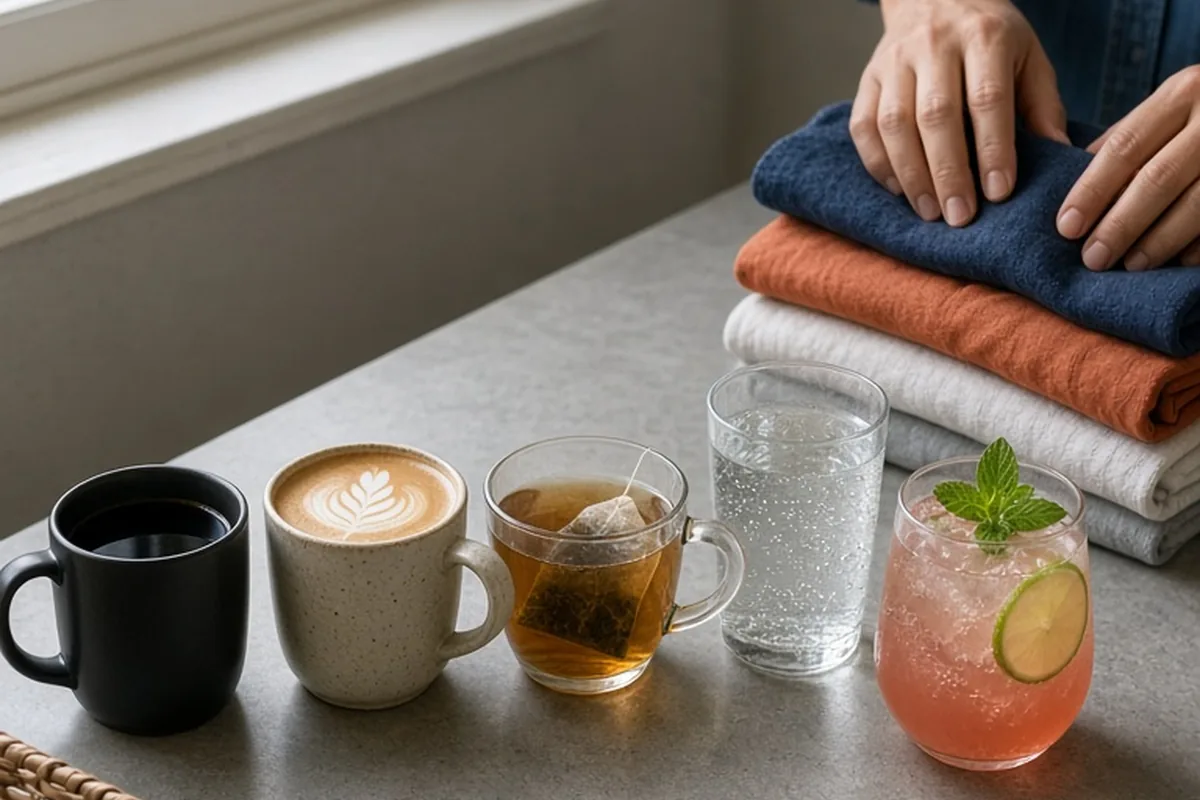
Your drink order sends a small social signal: black coffee reads as no-nonsense, a latte as approachable, tea as deliberate, sparkling water as health-aware, and a mocktail as confident without alcohol. But it is a weak signal. Coworkers remember whether you were prepared and pleasant far longer than what was in your cup.
People do read into drink orders, mostly because drinks are one of the few choices coworkers see you make every single day. Here is what the common orders tend to suggest, where those impressions hold up, and where they fall apart.
Why a Drink Order Feels Like a Personality Test
Humans are wired to make fast judgments from small cues, and a drink is an unusually visible cue. Unlike your spreadsheet skills, your cup sits on the conference table in front of everyone. It shows up in your hand on video calls, on your desk during one-on-ones, and in the group photo from the offsite. Because it repeats daily, people treat it as a pattern rather than a one-off choice, and patterns feel like personality.
There is also a ritual element. Coffee, tea, and happy hour drinks all carry cultural shorthand built up over decades of ads, movies, and office folklore. When someone orders a double espresso, coworkers are not just seeing caffeine; they are seeing every fictional closer and newsroom editor who ever drank one. That shorthand is real, but it is worth being honest about its limits: it mostly confirms what people already think. A drink order might color a first impression, yet it almost never overturns one built on how you actually work.
What Coffee Orders Tend to Signal
Coffee is the most decoded drink in any office because it is the most common. Each variation carries a loose stereotype, and while none of them are reliable facts about a person, they are the impressions people tend to form.
The trade-off comes with complicated orders. A very specific drink, like a half-caf oat milk latte at a precise temperature, can read two ways depending on the room: as someone who knows exactly what they like, or as someone who is hard to please. In a client-facing role where decisiveness matters, a simpler order is the safer signal. In a creative or design-driven team, the same order can read as having standards. Neither reading is fair, but both happen.
- Black coffee or drip: practical, routine-driven, low fuss. Often read as the order of someone who wants fuel, not a treat.
- Espresso or Americano: intensity and efficiency. Can suggest a person who likes things concentrated, including meetings.
- Latte or cappuccino: approachable and unhurried. The milk softens the signal, so it reads as social rather than purely functional.
- Cold brew or iced coffee year-round: trend-aware and a little contrarian. Drinking iced coffee in January gets noticed.
- Decaf: disciplined or health-motivated, though some people will tease it. Ordering it confidently tends to neutralize the joke.
- Fancy seasonal drinks: playful and not overly concerned with looking serious. Fine in most offices, riskier in very formal ones.
Tea, Matcha, and the Slow-Down Signal
Tea drinkers tend to get read as deliberate. Where coffee says go, tea says consider. Someone steeping a tea bag in a mug of hot water looks like they planned a pause, and in a hectic office that can read as calm under pressure. Herbal tea in the afternoon especially signals someone managing their energy rather than chasing it, which managers often interpret as self-awareness.
Matcha sits in its own category. Because it is associated with wellness culture, it can read as health-conscious and a little curated, the drink equivalent of a tidy desk. The limit here is context. In a fast-moving sales floor or startup, the tea person can occasionally get coded as detached or slow, fairly or not. In a research, editorial, or academic environment, the same habit reads as exactly right. If you are a tea person in a coffee culture, you do not need to switch; just know the signal you are sending is quieter, and let your work supply the volume.
Water, Seltzer, and the Quiet Signals
The person with the big water bottle is sending the safest signal in the building: prepared, health-forward, and not interested in performing anything. A reusable bottle on the desk reads as someone who thinks ahead, the same way a packed lunch does. It is a low-information signal, which is both its strength and its weakness. Nobody will judge you for it, and nobody will remember it either.
Sparkling water occupies a middle lane. It suggests someone who wants a small pleasure without caffeine, sugar, or alcohol, and it has become the default social drink for people skipping all three. The oversized trendy tumbler adds a different note: it reads as plugged into whatever the current thing is, which plays well in casual offices and slightly less well in conservative ones. If your goal is to blend in while still having something in your hand at a meeting, seltzer is the most neutral choice available.
Energy Drinks, Soda, and Deadline Culture
An energy drink on a desk is the loudest signal on this list. It says crunch mode, and people will usually assume one of two things: you are grinding through something brutal, or you run on chaos. In deadline-driven cultures like gaming, logistics, or event production, it reads as a workhorse badge. In a buttoned-up client meeting, the same can reads as someone who did not sleep, which is not the impression you want attached to your judgment.
Regular soda is quieter but still legible. The daily Diet Coke loyalist reads as habit-driven and unbothered by trends, which can come across as steady or as stuck depending on who is looking. The practical trade-off with both categories is timing. A morning energy drink barely registers; cracking one at four in the afternoon invites questions about your evening, your workload, or your sleep. If you rely on them, that is your business, but know that the can communicates before you do.
What to Order When the Drinks Are Social
Happy hour is where drink signals get the most attention and the most overthinking. The loose readings: a beer says easygoing and unpretentious, a glass of wine says classic and measured, a cocktail says you are treating the occasion as an occasion, and a mocktail or soda with lime says you are confident enough not to explain yourself. None of these will make or break your reputation, but ordering decisively matters more than what you pick. Hesitating, apologizing, or asking the group what you should have reads as uncertain in a way no specific drink does.
If you do not drink alcohol, the strongest move is ordering your alternative with the same directness everyone else uses, no justification attached. Most people will not notice, and the ones who do will usually respect the lack of fuss. One boundary worth holding in both directions: never pressure a coworker to drink, and do not let anyone pressure you. Pushing drinks on colleagues is a real workplace problem, not a bonding ritual, and declining one is a complete sentence.
How Much Your Drink Actually Matters
Here is the honest weighting: your drink order is a garnish on your reputation, not the meal. What people actually file away is whether you showed up on time, whether you were easy to talk to in line, and whether you remembered their name. A drink can nudge a first impression by a few degrees, but it cannot rescue a bad meeting or sink a good one. Anyone who judges your competence by your latte was going to judge you by something anyway.
That said, you can use the signal deliberately without performing. Pick a default order for work contexts, something you can say quickly, hold comfortably, and finish without fuss, and let it become boring background. Consistency reads as reliability, and reliability is the impression actually worth building. Save the adventurous order for your own time. The goal is not to curate a persona through beverages; it is to make your drink the least interesting thing about you so the rest of you can do the talking.
Frequently asked questions
Does my drink order actually affect how coworkers see me?
Only at the margins. A drink can add a small positive or negative tint to a first impression, but it is quickly overwritten by how you communicate and deliver. Think of it as a detail that supports your reputation rather than one that builds it.
What should I order at a work happy hour if I do not drink alcohol?
Order a mocktail, soda with lime, or sparkling water with the same confidence as everyone else, and skip the explanation. A decisive non-alcoholic order reads as self-assured, and most coworkers will not give it a second thought.
Is it worth changing my order to seem more professional?
Usually no, because performing a preference tends to show. The better move is simplifying: choose something easy to order and easy to hold in a meeting. Authenticity with a little polish beats a persona every time.
What is the safest drink order for a coffee meeting or interview?
A simple coffee or tea you actually enjoy, ordered without hesitation. The signal that matters is decisiveness, not the specific drink, and ordering something familiar means you can focus on the conversation instead of the cup.
Your next step
Before your next coffee meeting or team happy hour, decide on one simple default order you can say without thinking, then spend your attention on the people instead of the menu.