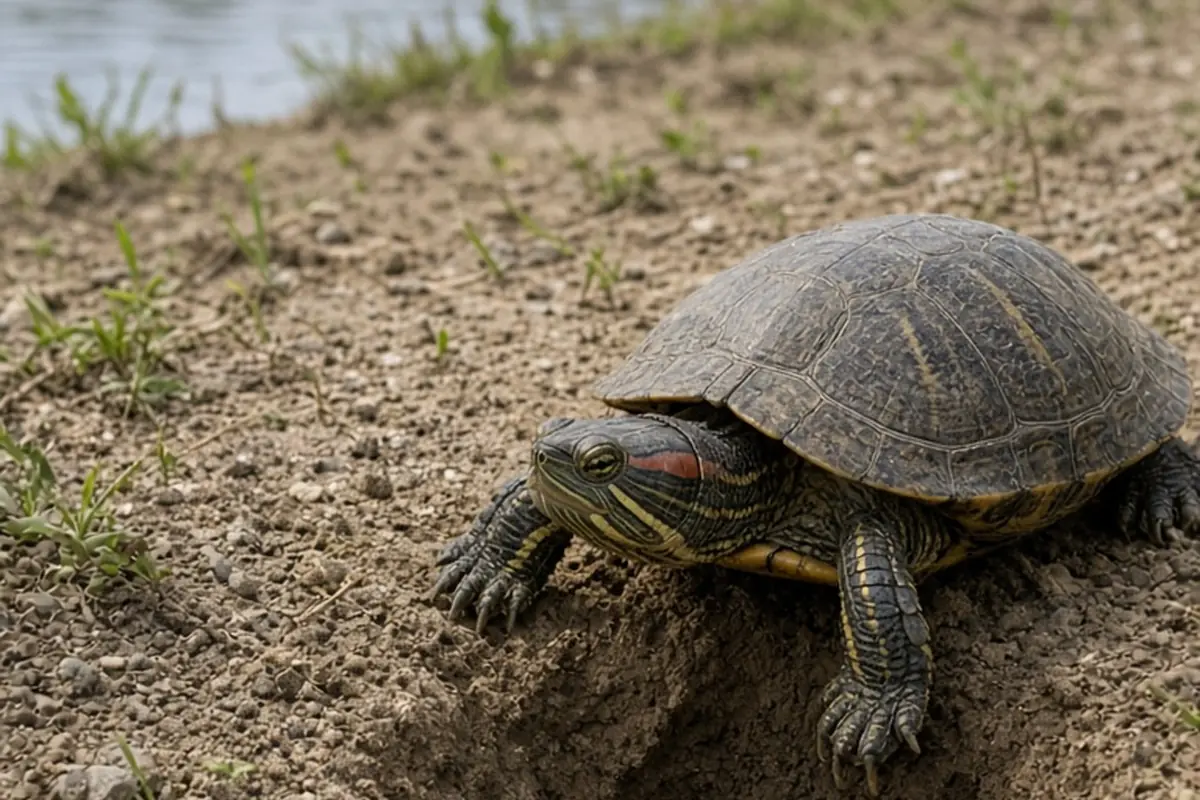
Female red-eared sliders typically lay eggs between late spring and mid-summer, spanning May through July in natural climates. In indoor enclosures, consistent warmth and artificial lighting can broaden this window from March through September. A female can lay fertile or infertile clutches once she reaches maturity, usually between two and five years of age or roughly six to eight inches in shell length.
Understanding the reproductive timeline of a red-eared slider is essential for maintaining her health, whether she lives in an outdoor pond or an indoor aquarium. Knowing what triggers nesting and how to recognize when an adult female is carrying eggs allows keepers to provide the right environment, reduce reproductive stress, and prevent dangerous health complications.
The Seasonal Timeline and Environmental Triggers for Egg Laying
In the wild, female red-eared sliders follow a reproductive schedule dictated by seasonal shifts in temperature, daylight hours, and rainfall. Mating generally occurs between March and June as waters warm, leading to egg deposition between May and July. Peak nesting activity often coincides with warm, overcast days or mild afternoons following a light rain, which softens the soil and makes excavation easier for the female.
Captive environments can shift this calendar significantly. Because indoor enclosures maintain stable water temperatures, artificial basking heat, and consistent photoperiods year-round, indoor females may not experience standard seasonal cues. Consequently, pet sliders frequently lay eggs as early as March or as late as autumn. If an indoor habitat provides uninterrupted warm water and long light cycles through the winter, a female's hormonal rhythms can prompt egg development outside normal outdoor seasons.
Understanding these triggers helps keepers anticipate nesting periods. If your turtle experiences gradual temperature increases and longer daylight schedules in early spring, her body will naturally treat that period as the prime window for egg development. Monitoring seasonal light shifts, even through nearby room windows, gives valuable context for when reproductive behaviors are most likely to begin.
Maturity Indicators: Age, Shell Size, and Solitary Laying
Age alone is not the sole indicator of when a slider will start producing eggs; overall size and growth rate play a decisive role. Wild females generally reach sexual maturity between four and seven years of age, whereas well-fed captive turtles often mature faster, reaching reproductive readiness between two and five years. As a practical benchmark, female red-eared sliders typically become capable of egg production once their straight carapace length measures between six and eight inches.
A common point of confusion for pet owners is whether a female turtle can lay eggs without a male present. Female sliders routinely develop, carry, and lay clutches of infertile eggs entirely on their own, much like chickens. Housing a female slider in isolation does not eliminate her reproductive cycle. Once she attains physiological maturity, her body will periodically manufacture follicles and shell eggs, requiring the same nesting accommodations as a mated turtle.
Assuming that a single turtle will never need a nesting area is a frequent oversight that can lead to health issues. Owners of solitary female sliders should anticipate egg laying once the turtle reaches adult dimensions, tracking growth milestones with periodic carapace measurements rather than relying strictly on chronological age.
Recognizing Behavioral Changes in a Gravid Slider
When a female slider is gravid, meaning she is carrying shelled eggs, her daily routine and demeanor alter noticeably over one to three weeks. One of the earliest signs is a sudden spike in restlessness. A normally calm turtle may spend hours pacing her enclosure, frantically swimming against the aquarium glass, or attempting to climb out of the tank. This behavior represents a natural instinct to search for suitable land where she can dig a nest.
In addition to increased activity, gravid turtles often undergo dietary and physical changes. Many females experience a sharp drop in appetite or refuse food altogether a few days prior to laying, as the growing eggs occupy substantial space within the body cavity. You may also observe her hauling out onto the basking dock repeatedly, only to immediately pace its perimeter or use her hind legs in a repetitive, rhythmic digging motion against the bare platform.
You can often gently verify whether a turtle is carrying eggs through physical palpation. By carefully placing a clean index finger into the inguinal fossa—the soft pocket of skin located just in front of her rear legs beneath the upper shell edge—you may feel smooth, firm, rounded shapes resembling small marble-like objects. Palpate very gently to avoid cracking internal eggshells, and avoid probing if the turtle retreats forcefully into her shell.
- Persistent swimming against glass walls or attempting to scale enclosure borders
- Refusal of regular pellets, leafy greens, or favored treats
- Rhythmic digging motions performed with the hind limbs on dry surfaces
- Increased frequency of basking paired with agitation rather than resting
- Firm, rounded objects detectable through gentle palpation in the rear leg pockets
Clutch Sizes, Annual Frequency, and Energy Demands
A typical red-eared slider clutch contains anywhere from two to fifteen eggs, with average clutch sizes usually ranging between five and ten eggs. The exact quantity depends on the female's physical size, age, health, and nutritional status. Larger, fully mature females tend to produce larger clutches than young adults laying for the first time.
A single nesting season can involve multiple clutches. A healthy female often lays two to four separate clutches spaced approximately three to four weeks apart during her active reproductive window. This multi-clutch cycle places significant metabolic demands on the turtle's body, requiring substantial energy reserves, protein, and calcium to synthesize yolk and construct rigid calcified shells.
Because producing multiple clutches drains bodily minerals, nutritional management during this window is vital. If a female's diet lacks adequate calcium, her body extracts minerals directly from her skeleton and shell to coat the eggs. Providing cuttlebone, calcium-dusted feeder items, and verified UVB exposure ensures she can produce healthy shells without compromising her own bone density.
Creating a Suitable Nesting Box for Safe Deposition
Aquatic turtles cannot safely deposit their eggs underwater. If a gravid slider is confined to an aquarium without access to appropriate substrate, she will often retain her eggs indefinitely, which creates severe health risks. Setting up a dedicated nesting box provides the secure, diggable environment she needs to release her clutch naturally.
To build a functional nesting area, select a large plastic storage container with high walls that prevent escape, ideally measuring at least two feet long and eighteen inches wide. Fill the container to a depth of eight to twelve inches with a fifty-fifty mixture of chemical-free organic topsoil and clean play sand or moist coconut coir. The substrate should be damp enough to hold its shape when a hole is dug, but never soggy or waterlogged.
Place the container in a quiet, low-traffic room with dim lighting to reduce stress. Suspend a low-wattage basking lamp over one side of the box to create a gentle temperature gradient around eighty to eighty-five degrees Fahrenheit. Place the gravid female into the box for two to three hours at a time. If she does not begin digging, return her to her main tank for hydration, basking, and rest, then try the nesting box again the following day.
Understanding Dystocia and When to Seek Veterinary Care
Dystocia, commonly referred to as egg binding, occurs when a female turtle is unable to expel one or more eggs from her reproductive tract. This condition can develop due to inadequate nesting conditions, nutritional deficiencies such as hypocalcemia, oversized or misshapen eggs, pelvic fractures, or physical exhaustion. Left untreated, retained eggs can rupture, lead to severe bacterial infections, or cause systemic organ failure.
Recognizing the transition from normal nesting behavior to clinical distress is critical for every slider keeper. If a turtle exhibits active restlessness and digging attempts for more than two weeks without laying, or if she abruptly becomes lethargic, weak, or unresponsive, medical intervention is required. Physical symptoms such as straining with no output, a swollen cloaca, or foul-smelling discharge warrant immediate evaluation by a qualified reptile veterinarian.
A veterinarian can perform radiographic imaging (X-rays) or ultrasound scans to evaluate the exact number, size, and position of retained eggs. Depending on the diagnosis, medical management may involve administering injectable calcium alongside oxytocin to stimulate contractions, or in advanced cases, surgical removal via a celiotomy. Early intervention significantly improves outcomes and prevents irreversible tissue damage.
- Severe lethargy, floppiness, or inability to lift the shell while walking
- Continuous straining movements from the rear limbs with no eggs produced
- Retaining eggs for several weeks past the onset of initial nesting behaviors
- Discharge, bleeding, or visible tissue prolapse around the vent
- Sunken eyes, persistent dehydration, and total refusal of water
Post-Laying Care, Enclosure Cleanliness, and Egg Handling
Once a female successfully completes egg deposition, she requires targeted recuperative care. Laying an entire clutch consumes immense energy and leaves the turtle dehydrated. Return her promptly to her clean aquatic habitat, ensuring the water is warm, filtered, and easily accessible without excessive current. Offer a nutrient-dense meal supplemented with high-grade calcium and vitamin D3 within twenty-four hours after laying.
Careful sanitation of the enclosure is also necessary. If the turtle laid her eggs in the water—a common occurrence when land access is missed—the eggs often break quickly or decompose, leading to rapid water fouling and dangerous bacterial spikes. Remove any submerged, cracked, or abandoned eggs immediately using an aquarium net, and perform a partial water change to preserve water parameters.
For infertile eggs produced by solitary females, freeze the eggs for twenty-four hours before disposing of them in household waste to prevent odors and bacterial growth. If eggs are potentially fertile from a known mating pair and you intend to hatch them, handle them with extreme care without rotating their orientation, and transfer them immediately into an established vermiculite incubator maintained at suitable temperature and humidity levels.
Frequently asked questions
Can a red-eared slider lay eggs directly in the water?
Yes, female sliders sometimes drop their eggs in the water if they lack access to a suitable nesting site on land. However, this is an unnatural stress response, and submerged eggs usually drown or crack quickly, risking water contamination and indicating that the turtle needs a dedicated nesting box.
How long can a female slider hold her eggs before it becomes dangerous?
A female turtle can safely retain eggs for a few days to a couple of weeks while searching for an ideal digging spot. If retention extends beyond three to four weeks or is accompanied by lethargy and loss of appetite, the risk of life-threatening egg binding increases dramatically.
Do female red-eared sliders need a male to produce and lay eggs?
No, female sliders do not need a male to develop and lay eggs. Mature females regularly produce infertile clutches throughout their adult lives, requiring the same nesting accommodations and nutritional support as mated females.
How many times a year do red-eared sliders lay eggs?
During a single reproductive season, a healthy adult female slider can lay between two and four distinct clutches, typically spaced three to four weeks apart. In consistent indoor conditions, this cycle can occur over an extended multi-month period.
Your next step
Determine if your female slider has reached adult size, monitor her behavior for seasonal pacing and digging signs, and keep nesting box materials ready so she can lay her eggs safely.