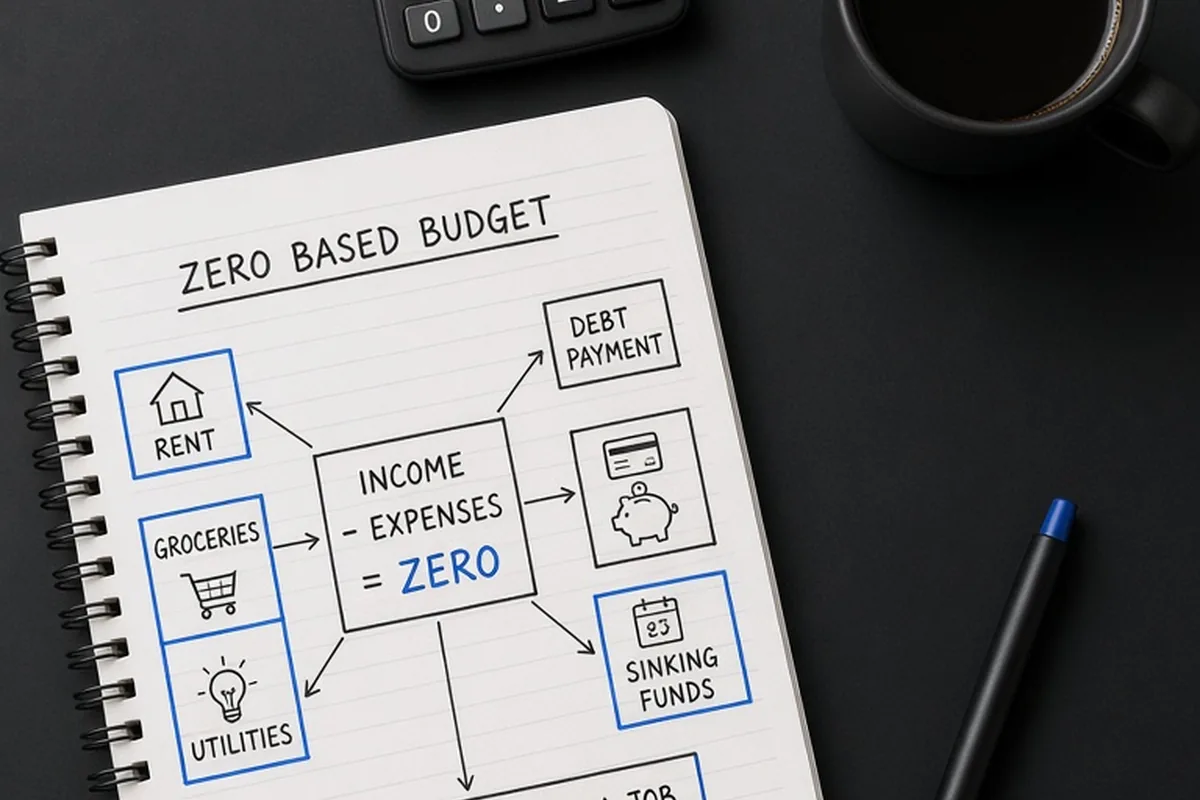
Zero based budgeting is a personal finance method where your monthly net income minus all allocated expenses, debt payments, and dedicated savings equals zero. Instead of leaving unassigned cash sitting in your checking account, you deliberately direct every dollar to a designated category before the month begins. This process ensures full visibility over cash flow, eliminates passive overspending, and directs leftover money toward specific financial milestones.
Transitioning from passive balance checking to active money management can feel overwhelming, particularly when unexpected bills and routine expenses compete for the same paycheck. Understanding how to build a zero-sum framework gives you clarity over where your money goes rather than wondering where it vanished.
How the Zero-Sum Allocation Method Functions
The core mechanism of zero based budgeting rests on a straightforward formula: net monthly income minus planned outflows equals zero. This does not mean your checking account balance reaches zero dollars at the end of every pay cycle, nor does it imply spending down every cent until you are broke. Rather, the term reflects mathematical accounting balance. Net income includes all take-home pay received during the calendar month, such as salary distributions, contract payments, and auxiliary earnings. Outflows encompass every possible destination for those funds, spanning core fixed essentials, variable lifestyle costs, debt service payments, and intentional allocations into emergency or retirement accounts. When every inbound dollar carries a designated function, unaccounted balance leakage stops entirely.
In traditional budget frameworks, individuals often track rent, utility commitments, and estimated grocery costs, leaving the remainder unallocated. That unassigned surplus typically drifts into discretionary spending, frequent restaurant orders, or small daily card swipes that go unnoticed until account alerts trigger. A zero-sum layout alters this dynamic by establishing predefined boundaries before transactions happen. By forcing a deliberate assignment for remaining surpluses—whether funneling twenty dollars toward building a modest rainy day cushion or routing fifty dollars toward principal loan balances—you eliminate the ambiguity that fuels impulse purchases. This framework treats your future financial security as a non-negotiable expense category rather than an afterthought dependent on what happens to survive the month.
Calculating Net Cash Flow and Categorizing Monthly Outflows
Establishing an accurate baseline begins with determining your real monthly net income. Rather than relying on gross salary figures quoted on employment contracts or annual offer letters, calculate the actual cash deposited into your deposit accounts after federal withholdings, state tax assessments, payroll deductions, and employer-sponsored benefit contributions. If your compensation relies partly on tips, commissions, or seasonal shifts, look at your lowest-earning month over the past year to establish a reliable spending floor. Overestimating inbound cash during the design phase represents the most frequent beginner misstep, as it forces artificial cuts or reliance on revolving credit card balances midway through the monthly cycle.
Once your net income figure is locked, divide outgoing expenses into clear, non-overlapping tiers. The primary tier covers core baseline needs: mortgage or rent payments, property taxes, electrical and water utilities, staple food supplies, medical prescriptions, and basic commuting transit. The secondary tier addresses debt obligations, including minimum payments on credit accounts, automotive notes, and student loans. The tertiary tier encompasses variable discretionary outlays, such as streaming services, leisure dining, personal wardrobe refreshes, and hobby supplies. By grouping obligations hierarchically, you immediately understand which line items remain completely rigid and which can absorb reductions if net revenue drops or essential utility rates surge unexpectedly.
Sinking Funds: Managing Irregular Bills Without Breaking Cash Flow
A common point of failure for beginners using zero-sum frameworks is the arrival of periodic, non-monthly obligations. Predictable non-monthly bills—such as semi-annual vehicle insurance premiums, annual software subscriptions, pet veterinary wellness exams, vehicle tag registrations, and seasonal holiday travel—frequently destabilize budgets when treated as sudden emergencies. In reality, these expenditures are foreseeable operational costs. The mechanism designed to absorb them within a zero based framework is a sinking fund, where the total anticipated annual cost is split across regular pay periods and set aside incrementally.
To establish sinking funds, list every recurring expense that occurs outside regular monthly billing cycles, estimate the payment deadline, and divide the anticipated total by the number of months remaining before the invoice arrives. For example, if an automobile insurance premium requires a semi-annual renewal fee, dividing that total across six equal monthly allocations allows you to fund the obligation gradually. As each month passes, that dedicated category carries forward an accrued cash reserve inside your liquid account. When the provider bills your profile, the capital is immediately accessible, preserving your primary monthly budget from shock and ensuring that routine maintenance never morphs into high-interest credit card debt.
Tool Comparison: Dedicated Apps Versus Custom Digital Spreadsheets
Deciding which platform to employ depends on personal comfort with manual tracking, time availability, and privacy preferences. Dedicated financial applications and custom digital spreadsheets represent the two primary mechanisms for maintaining a zero based ledger, each presenting unique operational advantages and structural drawbacks.
Dedicated budgeting software, such as You Need A Budget (YNAB) or EveryDollar, uses purpose-built zero-sum architectures. These platforms often connect directly to banking institutions via financial data aggregation services, automatically importing settled card transactions and account balances. Automated import saves operational time, while built-in mobile applications permit category checks before purchasing at physical retail locations. However, these proprietary tools typically mandate ongoing subscription fees billed monthly or annually, which adds an ongoing fixed overhead line item to your budget. Furthermore, third-party bank linking can experience intermittent connection errors or sync delays, requiring manual bank credential re-authentication and occasional reconciliation fixes.
Conversely, custom digital spreadsheets created through programs like Microsoft Excel or Google Sheets carry zero recurring software fees beyond your existing productivity suite access. Spreadsheets offer total design flexibility, enabling you to construct formulas, visual charts, and category structures tailored to your household structure without data-sharing concerns. The operational trade-off lies in data entry discipline. A spreadsheet demands manual entry of every receipt, invoice, and bank transfer. For beginners who struggle with consistent recordkeeping, entering transactions by hand several times per week can become burdensome, leading to tracking gaps that obscure account balances. Beginners should evaluate whether the automation of a paid software application justifies the recurring cost or whether the privacy and zero-cost structure of a manual spreadsheet aligns better with their current financial habits.
Managing Irregular Income and Variable Earnings Under Zero-Sum Rules
Applying zero based budgeting when income fluctuates presents a distinct operational challenge. Independent contractors, freelancers, hospitality staff, and commission-based professionals cannot rely on identical bi-weekly paychecks. Attempting to assign future dollars that have not yet cleared bank verification creates budget deficits when hours drop or clients delay invoice settlements. To resolve this friction, workers with irregular cash flow must base their operational monthly plan on either historical baseline minimums or a holding buffer system.
Under the holding buffer method, you do not allocate the money you anticipate earning during the current month. Instead, you build a liquid buffer equal to one full month of baseline living costs in a separate checking or high-yield savings account. During the active month, all incoming revenue from client invoices, contract projects, and shifts is swept directly into this buffer account without being split into immediate spending categories. On the first day of the subsequent month, you pay yourself a predetermined, steady baseline draw derived from the accumulated buffer, distributing that static figure down to zero across your necessary categories. If a high-earning month yields surplus capital, that excess remains inside the holding reserve, serving as an internal stabilization cushion that covers revenue dips in lean months without disrupting household operations.
Troubleshooting Month-End Variances and Unplanned Expenses
No matter how meticulously a preliminary budget is constructed, real-world spending rarely aligns perfectly with preliminary estimates. Fuel costs shift at the pump, regional weather fluctuations alter residential utility usage, and household grocery receipts fluctuate based on seasonal ingredient pricing. When category spending exceeds its assigned limit, a zero based budget requires immediate category rebalancing, colloquially referred to as rolling with the punches. Overspending in one bucket cannot simply be ignored; it must be offset by moving unspent funds from a lower-priority category before the billing cycle concludes.
To manage this smoothly, create a modest miscellaneous buffer category containing a small discretionary allotment designed specifically to absorb minor overruns. If automotive repair expenses exceed your projection, you must intentionally transfer money out of flexible allocations—such as dining out, personal entertainment, or new clothing purchases—to bring the negative balance back to zero. This explicit trade-off mechanism forces ongoing awareness of financial priorities. Rather than feeling defeated when a line item shows a negative balance, recognize that rebalancing represents standard operational procedure. The budget serves as an adaptable financial management tool, not an inflexible decree.
Practical Financial Boundaries: Protecting Personal Savings Autonomy
In shared household environments or committed partnerships, building an operational budget requires explicit conversations surrounding financial autonomy and shared responsibilities. While combining income and expenditures into a unified zero-sum ledger can simplify joint mortgage and utility payments, subsuming all personal resources into an undifferentiated household pool frequently creates friction around minor individual purchases. Maintaining healthy financial boundaries within a zero based framework involves establishing individual discretionary allowances alongside shared family goals.
Under this approach, the joint budget assigns an equal, predetermined dollar allocation to each partner every month for personal, unmonitored spending. These individual funds are moved into separate personal deposit accounts where neither individual owes line-item explanations for how that balance is spent. This structural boundary protects personal independence and eliminates relational tension over subjective purchases. Crucially, each person retains autonomous access to their own financial assets, reinforcing personal agency and economic security. Clear financial boundaries ensure that collaborative zero-sum planning serves shared stability without compromising individual financial safety or self-determination.
Frequently asked questions
Does zero based budgeting mean my bank account balance must hit zero every month?
No, zero based budgeting refers to assigning every dollar of net monthly income an explicit destination on paper before spending occurs. You should always maintain a standard cash buffer inside your checking account to prevent unexpected overdraft fees or timing mismatches between deposits and automatic withdrawals.
How long does it take for a beginner to get comfortable with zero based budgeting?
Most individuals require roughly three full monthly cycles to refine their categories and establish realistic baseline spending estimates. The initial month often reveals forgotten subscriptions or underestimated expenses, which you can adjust and stabilize in the second and third iterations.
Can I use zero based budgeting if I still carry high-interest credit card debt?
Yes, zero based budgeting is well-suited for debt reduction because it prevents unallocated money from drifting into unmonitored lifestyle spending. You list the minimum required payments as non-negotiable fixed obligations, and then deliberately route surplus cash toward aggressive principal reduction on your target balance.
What is the best way to handle cash tips or cash transactions in this framework?
The most reliable approach is to deposit all cash earnings directly into your checking account before assigning those funds to your budget categories. If you prefer spending physical cash, assign a specific cash withdrawal line item in your plan, take that exact amount from the bank, and record the category as funded upon withdrawal.
Your next step
Log into your primary banking portal today, write down your total net income from the last thirty days, and create your first draft allocation by assigning every dollar of that total across your essential living expenses, debt payments, and emergency savings until the unassigned balance reaches zero.