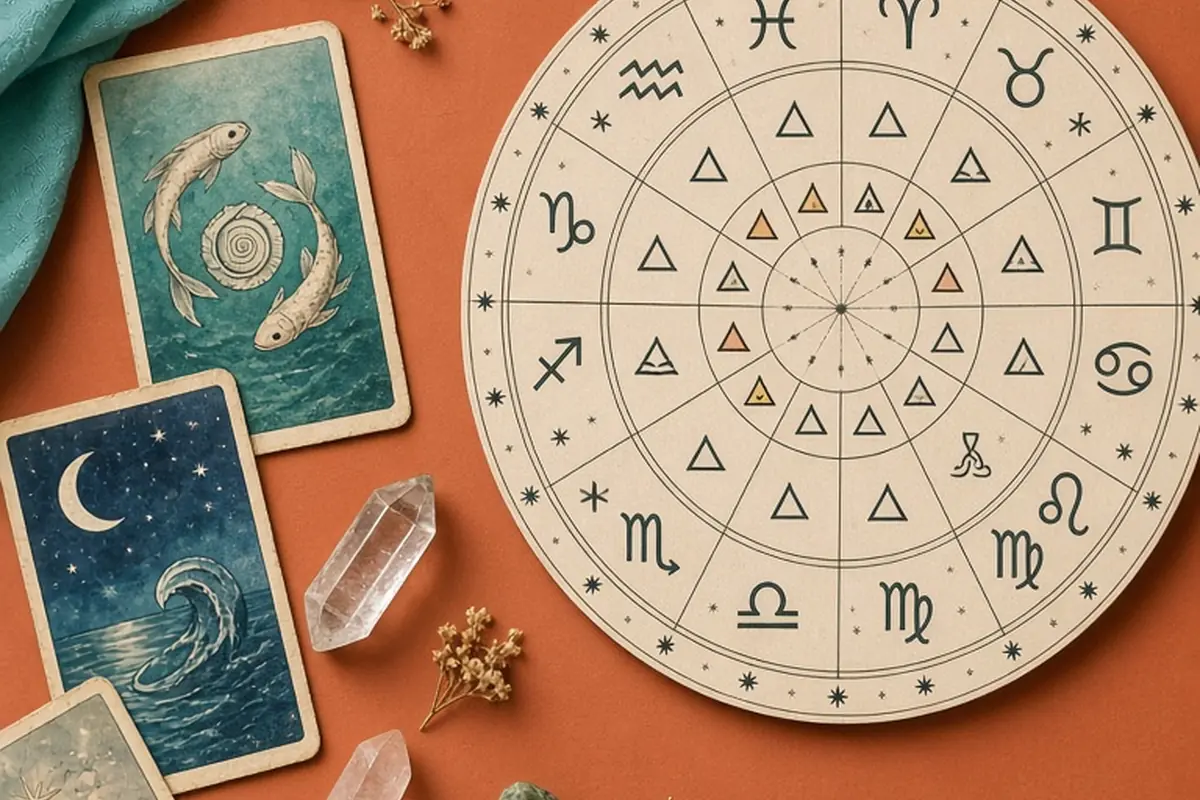
The zodiac circle is a 360-degree celestial wheel divided into twelve equal 30-degree segments, each represented by a distinct astrological sign such as Aries, Virgo, Scorpio, Aquarius, or Pisces. It serves as an archetypal map organizing personality traits, elemental energies (fire, earth, air, water), and behavioral tendencies across twelve houses. Understanding the circle helps you interpret natal charts and navigate personal patterns with structured self-reflection.
Whether encountered as a visual chart illustration or an interpretive system, the zodiac circle provides a cohesive framework that links twelve distinct archetypes into an interconnected cycle of human experience and relational dynamics.
The Geometric Structure of the 360-Degree Zodiac Wheel
The astrological wheel is constructed as a complete 360-degree circle divided into twelve symmetrical segments of 30 degrees each. Historically aligned with the path of the Sun across the celestial sphere over the course of a year, known as the ecliptic, this circular model creates an unbroken continuum where each sign occupies a dedicated spatial territory. Rather than viewing the signs as isolated archetypes, the circular geometry emphasizes their sequential relationship, where each sign represents an evolutionary response to the sign preceding it. The cycle traditionally begins at zero degrees Aries, marking the vernal equinox, and culminates in the final degrees of Pisces.
When analyzing the zodiac circle visually, you are looking at a dual-layered coordinate system that includes both signs and houses. The outer ring represents the twelve zodiac constellations in their fixed order, while the inner division represents the twelve mundane houses determined by the exact time and location of an individual's birth. A concrete example of this geometry in practice occurs when a planet is placed at 15 degrees Scorpio; it occupies the exact midpoint of Scorpio's 30-degree arc, simultaneously sitting within a specific house sector that dictates which area of life that planetary energy influences. A clear limitation of relying solely on the flat 360-degree diagram is that it simplifies complex three-dimensional astronomical movements into a symbolic two-dimensional map, meaning it should be treated as an interpretive tool rather than an empirical physical measurement.
The Four Elemental Triplicities Across the Wheel
Within the circle, the twelve signs are categorized into four fundamental elements: Fire, Earth, Air, and Water. These elemental groupings, known as triplicities, are arranged at equal 120-degree angles across the wheel, forming equilateral triangles that astrologers refer to as trines. Fire signs (Aries, Leo, Sagittarius) represent vitality, initiative, and passionate expression. Earth signs (Taurus, Virgo, Capricorn) emphasize pragmatism, physical structure, and material stability. Air signs (Gemini, Libra, Aquarius) govern conceptual thought, social connectivity, and objective analysis. Water signs (Cancer, Scorpio, Pisces) navigate emotional depth, intuition, and psychological nuance.
Understanding how elements operate within the circle allows you to observe elemental balance and friction within a personality or relationship. For instance, when an individual has predominant placements in Water signs like Scorpio and Pisces alongside Earth signs like Virgo, the chart suggests a grounded, receptive approach where emotional insights find practical, tangible application. Conversely, an individual whose chart leans heavily toward Air without grounding Earth placements may produce brilliant ideas through intellectual processing but encounter difficulty sustaining day-to-day follow-through. A trade-off of focusing primarily on elemental groupings is that it highlights broad temperamental inclinations while occasionally obscuring the highly specific behavioral nuances unique to each individual sign within that element.
The Three Modalities and the Rhythm of Action
In addition to elements, the zodiac circle is divided into three distinct behavioral modes known as quadruplicities or modalities: Cardinal, Fixed, and Mutable. These modalities describe how energy is initiated, sustained, and adapted over time. The circle alternates rhythmically through these modes in every quadrant. Each season of the year begins with a Cardinal sign, stabilizes under a Fixed sign, and concludes with a Mutable sign, creating a predictable energetic cadence across the entire wheel.
Cardinal signs (Aries, Cancer, Libra, Capricorn) serve as the initiators and catalysts who launch projects, establish direction, and break new ground. Fixed signs (Taurus, Leo, Scorpio, Aquarius) act as the anchors who provide stamina, focus, and long-term endurance, though they can sometimes struggle with inflexibility or resistance to necessary shifts. Mutable signs (Gemini, Virgo, Sagittarius, Pisces) represent the adapters and synthesizers who navigate change, refine systems, and prepare for transitions. For example, in a workplace dynamic, a Cardinal Aries may instinctively initiate an innovative campaign, a Fixed Scorpio will protect and execute the strategic core with unwavering focus, and a Mutable Virgo will carefully audit and adjust operational details. The limitation of modal analysis is that extreme behavioral rigidity is rarely productive; balance across all three modes is essential for sustainable progress.
Navigating the Six Polarities Across the Circle
One of the most revealing aspects of the zodiac wheel is its system of direct oppositions, where signs sit exactly 180 degrees apart from one another. These six relational axes are not inherently hostile; instead, they represent two sides of the same fundamental psychological axis, each offering what the other lacks. Understanding these polarities helps transform apparent interpersonal friction into constructive collaboration.
The six axes organize core themes of human experience into complementary pairs across the circular plane:
Aries and Libra balance individual autonomy and assertive independence against relational diplomacy and partnership harmony.
Taurus and Scorpio balance personal tangible resources and bodily comfort against shared emotional investments and psychological transformation.
Gemini and Sagittarius balance local information gathering and immediate curiosity against overarching philosophical frameworks and global wisdom.
Cancer and Capricorn balance domestic vulnerability, emotional safety, and nurturing against public responsibility, structural discipline, and professional ambition.
Leo and Aquarius balance individualized creative self-expression and personal recognition against collective community progress and systemic innovation.
Virgo and Pisces balance analytical discernment, daily functional routines, and material precision against holistic imagination, spiritual acceptance, and boundless empathy.
- Aries and Libra balance individual autonomy and assertive independence against relational diplomacy and partnership harmony.
- Taurus and Scorpio balance personal tangible resources and bodily comfort against shared emotional investments and psychological transformation.
- Gemini and Sagittarius balance local information gathering and immediate curiosity against overarching philosophical frameworks and global wisdom.
- Cancer and Capricorn balance domestic vulnerability, emotional safety, and nurturing against public responsibility, structural discipline, and professional ambition.
- Leo and Aquarius balance individualized creative self-expression and personal recognition against collective community progress and systemic innovation.
- Virgo and Pisces balance analytical discernment, daily functional routines, and material precision against holistic imagination, spiritual acceptance, and boundless empathy.
Mapping the Twelve Houses to Real-World Life Spheres
While the zodiac signs describe archetypal styles and qualitative tones, the twelve houses of the astrological circle dictate the specific life arenas where these energies manifest. The wheel begins at the Ascendant, or Rising Sign, which marks the eastern horizon at the exact moment of birth and sets the boundary of the First House. As the circle progresses counterclockwise, each house governs a distinct domain ranging from identity to legacy.
The first six houses focus on foundational personal development: the First House governs self-identity and physical vitality, the Second House covers personal values and financial resources, the Third House oversees daily communication and immediate learning, the Fourth House anchors home and familial roots, the Fifth House hosts creative expression and romantic pursuit, and the Sixth House manages daily work habits and wellness. The upper six houses transition into relational and social spheres: the Seventh House addresses committed partnerships, the Eighth House manages shared assets and deep transformation, the Ninth House handles higher education and belief systems, the Tenth House shapes public reputation and career trajectory, the Eleventh House fosters social networks and communal ideals, and the Twelfth House addresses subconscious patterns and solitary restoration. A common challenge in chart analysis is mistaking house placement for sign energy; while they share symbolic parallels, the sign indicates how an energy behaves, whereas the house reveals where it happens.
Practical Applications for Interpersonal Dynamics and Self-Reflection
Using the zodiac circle as a framework for self-reflection allows individuals to identify behavioral blind spots, communicate more effectively, and understand relational tensions without relying on fatalistic assumptions. When people recognize that diverse temperaments naturally inhabit the same circular system, differences in communication style and emotional processing can be viewed as complementary strengths rather than fundamental flaws.
For example, in a personal relationship, if one partner holds significant placements in rational, fast-moving Air signs like Aquarius while the other has core placements in deeply emotional Water signs like Pisces, miscommunication can arise if the Air dominant partner attempts to intellectualize emotions that require compassionate presence. Recognizing this dynamic through the framework of the wheel allows both individuals to adjust their expectations, with one offering space for emotional expression and the other providing objective clarity when requested. However, a major risk in using astrological models in relationships is the tendency toward confirmation bias or stereotyping, where an individual reduces complex human behavior to a single zodiac sign, potentially excusing boundary violations or dismissing genuine personal responsibility.
Distinguishing the Full Wheel from Sun-Sign Generalizations
A widespread misconception regarding astrology is the reduction of the entire 360-degree system to an individual's Sun sign alone. Pop-culture horoscopes frequently treat individuals as monolithic representations of a single sign, ignoring the fact that a complete natal chart distributes multiple planetary placements across various signs, houses, and geometric aspects throughout the wheel.
An individual whose Sun is in Virgo, for instance, might also have their Moon in dynamic Aries, their Ascendant in communicative Gemini, and their Venus in intuitive Scorpio. This layered distribution means their day-to-day demeanor, emotional instincts, and relational habits will reflect a multifaceted blend of archetypes rather than an idealized textbook description of Virgo. When approaching the zodiac circle, treating it as an interconnected ecological system of traits provides a much richer and more realistic tool for personal exploration than rigid, isolated label assignments.
Frequently asked questions
What is the standard starting point of the zodiac circle?
The tropical zodiac wheel traditionally begins at zero degrees Aries, which corresponds with the vernal equinox in the Northern Hemisphere. This point represents renewal, emergence, and the initiation of the seasonal and astrological cycle.
Why are some zodiac signs positioned directly opposite one another?
Signs situated directly opposite each other on the 360-degree wheel represent psychological polarities that share an underlying theme. These paired signs highlight complementary qualities that work best when balanced rather than treated as contradictory forces.
How does a rising sign change the layout of a personal zodiac wheel?
Your rising sign, or Ascendant, determines which zodiac sign sits on the eastern horizon at the moment of your birth. This establishes the boundary of the First House and shifts the placement of all subsequent signs and planets throughout the twelve individual houses.
Your next step
To use the zodiac circle effectively for personal insight, calculate your complete birth chart using an accurate birth time and location, identify the elemental and modal balance across your planetary placements, and examine how your signs occupy specific houses rather than focusing exclusively on your Sun sign.