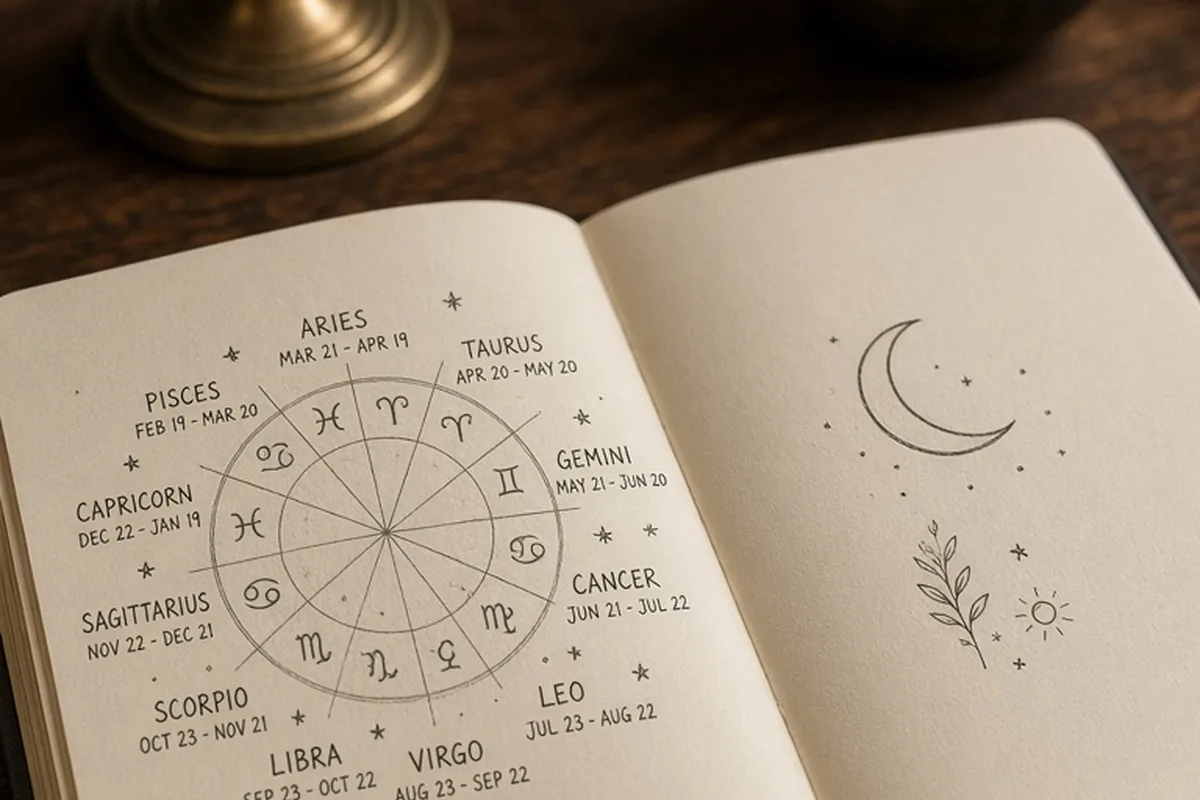
In Western tropical astrology, the twelve zodiac sign dates are determined by the sun's position across the year: Aries (March 21 to April 19), Taurus (April 20 to May 20), Gemini (May 21 to June 20), Cancer (June 21 to July 22), Leo (July 23 to August 22), Virgo (August 23 to September 22), Libra (September 23 to October 22), Scorpio (October 23 to November 21), Sagittarius (November 22 to December 21), Capricorn (December 22 to January 19), Aquarius (January 20 to February 18), and Pisces (February 19 to March 20).
Knowing your sun sign date provides a common entry point into astrological archetypes, offering a playful yet structured lens for self-reflection and relationship communication.
The Complete Calendar of Zodiac Sign Dates
Western astrology uses the tropical zodiac, which aligns the calendar with the equinoxes and solstices rather than visible constellations. Because the astronomical year begins at the vernal equinox in the Northern Hemisphere, Aries marks the start of the astrological cycle. Each sign corresponds to an approximate thirty-day span during which the sun appears to travel through that thirty-degree sector of the celestial longitude.
While these date brackets provide a reliable standard for most birthdays, the exact moment the sun shifts from one sign to the next varies slightly year to year due to leap years and time zone differences. The standard date ranges below serve as the foundational framework used by contemporary astrologers.
- Aries: March 21 – April 19 (Fire, Cardinal)
- Taurus: April 20 – May 20 (Earth, Fixed)
- Gemini: May 21 – June 20 (Air, Mutable)
- Cancer: June 21 – July 22 (Water, Cardinal)
- Leo: July 23 – August 22 (Fire, Fixed)
- Virgo: August 23 – September 22 (Earth, Mutable)
- Libra: September 23 – October 22 (Air, Cardinal)
- Scorpio: October 23 – November 21 (Water, Fixed)
- Sagittarius: November 22 – December 21 (Fire, Mutable)
- Capricorn: December 22 – January 19 (Earth, Cardinal)
- Aquarius: January 20 – February 18 (Air, Fixed)
- Pisces: February 19 – March 20 (Water, Mutable)
The Four Elements and Their Core Motivations
Every zodiac sign belongs to one of four classical elements: Fire, Earth, Air, or Water. Elements describe the underlying temperament, instinctive focus, and emotional drive of a sign. For example, Fire signs (Aries, Leo, Sagittarius) tend to approach life through enthusiasm, action, and creative expression, whereas Earth signs (Taurus, Virgo, Capricorn) focus on pragmatic outcomes, tangible stability, and steady progress.
Similarly, Air signs (Gemini, Libra, Aquarius) prioritize conceptual exchange, social curiosity, and analytical clarity, while Water signs (Cancer, Scorpio, Pisces) navigate the world through emotional nuance, intuition, and relational depth. Understanding an element helps clarify why two people might interpret the same situation differently; an Earth sign might look for practical steps to resolve tension, whereas a Water sign might first need emotional validation before moving forward.
A common pitfall is assuming that people are entirely defined by their sun sign's element. Because every person's birth chart includes planets across multiple signs and elements, element classifications are best viewed as broad thematic tendencies rather than rigid behavioral blueprints.
Understanding Cusp Dates and Planetary Ingress
If your birthday falls within a day or two of a sign transition—such as April 19 or October 22—you were born on what popular culture calls a zodiac cusp. In technical astrology, a planet can only occupy one sign at a time; the sun never occupies two signs simultaneously. The exact transition, known as solar ingress, happens at a precise minute and second on that day.
For instance, an individual born on August 22 might be a Leo if they arrived in the morning or a Virgo if born later in the evening, depending on the year's solar movement. To determine your precise sun sign if you fall on a boundary date, you must calculate an exact natal chart using your birth date, exact time, and geographic location rather than relying solely on a general calendar date range.
People born near boundaries often report identifying with traits from both adjacent signs. In psychological astrology, this is frequently explained by the proximity of Mercury and Venus to the Sun. Because Mercury never travels more than 28 degrees from the Sun, a late-degree Leo frequently has Mercury in Virgo, producing a natural blend of Leo's expressive energy and Virgo's analytical communication style.
The Role of Modalities: Cardinal, Fixed, and Mutable
Beyond elements, each zodiac sign is categorized by its quadruplicity or modality: Cardinal, Fixed, or Mutable. Modalities describe how a sign manages energy, tackles problems, and responds to environmental changes. Each season contains one Cardinal sign to initiate it, one Fixed sign to stabilize it, and one Mutable sign to transition it into the next season.
Cardinal signs (Aries, Cancer, Libra, Capricorn) are the initiators of the zodiac. They excel at launching projects, setting visions into motion, and driving momentum, though they may occasionally struggle with sustained follow-through. Fixed signs (Taurus, Leo, Scorpio, Aquarius) provide endurance, loyalty, and deep concentration, excelling at building lasting systems, but they can experience difficulty adapting when plans change unexpectedly.
Mutable signs (Gemini, Virgo, Sagittarius, Pisces) operate as the adapters and editors. They bring flexibility, resourcefulness, and openness to revision, thriving in dynamic settings while occasionally battling decision fatigue or inconsistency. Recognizing modalities can help collaborators balance project roles, pairing a Cardinal initiator with a Fixed builder and a Mutable troubleshooter.
Applying Zodiac Dates to Everyday Relationships
Astrological dates are frequently consulted to evaluate relational chemistry, but healthy relationship building requires a thoughtful approach. Comparing signs offers a structured way to talk about interpersonal needs, conflict resolution styles, and emotional boundaries, provided both partners treat astrology as an interpretive dialogue rather than a deterministic verdict.
For example, if a Gemini partner processes stress through talking out every perspective while their Scorpio partner needs time for quiet emotional introspection, the framework helps explain why a direct conversation might feel overwhelming to one and essential to the other. Recognizing these contrasting archetypes can prevent couples from taking different communication rhythms personally.
However, relying exclusively on sun signs to judge long-term compatibility creates substantial blind spots. Relationship success depends primarily on mutual respect, shared core values, emotional maturity, and open communication. Astrological concepts should never be used to excuse boundary violations, dismiss incompatibilities, or avoid taking personal responsibility for interpersonal actions.
Beyond the Sun Sign: Exploring the Complete Natal Chart
While your sun sign date reflects your core identity and conscious motivations, it represents only one component of a full astrological profile. A complete natal chart—a map of the sky at the precise minute and location of your birth—includes the Moon, the Ascendant (Rising sign), and several planetary placements across twelve distinct life areas known as houses.
The Moon sign, for instance, reflects instinctive emotional responses and private needs, while the Rising sign shapes external presentation and initial impressions. Two people sharing an identical Capricorn sun sign date can have completely different temperaments if one has an expressive Leo Moon and Sagittarius Rising while the other has a reserved Scorpio Moon and Taurus Rising.
If you want to move beyond date-based summaries, generating a free birth chart with your exact birth certificate data offers a far richer perspective. Approaching your chart as a multifaceted psychological map encourages nuance, allowing you to explore diverse strengths without feeling confined to a single twelve-sign stereotype.
Frequently asked questions
Can zodiac sign dates change from year to year?
Yes, the exact date and time the sun enters a new sign can shift by roughly one day depending on leap years and time zones. While general calendar dates are accurate for the vast majority of birthdays, individuals born on boundary dates should check an exact natal chart calculator.
What is the difference between tropical and sidereal zodiac dates?
Western tropical astrology calculates signs based on the relationship between the Earth and the Sun's equinoxes, keeping Aries aligned with the start of Northern spring. Sidereal astrology, commonly used in Vedic traditions, calculates signs based on the observable astronomical positions of constellations, resulting in dates that sit roughly twenty-four days earlier.
Why do some horoscopes list slightly different date ranges for the same sign?
Different publishers may round transition days differently or rely on different time zones when printing date charts. Because solar ingress happens at a specific universal time rather than midnight in every location, standard printed calendars occasionally show a one-day variance.
Does knowing someone's zodiac date tell you if you are compatible?
Sun sign dates provide interesting archetypal themes, but they cannot predict relationship viability on their own. Complete astrological compatibility involves reviewing full birth charts, while real-world partnership relies on shared ethics, mutual communication, and emotional maturity.
Your next step
To explore your astrological profile accurately, look up your exact time and location of birth to calculate your full natal chart rather than relying solely on calendar dates.