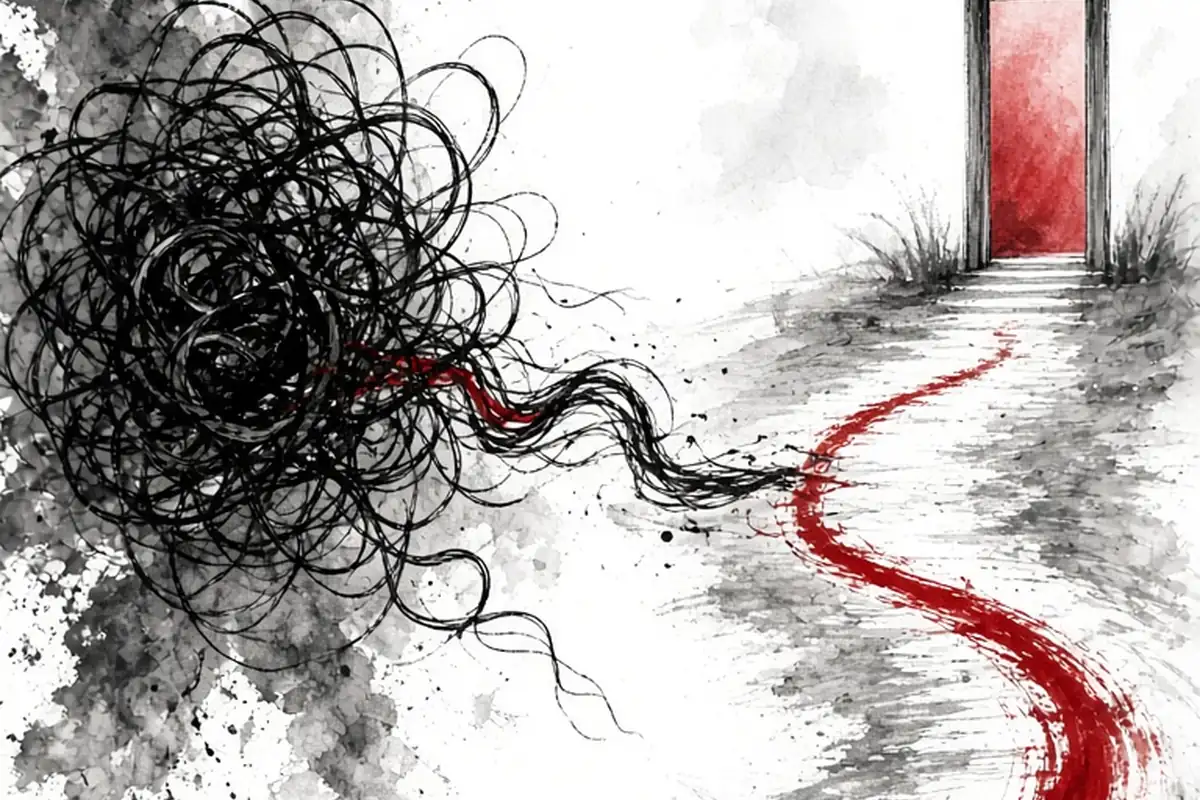
Affair fog is an informal term from infidelity-recovery communities for the distorted, euphoric mindset a cheating partner may show: rewriting the marriage's history, idealizing the affair partner, and blaming the spouse. It is not a clinical diagnosis. The most useful response is to stop arguing with the fog, set clear boundaries, and protect your own stability while you decide what you want.
If your partner has been unfaithful and suddenly seems like a person you do not recognize, you are probably searching for language that explains the strangeness. This article covers what the term means, why it resonates, and what you can realistically do about it.
What affair fog actually means
Affair fog describes a state in which a partner involved in an affair appears to think, feel, and remember differently than they did before. People who use the term describe a cheating spouse who insists the marriage was always bad, who treats the affair partner as flawless, and who seems genuinely unable to see the damage they are causing. The metaphor works because, from the outside, it looks like someone moving through a haze: confident in directions that make no sense to anyone else.
It is worth being precise about what the term is and is not. Affair fog is not a diagnosis, and no clinician will write it in a chart. It is a piece of community vocabulary, built by betrayed partners and some therapists who work with infidelity, to name a recognizable pattern. That pattern is real enough to be useful, but treating it as a medical condition can backfire. If you frame your partner as sick or possessed, you may wait passively for a cure instead of making decisions based on what they are actually doing.
Signs people commonly describe
The behaviors grouped under affair fog tend to cluster around a few themes. Not every cheating partner shows all of them, and some of these behaviors can appear for other reasons, which is why the label should describe a pattern rather than serve as a verdict.
A concrete example: a husband discovers his wife's affair, and within days she is telling him she never really loved him, that the marriage was dead for years, and that he is the reason she strayed. Six months earlier she was planning their anniversary trip. That whiplash, the sudden revision of a shared past, is the signature move people mean when they say fog. The limit worth naming: a partner who has genuinely been unhappy for years may say similar things without any fog at all. The difference is usually the speed, the certainty, and the refusal to engage with any evidence that contradicts the new story.
- Rewriting history: claiming the marriage was always unhappy, even when recent behavior said otherwise
- Idealizing the affair partner while finding fault in everything the spouse does
- Irritability or contempt toward the betrayed partner, as if they are an obstacle
- Compartmentalizing: acting warm at times, then cold and distant without explanation
- Confident talk about a future with the affair partner despite obvious practical problems
- Minimizing the harm: framing the affair as something that just happened rather than a series of choices
Why the fog seems to happen
The most common explanation is a mix of intensity and self-justification. An affair delivers novelty, secrecy, and focused attention, a combination many people describe as a powerful high. Some writers compare it to limerence, the term for an obsessive, infatuated state where the other person occupies most of your mental space. In that state, the affair partner sees only the curated version of each other: no bills, no chores, no morning breath. Real life cannot compete with a highlight reel.
The second engine is cognitive dissonance. Most people who cheat still think of themselves as decent. To keep the affair going without facing that contradiction, the mind builds a story: the marriage was bad, the spouse was neglectful, the affair was inevitable. Once that story is in place, defending it becomes more important than examining it. This is why arguing facts with a partner in the fog rarely works. You are not debating their memory of the marriage; you are threatening the justification their choices currently depend on. None of this excuses the behavior. Understanding the mechanism helps you respond strategically, but the choices remain theirs.
What the fog does to the betrayed partner
Living with someone in the fog is disorienting in a specific way: they deny a reality you both lived. When a partner insists the marriage was always miserable, many betrayed spouses start auditing their own memories, wondering if they missed years of unhappiness. Add the pressure to compete with a fantasy, and people fall into what recovery communities call the pick-me dance: being extra attentive, extra attractive, extra accommodating, hoping to win back someone who is currently measuring them against a mirage.
The cost is real. Chasing a partner in the fog usually produces more contempt, not less, because the fog needs you to be the problem. Every argument you lose about the past, every desperate gesture, can feed the story that you are controlling or pathetic. The more useful frame is this: you cannot argue someone out of a state they are motivated to stay in. Your job is not to fix their perception. It is to decide what you will and will not live with while their perception is unreliable.
How to respond without losing yourself
The practical response starts with boundaries rather than persuasion. A boundary is not a threat or a speech about the fog; it is a statement about your own behavior. For example: I will not stay in this marriage while you are in contact with her, or I am not willing to discuss our future until the affair has ended. Then you act on it. This works better than arguing because it does not require your partner to agree with your version of reality. It only requires you to know yours.
Alongside boundaries, build your own support structure: a therapist who has worked with infidelity, one or two trusted people who can hold confidence, and attention to the practical parts of your life, including finances and, if relevant, the kids' routines. The trade-off to be honest about: stepping back can feel like surrender, and some people around you will read it that way. It is not a tactic to win them back, and it offers no guarantee they will return. It is a way to stop bleeding while you figure out what you actually want, which is the only question you fully control.
How long the fog lasts and what tends to lift it
There is no reliable timeline, and anyone who promises one is guessing. In the stories people share, the fog often thins when the affair ends or collides with reality: the affair partner turns out to have their own problems, the logistics of a new life get ugly, or consequences arrive in the form of separation, lawyers, or children's questions. Sometimes it lifts only after the marriage is already over. Occasionally a partner never fully revises their story, because admitting the truth would cost too much.
What this means practically is that waiting for the fog to lift is not a plan. You can hope for clarity while still making decisions on a deadline that protects you. Some betrayed partners set a private timeframe: if the affair has not ended and genuine change has not started by a certain point, they move toward separation. Others decide the affair itself was the dealbreaker and skip the waiting entirely. Both are legitimate. The mistake is indefinite limbo, where your life pauses while someone else decides whether to wake up.
Protecting yourself while you decide
Whether you hope to reconcile or expect to leave, a few protective steps are worth taking early. Individual counseling gives you a place to sanity-check your own perceptions, which matters after months of being told your reality is wrong. Many people in this situation also choose to get tested for sexually transmitted infections, quietly consult a family-law attorney to understand their position, and make sure they have access to financial accounts and important documents. None of these steps commits you to divorce; they simply mean you are informed rather than vulnerable.
It also helps to define your dealbreakers in writing before the next emotional conversation. What would genuine change look like: the affair verifiably ended, honesty about what happened, willingness to do couples work? And what is non-negotiable regardless of the fog lifting? Writing it down matters because the fog is contagious in a subtle way: the longer you live inside someone else's distorted story, the harder it is to remember your own standards. A page of notes from your clearest moment is a useful anchor on your worst day.
Illustrative Scenarios
The husband who kept arguing with the fog
After discovering his wife's six-month affair, Daniel spent every evening presenting evidence: photos from their vacation, texts where she called him her best friend, the mortgage they had just signed. She dismissed all of it and repeated that she had been unhappy for years. Each debate left him exhausted and her more certain. A counselor suggested he stop litigating the past and state one boundary instead: he would not remain in the home while the affair continued. He moved to his brother's place, and the nightly arguments ended.
Key point: You cannot win a debate against a story someone needs to believe. A clear boundary protects you better than a perfect argument.
Coming out of the fog
Priya spent four months in an emotional affair with a coworker, convinced her marriage had been empty for years. When her husband found the messages and moved out, the affair partner panicked at the idea of a real relationship and pulled away. Alone in the quiet that followed, Priya started noticing the gap between the story she had told herself and the marriage she actually remembered. She ended the contact, began individual therapy, and eventually told her husband the truth without the justifications. They separated anyway, but she later described the fog lifting as the moment she stopped needing him to be the villain.
Key point: The fog often breaks when the fantasy meets reality, but clarity does not guarantee reconciliation; it only makes honest choices possible.
Frequently asked questions
Is affair fog a real medical or psychological condition?
No. It is an informal term from infidelity-recovery communities that describes a recognizable pattern of distorted thinking during an affair. It can be a useful shorthand for what you are seeing, but it should not replace evaluating your partner's actual behavior and choices.
Can a marriage survive affair fog?
Some marriages do recover, typically when the affair fully ends, the unfaithful partner takes honest responsibility, and both people commit to structured repair work. There is no approach that guarantees this outcome, and reconciliation is a choice, not an obligation.
Should I expose the affair to snap my partner out of the fog?
Exposure sometimes collapses the fantasy, but it can also deepen defensiveness or push the affair underground. If you consider telling an employer, family, or the affair partner's spouse, think through your actual goal and the fallout first, ideally with a counselor.
How can I tell if the fog has lifted?
Look for sustained behavior rather than convincing words: the affair verifiably ended, honest answers without blame-shifting, and consistent effort over months. A single remorseful conversation is a start, not proof.
Your next step
Your next step: write down three non-negotiable boundaries and one personal deadline, then share them with a therapist or one trusted person this week so your decisions rest on your clearest thinking, not on the fog's timeline.