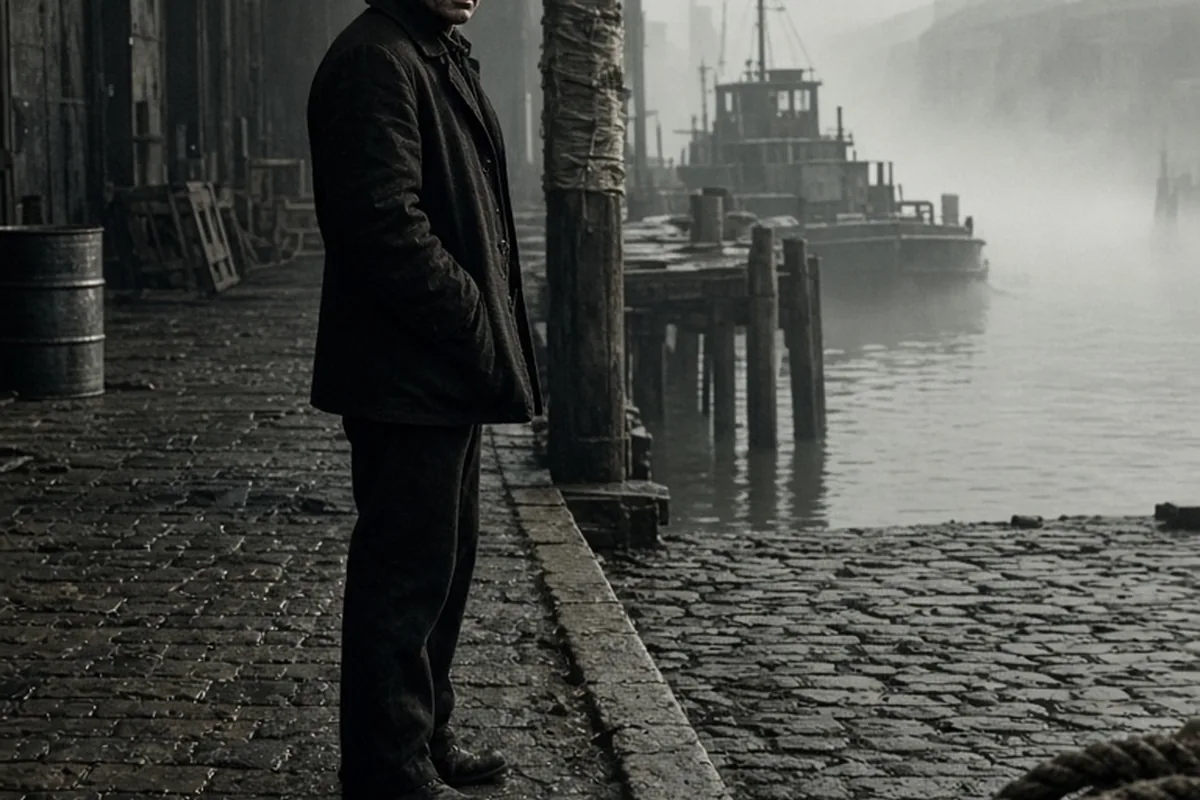
Marlon Brando did not wear visible decorative eyeliner in On the Waterfront, but makeup artists likely applied subtle lash-line pencil to define his eyes for black-and-white film. His striking look resulted from natural dark lashes, prosthetic boxer scar tissue, deep hooded eye anatomy, and Boris Kaufman's naturalistic, high-contrast cinematography, which cast intense shadows across the upper eyelids.
Viewers watching Terry Malloy pace the freezing docks of Hoboken often notice an arresting intensity in Marlon Brando's gaze, leading many to wonder if deliberate cosmetic liner defined his smoldering eyes.
The Screen Reality Behind Terry Malloy's Eye Makeup
In the 1954 classic On the Waterfront, Marlon Brando portrays Terry Malloy, a broken prizefighter working as a longshoreman trapped in mob corruption. Because Terry's world is bleak, cold, and unforgiving, the visual aesthetic of the film rejected the polished glamour typical of mid-century Hollywood productions. If viewers observe what looks like dark eyeliner framing Brando's eyes, they are seeing a combination of subtle character makeup, specialized black-and-white film techniques, and the natural physical features of the actor rather than an overt, stylized cosmetic application.
On-set makeup artists in the 1950s routinely used dark brown or charcoal pencils worked directly into the roots of male actors' eyelashes. This practice, known technically as lash-line darkening or early tightlining, was not intended to appear as makeup to the viewer. Instead, its purpose was corrective: harsh outdoor sunlight or intense tungsten fill lights could easily wash out facial expressions on panchromatic film. By dotting pigment precisely into the lash bed, artists restored the natural rim of the eye so that an actor's emotional nuances remained legible in close-up shots.
Beyond lash support, Brando's eye area in On the Waterfront received specific character makeup to reflect Terry's boxing past. Makeup artist Layne Britton applied discreet scar tissue appliances, slight discoloration, and built-up flesh around the eyebrow and orbital bone to convey the physical toll of repeated ring beatings. This raised texture slightly altered how light struck Brando's upper lids, deepening the shadow directly above his eyelashes and reinforcing the impression of a dense, dark contour around his eyes.
Studio Standards for Men in Black-and-White Cinematography
To understand why Brando's eyes look so distinctly outlined, one must look at standard cosmetic protocols for black-and-white film during the Golden Age. Black-and-white emulsion did not register color; it registered luminance, translating every hue into shades of gray. Because standard human skin tones often photographed flatter or more translucent on film than in life, every professional production utilized foundation bases, usually formulated by Max Factor, to even out skin pigmentation and regulate light reflection.
For male actors, standard makeup almost always included subtle eye shaping. Without pigment at the lid margin, eyes could easily appear small, tired, or lost under bright studio illumination. Artists kept male eye makeup invisible by avoiding sharp wings or liquid lines, opting instead for a soft grease pencil worked between the hairs or a touch of gray-brown greasepaint blended into the socket crease. When photographed on film, these tones registered as natural ocular depth rather than cosmetic embellishment.
The trade-off was that high-contrast lighting could sometimes overemphasize these boundary lines. When an actor possessed naturally prominent eyelashes, as Brando did, the union of dark pigment at the roots and dense natural hair created a pronounced border. To modern audiences accustomed to high-definition color video where makeup is easily distinguished from skin, these classic film adjustments can look surprisingly deliberate, resembling modern gel liner or smudged kohl.
Cinematography and Chiaroscuro on the Hoboken Docks
Cinematographer Boris Kaufman played an enormous role in creating the visual depth around Brando's eyes. Filmed on practical locations in Hoboken, New Jersey, during the dead of winter, On the Waterfront broke away from the controlled, diffused lighting setups standard on Hollywood soundstages. Kaufman utilized natural overcast daylight paired with directional fill lights, creating a moody, documentary-inspired atmosphere characterized by chiaroscuro—stark contrasts between light and dark.
In many of the movie's most memorable scenes, such as Terry's conversations with Edie in the park or his confession in the cab with Charley, overhead or side lighting dominates. Because Brando had deep-set orbital bones and a pronounced brow ridge, overhead light naturally cast deep, downward shadows across his upper eyelids. These anatomical shadows fell directly onto his lash line, doubling the apparent thickness of his eyelashes and creating the visual illusion of a smoky line tracing the lid.
This lighting technique served the emotional tone of the film. Shadowed eyes gave Terry Malloy an introspective, wounded demeanor, visually signaling his internal conflict and suppressed guilt. When an actor looks upward from beneath a shadowed brow, the white of the sclera stands out sharply against both the dark shadow of the brow and the darkened lash root, producing the smoldering gaze that has fascinated filmgoers for decades.
Brando's Natural Features and the Myth of Decorative Liner
A major reason people question whether Brando wore eyeliner in On the Waterfront is his distinct facial anatomy. Marlon Brando possessed heavy, hooded eyelids, strong orbital ridges, and unusually dark, thick eyelashes. Even in unadorned personal photographs, candid home footage, and early theater portraits taken before he entered film, his lash line exhibited a remarkably dense, dark perimeter that framed his hazel-green eyes.
When an actor has naturally full lashes along with hooded lids, the skin of the upper fold rests close to the base of the lashes. This anatomical structure minimizes visible eyelid space, meaning any shadow or natural lash thickness fills the entire visible gap between the eye and the crease. The result is an innate tightlined effect that requires little to no cosmetic intervention to look prominent on camera.
Furthermore, Brando did occasionally wear dramatic, stylized makeup in other screen roles, which may lead viewers to conflate his film appearances. In films like Julius Caesar (1953), where he played Mark Antony, theatrical eye framing was explicitly employed to match classical stage traditions. In contrast, On the Waterfront was committed to method realism; director Elia Kazan and Brando worked diligently to strip away artifice, making decorative vanity makeup entirely incompatible with the creative vision of the production.
Method Acting and the Rejection of Studio Glamour
The creative philosophy driving On the Waterfront was rooted in the Actors Studio and the principles of method acting, championed by director Elia Kazan. This movement valued psychological honesty, raw vulnerability, and gritty authenticity above traditional Hollywood glamour. The longshoremen depicted on screen were real laborers, and the main actors spent weeks observing dockworkers to absorb their posture, dialect, and weathered appearance.
In this creative environment, any noticeable decorative makeup on Terry Malloy would have disrupted the film's social realism. Had Brando walked onto the set with fashionable eyeliner, it would have clashed completely with Kazan's visual narrative of an impoverished, battered ex-boxer surviving in cold tenements. The makeup team had to exercise restraint, applying only what was technically required for optical legibility while intentionally roughing up Brando's appearance with wind-chapped textures and bruised tones.
The paradox of Brando's performance is that his natural charisma and striking features shone through despite the gritty styling. His expressive facial delivery and vulnerable expressions drew viewers' attention directly to his eyes. Because his gaze is the emotional center of pivotal scenes, viewers spend significant time studying his expressions, making them far more likely to notice the subtle technical interplay of film makeup and natural shadow.
Recreating Subtle Classic Lash Definition in Modern Cosmetics
For modern beauty enthusiasts intrigued by the understated, shadowed eye look seen on classic cinema screens, the underlying technique can easily be adapted for everyday wear. The goal of this look is not to create a graphic line, but rather to give the appearance of an inherently lush lash line and deep eye structure without looking made up.
Achieving this effect centers on modern tightlining. Rather than drawing across the top of the eyelid, pigment is pressed directly into the roots of the upper lashes and the upper waterline. Using a waterproof, matte dark-brown or slate-gray pencil prevents the harshness that can sometimes accompany pure black pigment in broad daylight. Pressing a flat brush against the pencil tip and wiggling the color between the lash roots deposits depth exactly where natural shadow would fall.
To balance this technique, consider how modern lighting differs from black-and-white film cinematography. Contemporary high-definition environments highlight dry powder or harsh boundaries, so softer, blendable formulas work best. After applying pigment to the lash bed, taking a clean cotton swab or smudger to soften the edges ensures there are no rigid geometric lines. Pairing this with a soft taupe matte contour in the natural eye crease mimics the chiaroscuro shadows created by classic directional film lights.
- Choose a matte gel or wax pencil in charcoal or deep espresso rather than shiny liquid formulations.
- Apply pigment strictly from beneath the lash line into the base of the hairs to keep the eyelid mobile and bare.
- Gently smudge the product before it sets to eliminate sharp edges and create a diffused root shadow.
- Dust a subtle, neutral matte transition powder into the orbital socket to replicate natural cinematic shading.
Frequently asked questions
Did Marlon Brando wear makeup in On the Waterfront?
Yes, Marlon Brando wore standard film foundation, corrective brow pencil, and prosthetic boxer scar appliances on set. This makeup was designed for character realism and technical readability under black-and-white film stock rather than vanity or glamour.
Why do Brando's eyes look so dark and outlined in black-and-white scenes?
His eyes appeared deeply outlined due to naturally dense dark eyelashes, deep-set eye sockets, and Boris Kaufman's directional lighting. Shadows cast by his heavy brow ridge combined with subtle lash-root pencil to mimic the look of eyeliner.
Did male actors normally wear eye makeup in 1950s films?
Yes, male actors routinely had their lash lines deepened and eyebrows shaped with dark grease pencils during the studio era. Without this subtle definition, bright studio lighting and high-contrast film stocks could wash out an actor's gaze on screen.
Your next step
To capture the subtle depth of classic cinematic eyes, practice tightlining with a soft espresso pencil directly into your upper lash roots rather than drawing across the lid.