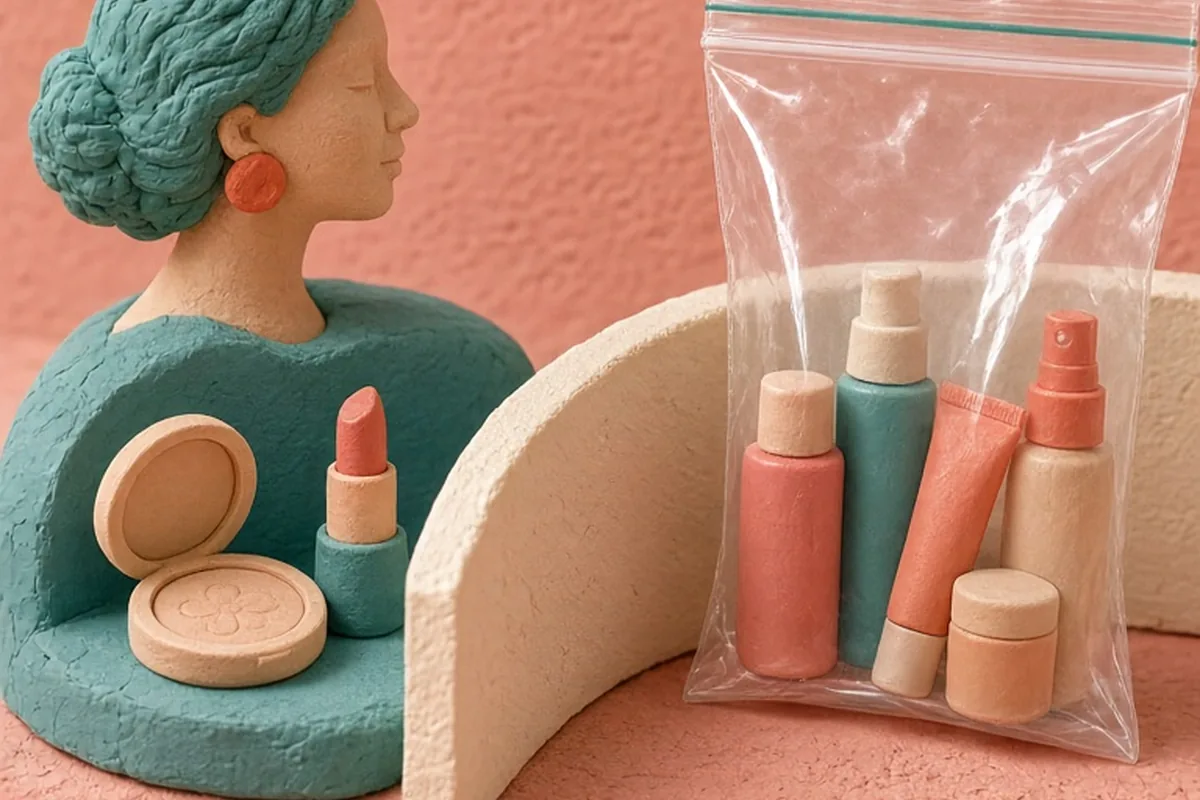
Yes, many types of makeup count as liquids under aviation security rules. Airport security considers any cosmetic that is spreadable, pourable, squeezable, or sprayable—such as liquid foundation, mascara, lip gloss, moisturizer, and setting spray—to be a liquid, aerosol, or gel. These items must follow the standard 3.4-ounce (100 milliliter) limit and fit inside a single quart-sized clear bag in your carry-on luggage.
Navigating airport security with a beauty routine requires understanding how aviation authorities define everyday cosmetics. Packing your favorite products becomes much easier once you know the exact line between solid makeup and regulated liquids.
The Practical Rule: What Makes a Cosmetic a Liquid?
Transportation authorities like the Transportation Security Administration (TSA) and international aviation bodies do not restrict their definition of a liquid to thin, watery fluids. Instead, security checkpoints operate under a broad regulatory category known as liquids, aerosols, and gels (often abbreviated as LAGs). If a cosmetic product can be poured, pumped, squeezed, sprayed, or easily spread across a surface, security personnel classify it within this category. This means items with creamy, pasty, or gelatinous textures fall under the same screening standards as a bottle of water.
A reliable physical test is to consider how the product behaves at room temperature. If the formula does not hold its own independent shape without a container, or if you can smear it with light pressure, security officers will treat it as a liquid. For example, a liquid highlighter and a tube of toothpaste both deform under pressure and can be spread, which places them squarely into the regulated category. Understanding this core distinction helps you anticipate how screeners view your cosmetics before you reach the checkpoint conveyor belt.
Everyday Makeup Products Regulated as Liquids, Aerosols, and Gels
Many daily makeup staples belong to the liquids category, even if they feel like thick creams or pastes during application. Every item in this group must comply with the 3-1-1 rule for carry-on luggage: each container must hold 3.4 ounces (100 milliliters) or less, and all containers must fit comfortably inside a single clear, resealable, one-quart bag.
Carrying these items in containers larger than 3.4 ounces will result in confiscation at the checkpoint, even if the bottle is only half full. Security staff assess the volume stated on the packaging label rather than the amount of product remaining inside. If you carry high-end foundations or setting mists in full-sized bottles, you must either transfer them to compliant travel containers or pack them into checked baggage.
Solid and Powder Cosmetics That Do Not Count as Liquids
Dry and solid cosmetics offer significant freedom when packing carry-on bags because they do not take up valuable space in your single quart-sized liquids pouch. You can pack these items directly into your standard makeup bag or carry-on suitcase without volume restrictions, provided they do not exceed general baggage weight limits.
Powder products, however, have their own minor security considerations on domestic and international flights. In the United States, TSA officers may request separate screening for loose or pressed powder containers larger than 12 ounces (about 350 milliliters). While standard eyeshadow palettes and compact powders rarely approach this threshold, oversized tubs of translucent setting powder or body shimmer might require extra inspection. Keeping powders accessible in your personal item makes this process faster if an officer asks to examine the compact.
The Gray Area: Cushion Compacts, Stick Formulas, and Cream Pots
Certain modern cosmetic formulas blur the boundary between solids and liquids, frequently leading to confusion at security checkpoints. Stick foundations, solid stick blushes, and twist-up solid primers generally pass as solids because they maintain a rigid, freestanding structure. However, if a stick formula is exceptionally soft or melts quickly at room temperature, an individual screening officer may occasionally dispute its status. When in doubt, placing questionable soft sticks in your clear quart bag prevents delays.
Cushion compacts and pot concealers represent another common gray zone. Cushion compacts contain a porous sponge saturated with liquid foundation or serum; security scanners detect the liquid suspension, meaning cushion compacts must technically follow the 3.4-ounce rule. Dense cream concealers and potted cream eyeshadows are also frequently flagged as pastes. If a cosmetic feels buttery, waxy, or damp to the touch, treat it as a liquid for carry-on planning purposes to avoid losing your product during screening.
Step-by-Step Carry-On Packing Strategy for Beauty Products
Maximizing the limited space inside a one-quart clear bag requires a deliberate packing strategy. Start by auditing your routine to separate non-negotiable liquid formulas from items you can easily swap for dry alternatives. Replacing liquid foundation with a pressed powder compact or switching liquid setting spray for an oil-control blotting powder immediately frees up room for skincare, liquid concealer, and mascara.
Next, downsize your essential liquids into specialized travel containers. A standard 1-ounce (30 milliliter) foundation bottle easily fits the regulations, but smaller contact lens cases or 5-milliliter airless pump bottles save substantial space for weekend trips. Always check that the manufacturer's printed capacity on any commercial travel-size product clearly displays 3.4 oz (100 ml) or less. Clear, legible labeling prevents security agents from questioning container volume during visual checks.
International Security Differences and Next-Generation Scanners
While the 3.4-ounce (100 milliliter) threshold is an international standard across most global aviation hubs, enforcement practices vary widely between countries and airports. In many European and Asian airports, security staff enforce the clear plastic bag rule with strict precision, rejecting personal cosmetic pouches that are not completely transparent or that exceed exact one-liter dimensions. Some hubs provide standardized plastic bags at the security line and require you to transfer all liquid items into them on the spot.
Conversely, airports equipped with advanced computed tomography (CT) 3D security scanners are gradually relaxing some liquid handling procedures. At terminals using these new machines, passengers are often permitted to leave liquids and electronics inside their carry-on bags during the scan. However, until these machines are universally deployed worldwide, you must continue packing your liquids in compliant containers to avoid issues during layovers or return flights from airports that still operate older X-ray equipment.
Preventing Leaks and Formula Separation in the Air
Airplane cabin pressure changes during ascent and descent cause air pockets inside cosmetic containers to expand and contract. This pressure differential frequently forces liquid foundations, lip glosses, and creams out through pump mechanisms and threaded bottle caps, creating messy spills inside your luggage. Tubed cosmetics and squeeze bottles with air trapped inside are particularly vulnerable to sudden leaks at cruising altitude.
To protect your cosmetics, expel as much excess air as possible from flexible squeeze tubes before screwing the cap on tightly. For pump bottles and screw-top jars, unscrew the lid, place a small square of plastic wrap over the bottle opening, and tightly screw the cap back on over the plastic barrier. Grouping your liquid cosmetics inside a leakproof silicone pouch or double-seal zip bag adds an extra layer of defense that keeps powder palettes and clean clothes safe from accidental spills.
Frequently asked questions
Does mascara count as a liquid when flying?
Yes, airport security classifies mascara as a liquid or gel formula due to its semi-fluid consistency. It must be included inside your clear, quart-sized liquids bag, though standard tubes are well below the 3.4-ounce limit.
Are traditional bullet lipsticks considered liquids by TSA?
No, standard solid bullet lipsticks and hard stick lip balms are classified as solid cosmetics and do not count toward your liquid allowance. In contrast, liquid lipsticks, lip glosses, and squeeze-tube balms are regulated as liquids.
What happens if my makeup container is larger than 3.4 ounces but almost empty?
Security personnel evaluate container capacity based on the printed volume on the label rather than the remaining product. If the container holds more than 3.4 ounces (100 milliliters), it will be confiscated at the checkpoint regardless of how little liquid remains.
Can I bring makeup brushes and cosmetic sponges in my carry-on?
Yes, dry makeup tools such as brushes, beauty sponges, powder puffs, and lash curlers are completely unrestricted and do not count as liquids. You can pack them freely in any makeup case or carry-on compartment.
Your next step
Sort your travel makeup into solid powders and liquid formulas before you pack, placing all spreadable products under 3.4 ounces into a clear quart-sized bag.