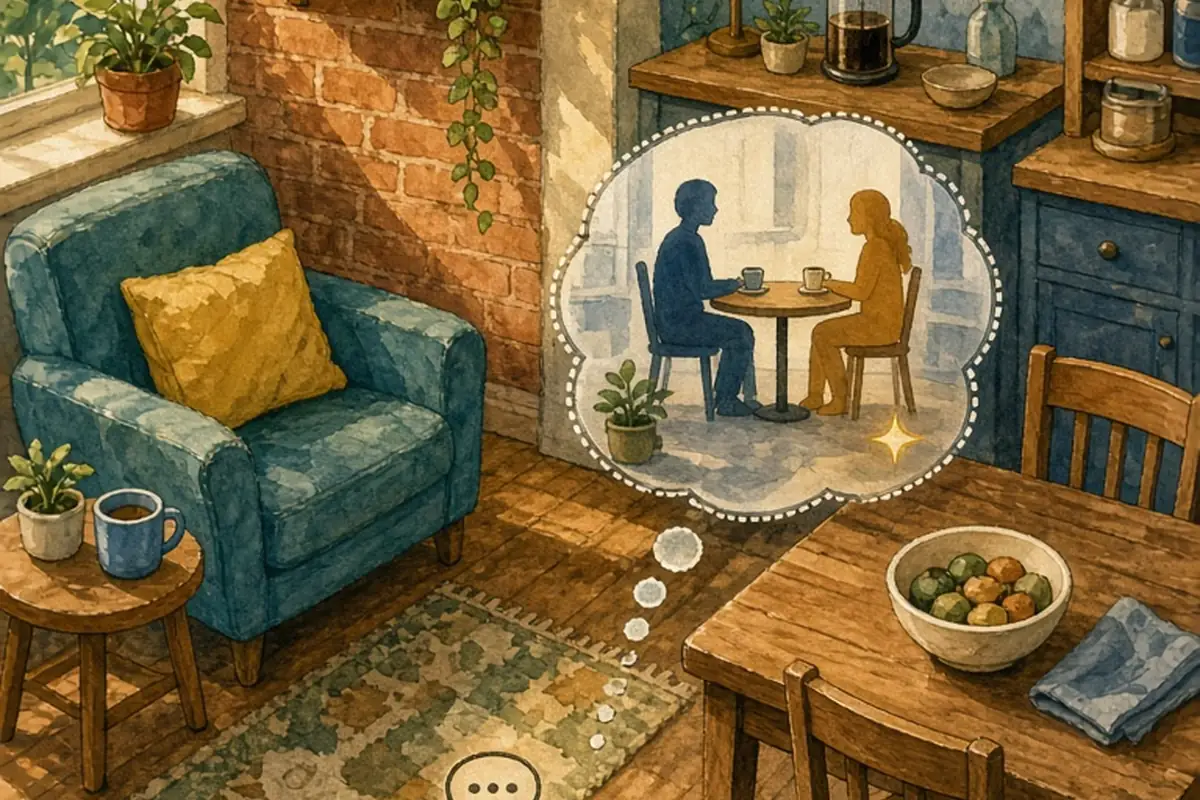
A first date with someone you met online works best when you keep it short, public, and low-pressure. Pick a casual spot, plan for 60 to 90 minutes, confirm the day before, and treat it as a vibe check rather than an audition. If the conversation flows, suggest a second date; if not, leave kindly.
Meeting someone from an app for the first time sits in a strange spot: you know their dog's name and their hot take on pineapple pizza, but you've never shared air. Here's how to make those first ninety minutes actually count.
Treat the first date as a vibe check, not a verdict
When you meet someone from an app, you've only seen the version they chose to show: the best photos, the edited bio, the messages they had time to compose. The first date isn't about deciding whether this is your person. It's about answering one smaller question: do I want a second date with this human? That framing lowers the stakes for both of you, which makes connection more likely, because nobody is performing for a marriage interview.
The cost of skipping this mindset is real. If you spent three weeks texting every night, you may arrive already attached to a person who doesn't exist yet, and ordinary awkwardness will feel like betrayal instead of information. Keep pre-date messaging warm but bounded, and expect the first twenty minutes to run a little stiff. Two people recalibrating from screens to faces need a few minutes to find their rhythm, and that's normal rather than a bad sign.
Choose a spot that makes talking easy and leaving easier
The best first-date venues share three traits: public, conversational volume, and a natural end point. Coffee shops, a casual bar early in the evening, a busy park with a walk and a snack stop, or trivia night at a low-key brewery all give you something to do with your hands and eyes while you talk. A concrete example: a 6 p.m. drink at a neighborhood bar beats an 8 p.m. dinner reservation, because a drink can end gracefully at one round or stretch to three if things click.
The trade-off to avoid is the impressive first date: a fancy dinner, a movie, a concert, or anything that locks you into two-plus hours of either silence or small talk across an expensive table. Movies are the classic trap, since you spend the whole date learning nothing about each other. Save the bigger plans for date two or three, when you already know the conversation can carry them.
Prepare lightly and keep expectations neutral
A little prep goes a long way. Skim their profile the day of so you remember the details they chose to share, like the dog's name, the hobby, or the trip they mentioned, because recalling specifics signals genuine attention better than any line. Confirm the plan the day before with a short message along the lines of "Still good for six at the place on Fifth?" so nobody wonders whether it's happening, and pick an outfit one notch sharper than the venue requires.
Where people overdo it is research and rehearsal. Deep-diving their social media can hand you facts you were never meant to have yet, and letting one slip about their sister's wedding from years ago reads as surveillance, not interest. Rehearsed openers have the same problem: they sound like lines. Aim for informed but curious. You know the outline, and you're letting them fill it in.
Keep the conversation a two-way exchange
Good first-date conversation is less about clever questions and more about ratio: roughly equal airtime, with follow-ups that show you heard the answer. Open with something easy and specific from their profile or the setting, then trade stories rather than firing interview questions. "You mentioned you grew up near the coast, do you still get out there?" invites a story. "Where do you see yourself in five years?" invites a resume.
A few topics reliably weigh down a first hour: exes, money, grievances about dating apps themselves, and anything you'd normally save for a close friend. The limit cuts the other way too, so don't sand yourself down into someone agreeable and blank. If you hate camping and they love it, say so with a smile, because small honest differences give the conversation friction and give them a real person to react to. And if a silence lands, let it breathe for a beat; scrambling to fill every gap reads as nerves, while a comfortable pause reads as ease.
Handle safety like a standard, not a suspicion
Meeting a stranger from the internet carries a small but real risk, and the standard precautions are boring precisely because they work. These aren't accusations, and a decent date won't flinch at any of them. Plenty of people share their location with a friend as pure routine.
This applies to everyone, whatever your gender. Men sometimes skip precautions because the stereotype says they shouldn't need them, but the same logic holds: you don't know this person yet. The cost is minimal, a text to a friend takes thirty seconds, and the payoff is that you can relax into the date instead of managing low-grade vigilance. If anything feels off, you're allowed to leave without a debate. "I'm going to head out, thanks for meeting me" is a complete sentence.
- Meet in a public, populated place you can leave easily
- Arrange your own transportation both ways
- Tell a friend the plan and set a check-in time
- Keep your drink and belongings in sight
- Share your live location with someone you trust
Read the signals without over-reading them
Interest on a first date usually shows up as engagement: they ask questions back, they lean in, they extend the date instead of checking the time, and they reference future plans even casually, like "you'd love this place." Disinterest is quieter, with short answers, phone glances, and a wrapped-up feeling at the forty-minute mark. Neither is a verdict on your worth. It's data about fit between two specific people on one specific evening.
The trap is decoding every micro-signal. A person who seems reserved might be shy rather than bored, and someone charming might just be charming with everyone. The more reliable read is what happens after: do they respond to your follow-up with energy and a yes? One more thing worth saying plainly: warmth and body language are not consent for anything physical. If you want a kiss and the moment feels mutual, a simple "Can I kiss you?" is confident rather than awkward, and if they decline or hesitate, taking it gracefully is the attractive move.
Follow up like an adult, whichever way it went
If you want a second date, say so within a day, and the same evening is fine. Skip the calculated waiting games, because a specific message beats a vague one. "I had a great time, want to check out that taco place you mentioned this weekend?" gives them something easy to say yes to. If they say yes, make an actual plan rather than drifting into another week of texting.
If you're not interested, a short kind message beats fading out: "Thanks for meeting up, I didn't feel the connection I'm looking for, but I wish you the best." It costs you ninety seconds and saves them a week of wondering. The exception matters though: if someone made you feel unsafe or was hostile, you owe them nothing. No reply, no explanation, block freely.
When the date goes sideways
Some first dates are just flat: no chemistry, mismatched energy, or a person noticeably different from their photos. You don't have to perform enthusiasm for two hours. Finish your drink, stay polite, and wrap at a natural point with something like "It was nice meeting you, I've got an early morning so I'm going to head out." You're not obligated to explain a lack of spark on the spot.
If they look different enough from their photos that you feel misled, that's legitimate information, and leaving early is fair. The same goes if they drink too much, are rude to the staff, or push past a boundary you've stated. The limit here is proportionality: nervous awkwardness deserves patience, while dishonesty or pressure deserves an exit. Learn to trust the difference.
Illustrative Scenarios
The photos didn't quite match
Dev, 29, arrived at a coffee shop and barely recognized his date; her photos were clearly several years old. His first instinct was irritation and a plan to bail in ten minutes. Instead he stayed for one drink, treated it as a normal conversation, and noticed he was still bothered, not by her looks but because the photos felt like a small lie. He wrapped politely, sent a brief honest text the next day, and moved on.
Key point: A mismatch between photos and reality is fair grounds to pass, but you can leave with courtesy instead of making a scene.
The three-day silence after a great date
Alina, 31, had a first date that ended with easy laughter and a hug, then heard nothing for three days. Her first read was that she'd imagined the chemistry, and she drafted and deleted five texts. Instead she sent one direct message: "I had fun Saturday. Want to do it again?" He replied within the hour; he'd been traveling for work and assumed he'd already signaled interest. They dated for several months.
Key point: One clear follow-up beats decoding silence, and whatever the answer turns out to be, you're better off knowing.
Frequently asked questions
How long should a first online date last?
Plan for 60 to 90 minutes, which is long enough to get past the initial nerves and short enough that a good date ends wanting more. If it's going well you can always extend it, but building in a natural end point keeps the pressure off both of you.
Who should pay on a first date from an app?
The simplest norm is that whoever invited can offer to cover it, and splitting is always acceptable. What matters more than the rule is handling it without games: offer or split cleanly, and don't treat paying as buying anything, including a second date.
Is it okay to kiss on a first online date?
If the mutual interest is clearly there, yes, but nothing is owed either way. If you're unsure, asking "Can I kiss you?" is direct and confident, and a no or a hesitation deserves a gracious response rather than persuasion.
What if they look nothing like their photos?
Mild differences are normal, since everyone picks flattering photos. If the gap is big enough that you feel misled, that's fair grounds to end the date early and politely; you can be courteous without staying, and you don't owe a detailed explanation.
Your next step
Your next step: the day before the date, send a short confirmation text and lock in a public spot with an easy exit. That one message and one venue choice do more for a good first date than any clever opener.