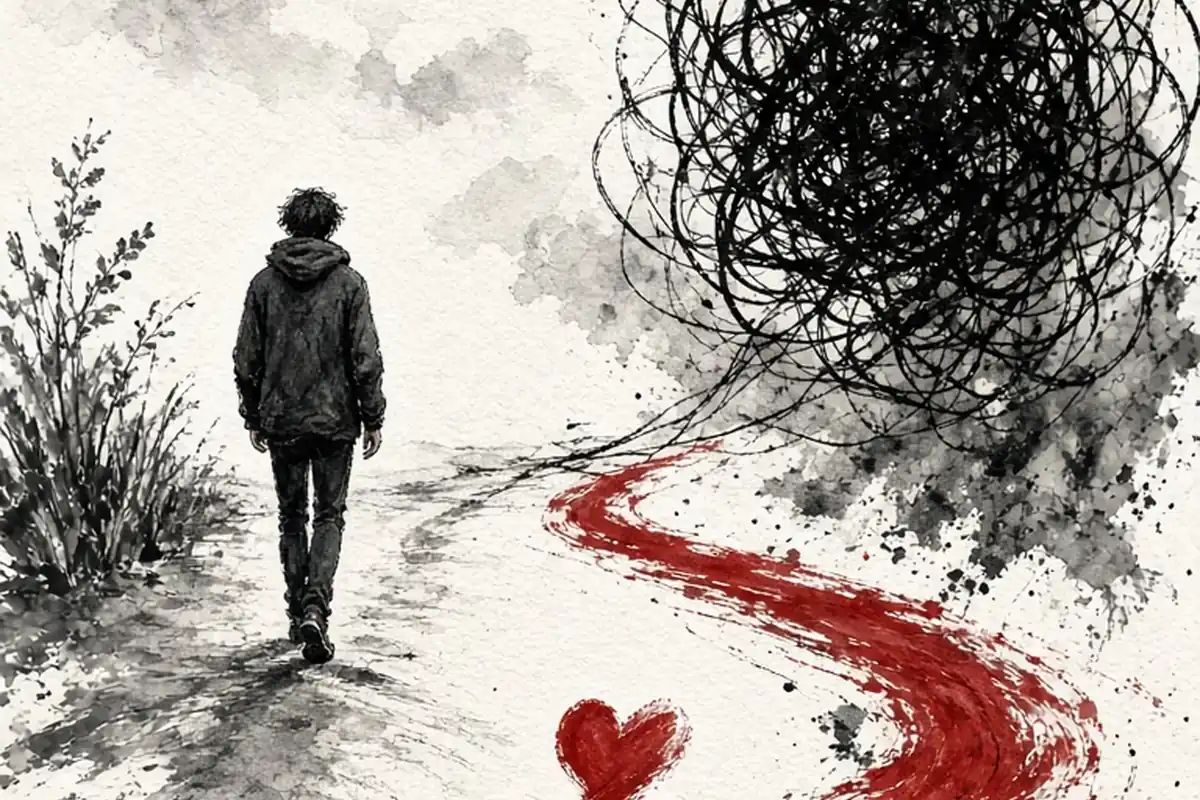
First love is your first deep romantic attachment, the first person who makes you feel chosen, seen, and wanted in a new way. It feels overwhelming because every emotion is brand new. Some first loves become lifelong partnerships; most become formative memories. Either outcome is normal, and neither one decides your worth or your future.
Whether you are in the middle of it right now or still thinking about someone from years ago, this guide covers what first love is, why it hits so hard, and how to handle it without losing yourself.
What First Love Actually Means
First love is not the same as a first crush or a first date. A crush is mostly projection, and a first date is just an event. First love is the first time another person becomes emotionally central to your life: you plan your week around them, their mood changes yours, and you start picturing a future that includes them. It can happen at fifteen or thirty-five. The word first describes the experience, not your age, so there is no deadline you missed if it has not happened yet.
The label matters less than the behavior inside the relationship. Calling something first love does not obligate you to keep it forever, and hesitating to say the word does not make the feelings less real. If one person says I love you at three months and the other is not ready, that is a timing difference, not a verdict. The more useful question is not is this my first love but is this relationship good for both of us right now. That question stays useful long after the first one stops mattering.
Why First Love Feels So Intense
First love feels enormous partly because you have no reference point. Every milestone is uncharted: the first hand you hold that means something, the first I love you, the first real fight, the first making up. At the same time, most people meet their first love while still figuring out who they are, so the relationship and your identity get braided together. That is why people can recall a first love in sharp detail decades later, even when later relationships were longer or happier.
Here is the trade-off worth knowing early: intensity is not the same thing as compatibility. Anxiety can masquerade as passion, and constant texting can masquerade as intimacy. A person who makes you feel calm and respected may register as less exciting than one who keeps you guessing, when the opposite is usually healthier. Enjoy the intensity for what it is, but do not use it as the measuring stick for every relationship that comes after. Fireworks are a feeling, not a forecast.
Can First Love Last? An Honest Look
Sometimes it does. People do build whole lives with a first love, and it tends to work when a few things line up: both partners keep growing in compatible directions, they learn to fight and repair instead of just fight, and they keep choosing each other on purpose rather than by default. Timing helps too. Two people who meet when they are actually able to build a life together have a real advantage over two people who meet years before either is ready.
Often it does not last, and that is not a failure. People change enormously between their teens and their late twenties, and a relationship that fit at seventeen may genuinely not fit at twenty-five. Ending it does not prove the love was fake. The mistake runs in both directions: staying only because they were my first can trap you in something you have outgrown, while leaving only because first loves never last can throw away something good. Judge the relationship on its current health, not on its label or its order in your history.
How to Handle First Love While You Are In It
The biggest risk in a first love is merging so completely that you disappear. It feels romantic for a month and suffocating by month six, for both of you. Keep a standing plan with friends, keep the sport or job or class that was yours before them, and let the relationship be an addition to your life rather than a replacement for it. A partner who is threatened by you having a life is telling you something important.
The second skill is direct communication. First loves are full of guessing games: waiting to text back, hinting instead of asking, testing whether they get jealous. Skip all of it. Say the awkward thing plainly and ask for the same. And learn to spot control dressed up as love, like checking your phone, isolating you from friends, or guilt-tripping you for normal independence. A few habits worth building now, because they carry into every relationship after this one:
A relationship that only works when you shrink is not love; it is a cage with good lighting.
- Keep at least one friendship and one interest that belong to you alone
- Say the awkward thing directly instead of hinting or testing
- Treat jealousy as a feeling to discuss, not a license to control
- Let the relationship earn milestones instead of racing to them
When First Love Ends: Letting It Hurt and Letting It Go
A first breakup hurts out of proportion to its length because you have no proof yet that you can survive it. You are not just losing a person; you are losing the future you had privately built around them. Let it be a real grief. Cry, be angry, be boring about it to your friends. Performing that you are fine only stretches the process out.
A few things genuinely help. Reduce contact and stop checking their social media, because every look reopens the wound. Do not rush into a rebound to prove you are over it. Stay close to the people who knew you before the relationship. Expect the timeline to be months, not days, and expect it to be uneven: a good week followed by a bad day does not mean you are back at zero. If the sadness turns into persistent hopelessness or you cannot function for a long stretch, talking to a counselor is a reasonable step, not an overreaction.
Carrying a First Love Into New Relationships
The most common way a first love follows you is the comparison trap. Memory is a ruthless editor: it cuts the boredom and the fights and keeps the highlight reel. Measuring a real, imperfect new partner against a polished memory from years ago is unfair to everyone, including you. If every new person gets graded on whether it feels like it did back then, nobody will pass, not because they are worse but because first-time novelty cannot be repeated.
The better move is to keep the lessons and drop the idealization. Keep what the relationship taught you about what you need, how you handle conflict, and what you will not accept again. Drop the fantasy version of the person. If you are still genuinely attached, checking their profile or daydreaming about a reunion, be honest with yourself about whether you are ready to date at all. And if your partner is the one haunted by a first love, you can ask for presence and honesty without demanding they erase their past. Everyone arrives with a history; what matters is whether they are actually here now.
Illustrative Scenarios
The Three-Hour Reply
Marcus, nineteen, was three months into his first serious relationship when his girlfriend went quiet one Saturday afternoon. After three hours he had sent five texts, ending with a string of question marks. She finally replied that she had been at her sister's recital, and that the pile of messages made her feel crowded. His first instinct was to apologize and then do it again next weekend. Instead, he asked how she liked to handle texting on busy days. They agreed on a simple heads-up when either of them would be offline for a while.
Key point: Anxiety in a first love feels like a signal to chase. Most of the time it is actually a signal to ask a direct question.
The Highlight Reel
Dana, twenty-nine, was three dates into something promising with a man who was kind, funny, and consistent, and she kept thinking it just does not feel like it did with my first love. Talking it through with a friend, she realized she was comparing a real Tuesday-night dinner to a memory of being twenty that had been edited down to its best moments. She decided to judge the new relationship on how she actually felt around him, calm and respected, rather than on whether it reproduced old fireworks. Six months in, the calm had become the thing she valued most.
Key point: A first love sets your first template, not your permanent standard. Judge new partners on how they treat you, not on reruns.
Frequently asked questions
Is first love the deepest love you will ever have?
Not necessarily. It is usually the most vivid because it was first, not because it was the best fit. Many people describe later loves as deeper precisely because they knew themselves better and chose more deliberately.
Can you end up with your first love?
Yes, some people do, and it can work well when both partners keep growing and keep choosing each other on purpose. It is not more or less likely to succeed because it was first; the health of the relationship matters more than its order.
How long does it take to get over a first love?
There is no fixed timeline, but weeks to months is common, and longer for long relationships. It tends to fade faster when you limit contact, stay connected to friends, and let yourself grieve instead of performing that you are fine.
Is it normal to still think about a first love years later?
Yes. Occasional memories are normal and do not mean your current relationship is wrong. It is only worth a closer look if you are constantly comparing, checking their profiles, or emotionally somewhere else.
Your next step
Pick one concrete move this week. If you are in a first love, protect one piece of your own life, a friend, a goal, a routine, and keep it non-negotiable. If you are carrying an old one, write down three things it taught you about what you need, and use that list, not the memory, as your standard.