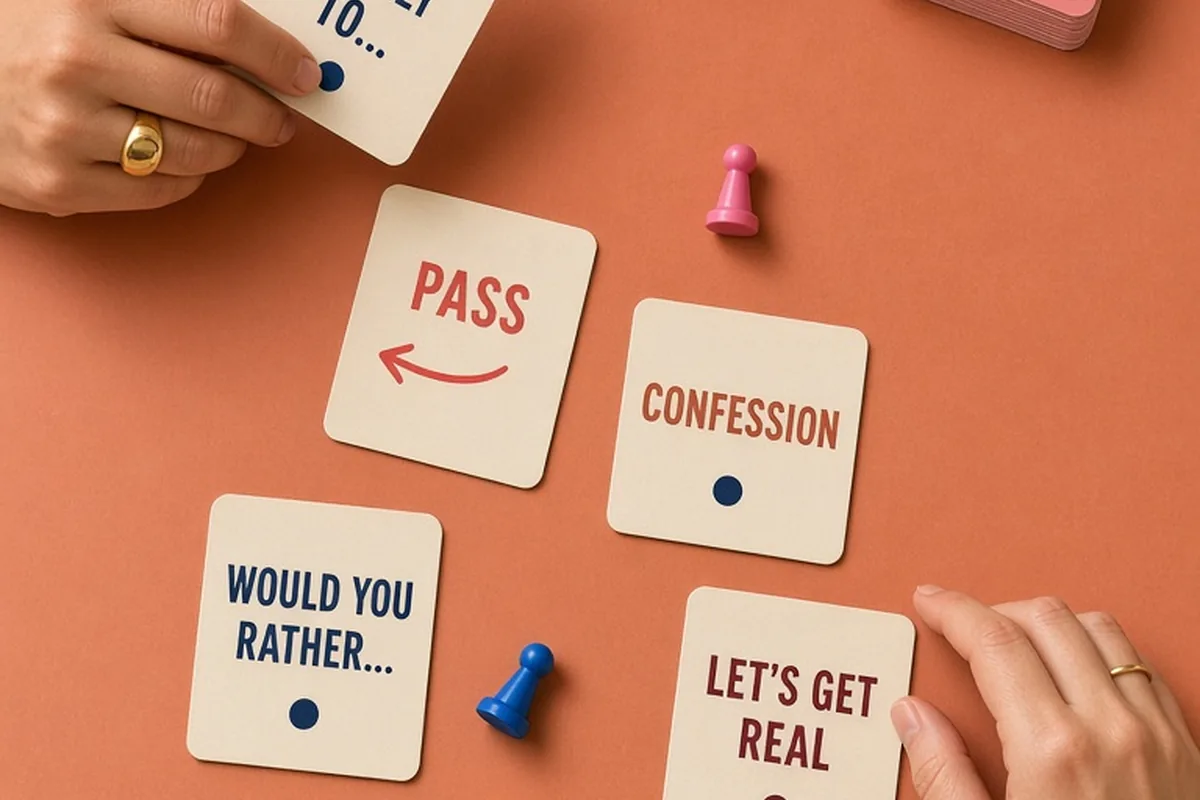
The best games for a house party are low-pressure icebreakers like Two Truths and a Lie, playful group games like Most Likely To, and flirty classics like Truth or Dare run with a clear pass rule. Pick one game to warm up the room and one for later, keep participation optional, and let the games open the door to real conversation rather than replace it.
A house party is one of the last places adults can flirt the old-fashioned way, across a kitchen island instead of a screen. The right game gives everyone a reason to talk; the wrong one makes people check their phones. Here is how to choose well.
Why the Right Party Game Does More Than Fill Time
A good party game solves the two problems that kill most house parties: strangers standing in separate clusters, and interesting people who never get a reason to talk to each other. A game gives the room a shared focus, which means the shy guest gets cover, the confident guest gets an audience, and two people who might flirt get a low-stakes excuse to interact. That structure is the real value. Nobody remembers who won; they remember the moment someone gave a surprising answer and the whole room reacted.
The limit worth knowing is that a game is a tool, not a script. If the room is already buzzing, forcing everyone into a circle can flatten the energy you wanted to build. Read the night first. Games work best when conversation is stalling, when two friend groups are not mixing, or when you want to raise the temperature from polite to playful. If people are already deep in good conversations, let them be.
Easy Icebreaker Games to Open the Night
Start with games that ask for almost nothing. Two Truths and a Lie works because everyone can play from their seat with a drink in hand, and the guessing naturally produces teasing and follow-up questions. Most Likely To does the same job faster: someone reads a prompt like most likely to text an ex at midnight, everyone points, and the accused has to defend themselves. That mock-defense is where personalities show up. Never Have I Ever can work here too if you keep the prompts light early and let the room decide how bold it wants to get.
Run one icebreaker for fifteen to twenty minutes, then stop while it is still fun. The common mistake is riding a game until it dies. Icebreakers are kindling, not the fire. Their job is to get names learned, a few laughs logged, and a couple of people marked as interesting. Once that happens, the party can carry itself for a while, and you can save the bolder games for later when the room has warmed up and people have self-sorted into smaller groups.
Flirty Games That Build Tension Without Pressure
Once the room is comfortable, games with a little charge work well. Truth or Dare is the classic for a reason, but it only stays fun with ground rules: anyone can pass or swap a dare, no dares that require touching someone who has not agreed, and nothing that leaves the room. Would You Rather with playful prompts, like kiss a stranger or never kiss anyone again, gets people revealing preferences in a way that feels like a game rather than an interview. Paranoia, where a question is whispered and a coin flip decides whether it gets read aloud, creates suspense without forcing anyone to perform.
The trade-off is real: flirty games only work when the room already feels safe. If guests are still stiff or someone looks uncomfortable, a charged game will read as pressure instead of play. The fix is sequencing. Earn the flirty round with an easy round first, and keep every prompt something people can laugh off. The goal is tension that feels like a wink, not a spotlight. When a game gives someone a graceful exit, the people who stay in are genuinely enjoying themselves, and that is what makes the flirting feel mutual.
Group Games That Keep the Energy High
Between the icebreaker and the late-night flirting, you want a game that keeps the whole room loud. Charades with adult prompts, an adult fill-in-the-blank card game, or a phone-based guessing game where teams shout answers all do the job. Bluffing games are especially good at parties because they reward personality over skill; watching someone lie badly about a made-up word tells you more about them than twenty minutes of small talk. Team formats also mix the room, putting people next to guests they would never have approached on their own.
The limit here is that big group games can sideline quieter guests. If someone is content watching from the couch with a drink, let them. Spectators often join the next round once they see the tone is friendly, and even those who never play are still part of the room. What you want to avoid is a host who treats non-players as a problem to fix. Energy comes from people choosing to join, not from being drafted.
Setting Ground Rules So Nobody Feels Trapped
The single most effective rule is the pass rule, announced out loud before the first round: anyone can skip any question or dare, no explanation needed, no penalty. It takes ten seconds to say and it changes the whole feel of the game, because every answer after that is clearly a choice. Add two more basics: no dares involving physical contact unless the other person agrees first, and drinking is always optional. Someone can sip water, answer instead of drink, or sit out entirely.
This is not about being cautious for its own sake. Pressure is the fastest way to kill attraction at a party. When a guest realizes they can leave any round without embarrassment, they relax, and relaxed people flirt better. The opposite is also true: if someone gets pushed into a dare they did not want, the room remembers, and the person who did the pushing looks worse than the person who declined. Protecting people's exits is not being a killjoy. It reads as confidence, and it keeps the night fun for everyone including you.
Reading the Room: When to Start, Switch, or Stop
Timing beats game selection almost every time. A game is working when people lean in, laugh without being prompted, and pull others into the circle. It is dying when answers get shorter, phones come out between turns, or one loud person is carrying the whole thing while everyone else waits. The skill is ending a game on a high note rather than squeezing out one more round. Say something like last round, make it count, and let the energy spill back into open conversation.
Starting matters just as much. Do not launch a game the moment guests arrive, when people are still getting drinks and finding their footing. Wait until the room has a baseline hum but the conversations are starting to repeat themselves, usually forty-five minutes to an hour in. And if you propose a game and the response is lukewarm, take the no gracefully. A host who can drop an idea without sulking keeps far more goodwill than one who talks the room into a game nobody wanted.
Turning a Game Moment Into a Real Connection
The best use of a party game is as an opener, not the whole evening. When someone gives a funny truth answer or a surprising confession, that is your material for later. After the game breaks up, find them and follow up on it: okay, I need the full story behind that answer. It works because it is specific, it shows you were paying attention, and it gives them something easy to talk about. That is a far better entry than a generic compliment, and it feels natural because the game already introduced you.
Keep one limit in mind: flirting inside a game is not a promise of interest outside it. Someone playing along with a cheeky prompt is playing a game, not making a commitment. If you move toward a real conversation and they engage, great. If they drift back to their friends or give short answers, let it go without pushing. The people worth connecting with at a party are the ones who choose to keep talking when the game is over, and you find them by offering an easy opening, not by treating a game moment as a green light.
Mistakes That Kill the Mood Fast
The biggest mistake is confusing the game with the point. Hosts who run three hours of structured activities leave no room for the loose, wandering conversations where attraction actually builds. Plan two or three games maximum and treat them as seasoning. The second mistake is letting alcohol do all the work. Drinking games can be fun, but when the only mechanic is drink when X happens, the night gets sloppy fast and the flirty possibilities disappear with everyone's judgment.
Two quieter mistakes deserve mention. First, games that split the room into couples leave single guests watching other people flirt, which is the opposite of what a party should do; pick formats where anyone can play. Second, letting one dominant personality run every round. If the same person keeps grabbing the spotlight, redirect gently by asking the quietest person to read the next prompt. A good host manages the room so that everyone who wants a moment gets one, because the guest who feels seen is the guest who stays, talks, and maybe becomes the reason someone else had a great night.
Illustrative Scenarios
The Dare That Almost Went Wrong
At a friend's birthday house party, Marcus joined a Truth or Dare circle that was going well until someone dared a guest to kiss the person across from her. She laughed, but it was the tight kind, and the room went quiet waiting. Instead of letting it hang, Marcus said, house rule, anyone can swap a dare, and offered her a replacement: trade seats with whoever you want. She took it, the game kept moving, and later she told him the save was the moment she decided he was worth talking to.
Key point: Protecting someone's exit mid-game reads as confidence and awareness, not as ruining the fun, and it often makes a better impression than the boldest dare.
The Icebreaker Nobody Joined
Dana hosted a housewarming and was so eager to get things going that she pulled out a card game twenty minutes after the first guests arrived. Half the room was still pouring drinks and saying hellos, so her invitation landed in awkward silence. Rather than pushing, she shelved the game, put music on, and let the party breathe. An hour later, when conversations started looping, she suggested a quick round of Most Likely To, and this time the whole room piled in.
Key point: The same game can flop or fly depending on timing; if a proposal lands flat, drop it gracefully and try again when the room is warm.
Frequently asked questions
Do house party games have to involve drinking?
No. Every game in this article works with any drink in hand, including water or soda. Keeping alcohol optional also keeps consent clearer and the night sharper, which helps if flirting is part of your plan.
What if one person refuses to play?
Let them sit out without commentary. Spectators often join a later round once they see the tone is friendly, and even those who never play are still enjoying the party. Pressuring a holdout makes everyone else more guarded too.
How many games should you plan for one party?
Two or three is plenty: one icebreaker for early in the night, one bigger or flirtier game for later, and one backup in case energy dips. More structure than that crowds out the free conversation where real connections happen.
How do you flirt during a game without being creepy?
Keep your attention playful and brief, react to what people say rather than how they look, and never use a dare or prompt to push physical contact. If someone engages with you after the game, follow up with a real conversation; if they drift off, let them.
Your next step
Before your next party, pick one easy icebreaker and one flirty game, decide on a pass rule, and announce that rule out loud before the first round starts.