Heartfelt sayings celebrating grandparents focus on gratitude, steady guidance, and family roots. The most meaningful messages name specific everyday memories, acknowledge unconditional warmth, or honor family traditions. Whether written in a birthday card, inscribed on a photo album, or spoken during an anniversary gathering, effective sentiments balance gentle appreciation with sincere personal detail rather than relying solely on generic rhyming clichés.
Expressing love for grandparents often brings up a unique blend of deep respect, nostalgia, and quiet affection. Finding words that match the depth of their influence can feel challenging when standard greeting cards lean toward predictable rhymes or vague praise. Taking time to select or customize a phrase that reflects your actual relationship turns an ordinary note into a keepsake they will revisit for years.
Thoughtful Lines for Greeting Cards and Milestone Birthdays
Greeting cards for milestone birthdays and family anniversaries often call for words that honor both longevity and emotional connection. When addressing an older relative on a major occasion like an eightieth birthday or a golden anniversary, the sentiment should acknowledge the enduring foundation they have provided. Rather than focusing merely on age, highlight the stability, patience, and humor they bring to family gatherings.
To make your message resonate, pair a broad expression of appreciation with an observation about how their presence shapes your daily choices. Grandparents frequently value knowing that their stories, habits, or quiet support carried forward into the next generation. A sincere message does not need theatrical language; clarity and emotional warmth carry far more weight than ornate phrasing.
- Your home has always been a place where patience lives, stories are treasured, and love needs no explanation.
- Thank you for teaching our family that kindness is a daily choice and laughter is the best way to handle life.
- Your life is a living blueprint of resilience, grace, and what it truly means to put family first.
- Celebrating you today is easy because your warmth has guided every generation that followed in your footsteps.
- May your year ahead be as full of comfort, peace, and delight as the childhood memories you gave to all of us.
Short Expressions for Engravings, Keepsakes, and Photo Albums
When personalizing a gift such as an engraved picture frame, an embroidered blanket, or a custom watch back, character limits require brevity. Every word must perform meaningful emotional work. Phrases intended for physical keepsakes should be timeless rather than tied to fleeting jokes, ensuring the item remains poignant regardless of how many years pass.
Short sentiments work best when they crystallize a single core truth about the relationship. For photo albums and scrapbooks, a concise phrase beneath a candid picture anchors the image in shared meaning. Keep the tone grounded, avoiding overly formal language that sounds detached from your real-life conversations.
- Anchored in your love, growing through your wisdom.
- Your stories are our heritage; your love is our home.
- Every sweet family memory begins with your steady hand.
- Held in your arms, guided by your heart, always.
- A lifetime of devotion, woven into everything we do.
Warm Sayings to Welcome and Celebrate New Grandparents
Stepping into the role of a grandparent represents a profound life transition, bringing a fresh kind of joy untethered from the immediate logistical stresses of early parenthood. New grandparents often experience an overwhelming surge of pride mixed with wonder as they watch their own adult children step into caretaking. Messages welcoming them to this chapter should celebrate that distinctive freedom to nurture, teach, and spoil without carrying the primary disciplinary load.
When writing to your own parents who have just become grandparents, acknowledging their transition honors their lifelong investment in you. It signals trust, inviting them to share their wisdom while carving out their unique bond with the infant. A supportive note reaffirms that their love remains central to the family as its boundaries expand.
- The very best parents become the gentlest grandparents; our child is lucky beyond measure to learn from you.
- Welcome to the easiest job in the world: endless cuddles, proud smiles, and zero bedtime enforcement duties.
- Watching you hold the next generation confirms everything I have always known about your generous heart.
- A brand new chapter of spoiling, storytime, and sweet memories starts today, and nobody deserves it more.
- May this new title bring you all the delight you gave us, wrapped in tiny hands and unconditional wonder.
Meaningful Sentiments for Long-Distance Grandparents
Geographic distance can create feelings of missed moments, particularly when grandchildren are growing quickly. When families live across different states or continents, messages sent in care packages, letters, or video call summaries carry extra significance. The goal of these sentiments is to bridge physical miles by affirming that emotional closeness does not depend on daily proximity.
Acknowledge the effort involved in maintaining contact across time zones, whether that involves regular Sunday phone calls or traveling for holidays. Reassuring an older relative that their voice, advice, and presence remain vividly felt helps soothe the natural longing that comes with living far apart. Consistency in communication reinforces the truth of the words you write.
- Though miles separate our kitchen tables, your love and voice are woven into every single day.
- Distance cannot dim the wisdom you share or the comfort we feel whenever we hear your laughter on the phone.
- Every package, postcard, and phone call reminds us that family roots run deeper than any map can measure.
- You may not be in the front row every afternoon, but your encouragement is felt in every step we take.
- Counting down the days until our next hug, and carrying your kindness with us everywhere until then.
Celebrating Grandmothers and Grandfathers Across Diverse Family Dynamics
Family structures vary widely, and the roles grandparents inhabit are rarely identical. Some grandparents act as primary daily caregivers, providing essential childcare, school pick-ups, and emotional grounding. Others offer occasional weekend companionship, mentorship, or cultural heritage preservation. Tailoring your language to the specific nature of their involvement prevents your note from feeling borrowed or generic.
When honoring a grandfather, messages often lean on themes of quiet strength, practical lessons, and patient storytelling. For a grandmother, expressions frequently touch on comfort, emotional attentiveness, and family cohesion. However, do not feel confined by traditional gender roles; speak directly to whatever individual gifts they bring, whether that is a grandfather who baked bread with you or a grandmother who taught you carpentry.
- For Grandfather: Thank you for teaching me how to listen closely, work honestly, and stand tall when things get hard.
- For Grandfather: Your quiet humor and practical advice have bailed me out of more tough spots than you know.
- For Grandmother: Your kitchen was my sanctuary, but your understanding heart was the real comfort all along.
- For Grandmother: You showed me that softness is not weakness, and that listening is the most generous gift of all.
- For Caregiving Grandparents: Your sacrifice and daily presence built our family. We owe our security to your hands.
Gentle Words of Remembrance for Grandparents Who Have Passed
Holidays, memorial dates, and personal milestones can bring a sharp ache of absence when grandparents are no longer present. Writing about a deceased grandparent allows families to process grief while honoring the living legacy left behind. Messages of remembrance should hold space for the sorrow of loss while celebrating the durable habits, recipes, and values they imparted.
These sentiments serve well in dedication books, memorial programs, or quiet private journaling. Rather than avoiding the reality of their passing, focus on the ways their influence remains active in your daily routines. Mentioning a specific lesson or character trait turns a somber moment into a tribute to a well-lived life.
- Your chair may be empty at the holiday table, but your voice echoes through every family story we tell.
- Grief fades into quiet gratitude when we realize how much of your kindness lives on in our own choices.
- You gave us roots strong enough to weather any storm, and we still feel your blessing in quiet moments.
- Remembering the gentle laugh that made every burden lighter, and living each day to honor your memory.
- Though you are no longer here to hold our hands, the path you walked continues to guide our feet.
How to Personalize a Message with Specific Shared Memories
A pre-written quote or saying provides an excellent foundation, but personalizing it transforms it into an intimate family treasure. To customize an expression, follow a simple three-step structure: begin with a broad quote or saying, connect it directly to a specific sensory memory, and close with a forward-looking statement of appreciation. This structure prevents writer's block and ensures your voice sounds genuine.
Sensory details make an appreciation note come alive. Instead of writing that your grandfather is generous, mention the way he always shared the best half of his grapefruit or spent an afternoon fixing a broken bicycle wheel without complaint. Instead of calling your grandmother loving, describe the smell of her lavender soap or the handwritten recipe card tucked into your recipe box. These tangible anchors give abstract concepts like love and guidance real emotional weight.
- Identify one specific routine: Name a morning walk, a card game, a woodworking bench, or a garden ritual you shared.
- Describe what it taught you: Frame the memory around the character trait it demonstrated, such as patience or curiosity.
- Acknowledge their ongoing impact: Explain how that specific memory influences how you work, parent, or treat friends today.
- Keep the ending simple: Close with genuine affection rather than trying to craft a dramatic literary conclusion.
Illustrative Scenarios
Moving Past Clichés for a Milestone Anniversary
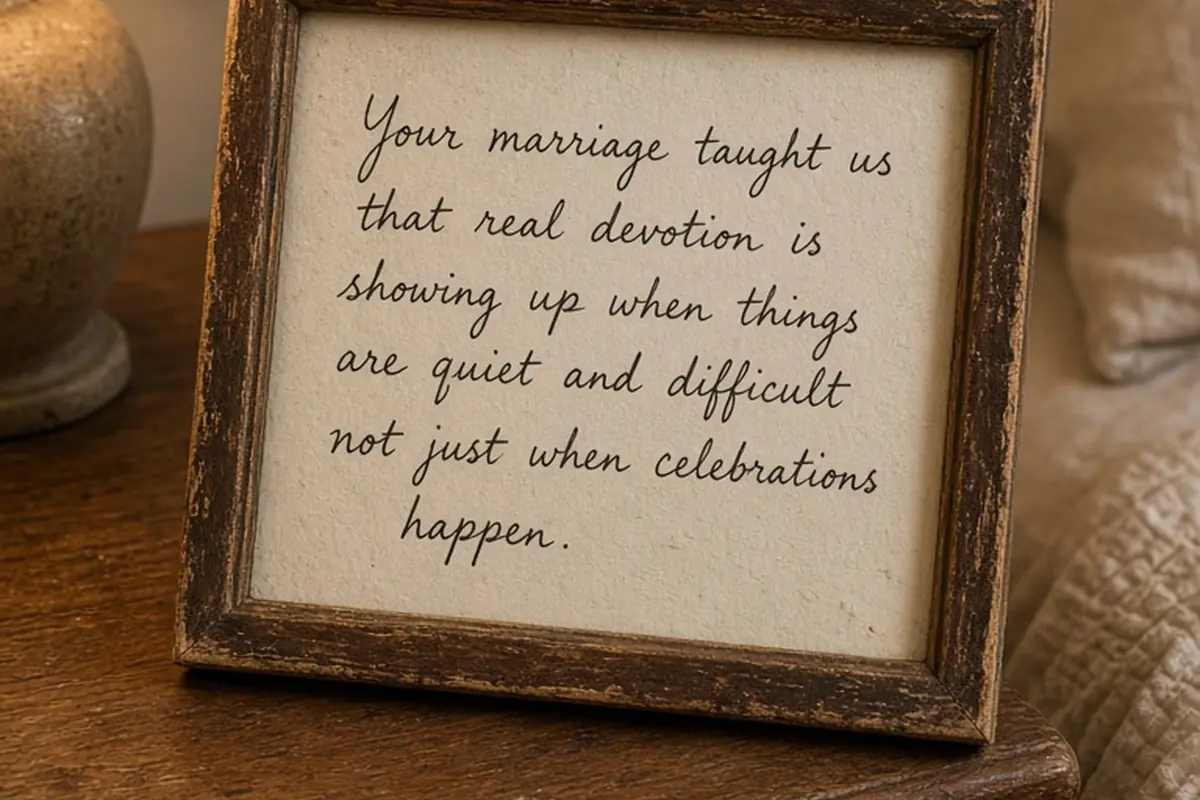
Marcus wanted to write a meaningful toast for his grandparents' sixtieth wedding anniversary. Staring at commercial cards, he found only platitudes about endless romance that felt completely disconnected from the resilient, pragmatic partnership he had observed his entire life. Marcus chose to discard the generic rhymes. He focused instead on how his grandparents took turns caring for each other during farm chores and family illnesses, writing: 'Your marriage taught us that real devotion is showing up when things are quiet and difficult, not just when celebrations happen.' His grandparents kept the handwritten text of his toast framed beside their bed.
Key point: Authentic observations about how people actually live and love together carry far more emotional power than idealized poetic statements.
Bridging Distance Through Personal Storytelling
Elena lived three thousand miles from her grandmother and worried that her brief holiday cards felt cold and transactional. Determined to build a genuine record of connection, she paired a short sentiment about enduring guidance with a specific memory of her grandmother teaching her how to knit over summer break. She mailed a handwritten postcard describing the current scarf she was working on, explaining how those stitching lessons kept them connected across the country. Her grandmother called in tears of appreciation, noting that she kept the postcard in her knitting basket as a daily comfort.
Key point: Connecting a warm saying to a tangible, shared sensory habit dissolves geographic separation and creates an enduring bond.
Frequently asked questions
What should I write in a grandparent card if our relationship is distant or complicated?
When family dynamics are strained, focus on simple, respectful acknowledgment rather than exaggerated intimacy. A neutral statement such as 'Wishing you good health and peace this season' or 'Thinking of you on your birthday and hoping your year brings comfort' offers polite warmth without pretending past difficulties never existed.
How can young grandchildren contribute to a message when they cannot write yet?
You can ask the child two or three simple questions about their grandparent, transcribe their exact answers word for word, and let the child add a drawing. Grandparents frequently cherish the unedited honesty of a young child's perspective, such as 'Grandpa has soft sweaters and shares his crackers,' alongside an adult's note of gratitude.
Is it appropriate to use humor in a message celebrating grandparents?
Humor is wonderful when it reflects an established banter between you and your relative. Gentle jokes about their card-playing competitiveness, secret candy stashes, or refusal to follow modern technology work well, provided the punchline stays affectionate and does not mock genuine physical or cognitive challenges.
What is the best way to present a meaningful saying as a physical keepsake?
Handwritten notes on high-quality archival paper tucked inside a classic book or framed alongside an authentic family photograph make the most durable gifts. Avoid mass-produced plaques with standard lettering; the personal handwriting of a loved one gives the chosen sentiment its true sentimental value.
Your next step
Choose one specific memory from your time with your grandparents this week, write it by hand on a simple card beneath one of these sentiments, and mail it without waiting for an official holiday.