Family roles have evolved from rigid, gender-segregated structures centered on a single breadwinner toward collaborative, flexible partnerships where earning, caregiving, and domestic management are shared. Over recent decades, economic shifts, broader participation in the workforce, and evolving social values replaced prescribed authority with ongoing negotiation. Today, successful families focus less on traditional rules and more on clear communication, equitable divisions of practical and emotional labor, and mutual respect tailored to their household's real circumstances.
When people look at their parents or grandparents, they often notice stark contrasts in how meals were planned, bills were paid, and decisions were reached. Tracing this generational shift helps clarify why modern family life feels both uniquely liberating and occasionally complicated to organize without an inherited script.
The Mid-Century Blueprint: From Prescribed Duty to Economic Necessity
In the mid-twentieth century, Western family life was largely organized around distinct, non-overlapping functions. The dominant cultural ideal assigned the father the role of primary earner and disciplinarian, while the mother managed the home, cooked meals, and handled daily childcare. This arrangement provided predictable expectations, but it rested on rigid social conventions and an economic climate where a single working-class or middle-class wage could reliably support an entire household. Individual preferences were often subordinated to duty, leaving little room for men to explore nurturing roles or for women to pursue careers outside the domestic sphere.
Beginning in the late 1960s and accelerating through the 1970s and 1980s, significant economic changes altered this model. Rising costs of living, changes in manufacturing, and increased educational opportunities for women made dual-income households both an economic necessity and a standard personal aspiration. As millions of mothers entered the labor force, the material foundation of the old domestic arrangement disappeared. Yet cultural attitudes did not change overnight, leaving many families to navigate a confusing transition period where external demands had multiplied but domestic duties remained stubbornly tied to old expectations.
The disappearance of that single blueprint gave couples unprecedented freedom to design their lives according to personal values rather than rigid societal mandates. However, removing prescribed scripts also introduced a new challenge: every aspect of domestic life, from who cooks dinner to who manages the family budget, now had to be actively discussed and agreed upon. Where earlier generations simply inherited their domestic patterns, modern partners must consciously create them.
The Redefinition of Fatherhood: Moving Beyond the Distant Provider
For decades, fatherhood was primarily measured by financial provision, physical protection, and occasional moral authority. Fathers were often portrayed as peripheral to the emotional and practical realities of early childhood, stepping in mainly when disciplinary action was required or during weekend leisure. Paternity leave was almost nonexistent, and workplace environments offered little grace for men seeking time off for pediatrician visits, school assemblies, or sick days.
Over recent decades, cultural understanding of fatherhood has transformed dramatically. Modern fathers are widely expected to be actively involved from infancy, participating routinely in feedings, bedtime routines, emotional comfort, and developmental monitoring. Emotional availability has replaced distant stoicism as a core ideal of paternal involvement. Men increasingly view active parenting not as an optional recreational hobby or babysitting, but as an indispensable component of their daily adult identity.
Despite this progress, modern fathers frequently face friction between modern family values and lingering workplace norms. Professional cultures may still quietly celebrate workers who prioritize long office hours over domestic presence, creating a persistent tug-of-war for men trying to be fully engaged at home while fulfilling career obligations. Navigating this tension requires setting firm boundaries around work availability and treating caregiving as an equal priority alongside workplace deliverables.
Shifting Expectations Around Motherhood and the Burden of the Second Shift
As women entered professional workplaces in vast numbers, they quickly encountered what sociologists described as the second shift: returning home from a full workday only to complete another full shift of cooking, cleaning, and child management. For years, the expanding professional opportunities for women were not matched by an equivalent redistribution of domestic tasks. This dynamic produced widespread chronic fatigue and simmering domestic friction across households attempting to maintain traditional domestic standards alongside modern work hours.
Beyond physical chores like laundry and dishwashing, families have increasingly recognized the weight of emotional and cognitive labor. This invisible management includes anticipating when shoes will be outgrown, scheduling dental checkups, tracking dietary restrictions, keeping school forms organized, and maintaining relationships with extended family. Historically, this mental workload fell almost automatically onto mothers, even in homes where both partners earned equal incomes and divided physical cleaning tasks evenly.
Modern couples address this imbalance by naming and transferring whole responsibilities rather than merely trading individual chores. Instead of one person acting as the domestic project manager who delegates tasks to a helpful partner, equitable households assign full ownership of specific functional domains. When one person takes complete charge of meal planning, grocery acquisition, and preparation, both the physical effort and the mental load are truly shared.
Changing Realities of Modern Grandparenting and Intergenerational Care
Generational roles have also shifted at the grandparent level. In prior eras, extended families frequently lived in the same neighborhood or shared multi-generational homes, allowing elders to provide built-in, everyday support for child rearing. As geographic mobility increased for employment and housing affordability shifted across regions, many families found themselves separated from grandparents by hundreds of miles, requiring modern parents to purchase childcare services that were once provided informally by relatives.
Concurrently, modern grandparents are working later into life, pursuing independent travel, or maintaining active social routines of their own. Many grandparents are eager to form close emotional bonds with their grandchildren without serving as full-time, unpaid daycare providers. When grandparents do provide routine childcare, differences in parenting philosophies—such as evolving guidelines on safe sleep, screen time, nutrition, and discipline—can trigger intergenerational tension if expectations are left unspoken.
Maintaining healthy intergenerational dynamics requires explicit, empathetic communication. Parents benefit from identifying their absolute safety priorities while giving grandparents reasonable latitude on minor lifestyle preferences. Acknowledging that grandparents have separate lives and boundaries fosters mutual appreciation, ensuring that time spent together remains joyful rather than an obligation that strains family goodwill.
How Diverse Family Structures Have Built New Cooperative Templates
The traditional nuclear model—two married parents raising biological children together under one roof—is no longer the default experience for millions of households. Single parents, blended families, co-parents operating out of separate homes, and couples without children have created alternative frameworks that function with great resilience. These varied family forms have demonstrated that healthy child development and emotional stability depend on consistent care, safety, and affection, rather than conformity to a single historical pattern.
In blended families and step-parenting dynamics, roles require careful, conscious calibration rather than immediate assumptions of traditional authority. Stepparents often find greater long-term success by serving initially as reliable adult allies, mentors, and supportive household contributors before attempting to assume disciplinary control. Establishing clear agreements between biological co-parents and step-parents minimizes role ambiguity and keeps children from feeling caught in conflicting loyalties.
Furthermore, many people now rely on chosen family networks—close friends, trusted neighbors, and mutual-aid community circles—to build practical support systems. When biological relatives are distant or absent, sharing carpool duties, joint weekend meals, and cooperative child supervision with trusted peers creates the stability historically supplied by extended kin, proving that cooperative community care remains fundamental to human thriving.
Resolving Daily Household Friction When Generational Scripts Clash
Much of the daily tension in modern partnerships stems from invisible assumptions learned in childhood. One partner may have grown up in a home where Saturdays were dedicated to rigorous deep-cleaning, while the other grew up in an environment where weekends were reserved exclusively for leisure and outdoor activities. When these two backgrounds meet under one roof, ordinary chores can suddenly feel like tests of personal respect, cleanliness, or moral character, even though they are simply competing habits.
To break out of defensive arguments, partners must separate their inherited habits from what actually serves their present household. Labeling a partner as lazy or controlling usually misinterprets the root cause; in reality, both individuals are usually following unexamined scripts handed down by previous generations. Acknowledging that neither inherited model is inherently superior allows a couple to build a deliberate third culture unique to their own home.
A practical method for resolving these differences is establishing a recurring, low-pressure domestic check-in. Rather than bringing up chore imbalances during moments of exhaustion or stress, partners can spend fifteen minutes once a week reviewing logistical commitments, upcoming expenses, and task allocations. Framing this routine around shared problem-solving transforms household maintenance from an ongoing source of friction into an organized collaborative effort.
Illustrative Scenarios
Navigating Morning Routine Imbalances
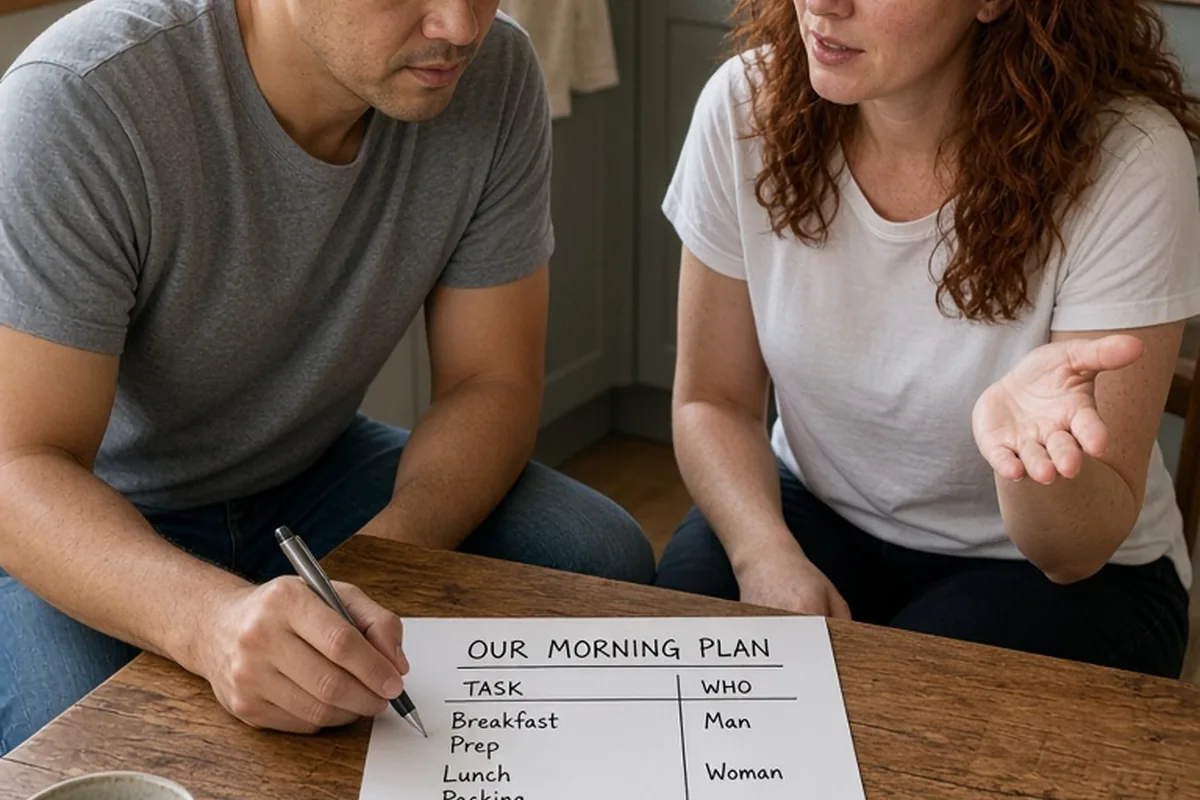
Mark and Elena both worked full-time corporate jobs, but Elena found herself waking up an hour earlier every weekday to prepare breakfasts, pack lunches, sign permission slips, and dress their two elementary-aged children. She assumed Mark would naturally step in when he noticed her rushing, while Mark assumed Elena genuinely preferred managing the morning routine because her mother had always run their household kitchen. Elena's resentment peaked during an ordinary school morning when an accidental spill triggered an angry argument. That weekend, rather than rehashing the fight, they wrote down every single morning task on a shared document. Mark took full ownership of breakfast, lunch packing, and backpack checks, while Elena managed clothing and medication. The clear separation of responsibilities removed the unspoken assumptions that were fueling their daily frustration.
Key point: Unspoken expectations inherited from childhood habits foster quiet resentment; explicitly documenting and dividing specific routines turns ambiguous friction into reliable teamwork.
Aligning Boundaries with Caregiving Grandparents
After returning to work, Jordan asked her father, Robert, to watch her toddler son two days a week. Robert frequently ignored Jordan's nap schedule and allowed unrestricted television, maintaining that strict schedules were unnecessary and that his own children had turned out fine. Jordan felt conflicted between deep gratitude for free childcare and frustration that her son was overtired and irritable every evening. Instead of sending reactive critique messages during her workday, Jordan invited Robert out for breakfast without the baby present. She clearly explained that consistent nap times made the evenings manageable for their family, identifying two specific non-negotiable guidelines while giving Robert complete freedom over outdoor games, books, and crafts. Robert felt respected as a grandfather rather than treated like an employee, and he gladly adopted the key sleep schedule.
Key point: Receiving intergenerational help requires separating gratitude from parental leadership by clearly identifying a few core non-negotiable boundaries calmly and in advance.
Frequently asked questions
Why does negotiating modern family roles often feel more tiring than following traditional ones?
Traditional roles were prescribed by culture, meaning couples rarely had to spend time or emotional energy deciding who handled which responsibility. Modern flexible relationships offer far more freedom and fairness, but they require continuous communication, planning, and compromise to keep household expectations aligned.
How can partners divide invisible emotional labor without keeping an unhealthy scorecard?
The most effective method is assigning full ownership of complete operational categories rather than delegating individual tasks. When one person completely owns an entire responsibility—such as veterinary care or extracurricular registrations—from planning to execution, the cognitive load is genuinely shared without needing to track small daily chores.
What should a family do if one partner values traditional roles while the other wants strict equality?
Partners should focus on mutual consent and practical household balance rather than ideological labels. A successful arrangement is defined by whether both partners feel respected, supported, and free from unilateral burdens, regardless of whether their final division of labor looks traditional, modern, or blended.
How should couples respond when older relatives criticize their non-traditional division of labor?
Respond with calm, polite firmness without entering an extended debate or seeking defensive validation. A simple acknowledgment that every generation adapts to different economic and family realities allows you to honor your relatives' experience while maintaining clear boundaries around how your own household functions.
Your next step
Pick one recurring daily or weekly routine that currently causes friction, sit down with your partner or household members for twenty minutes this week, and explicitly assign complete end-to-end ownership of that entire task to one person.