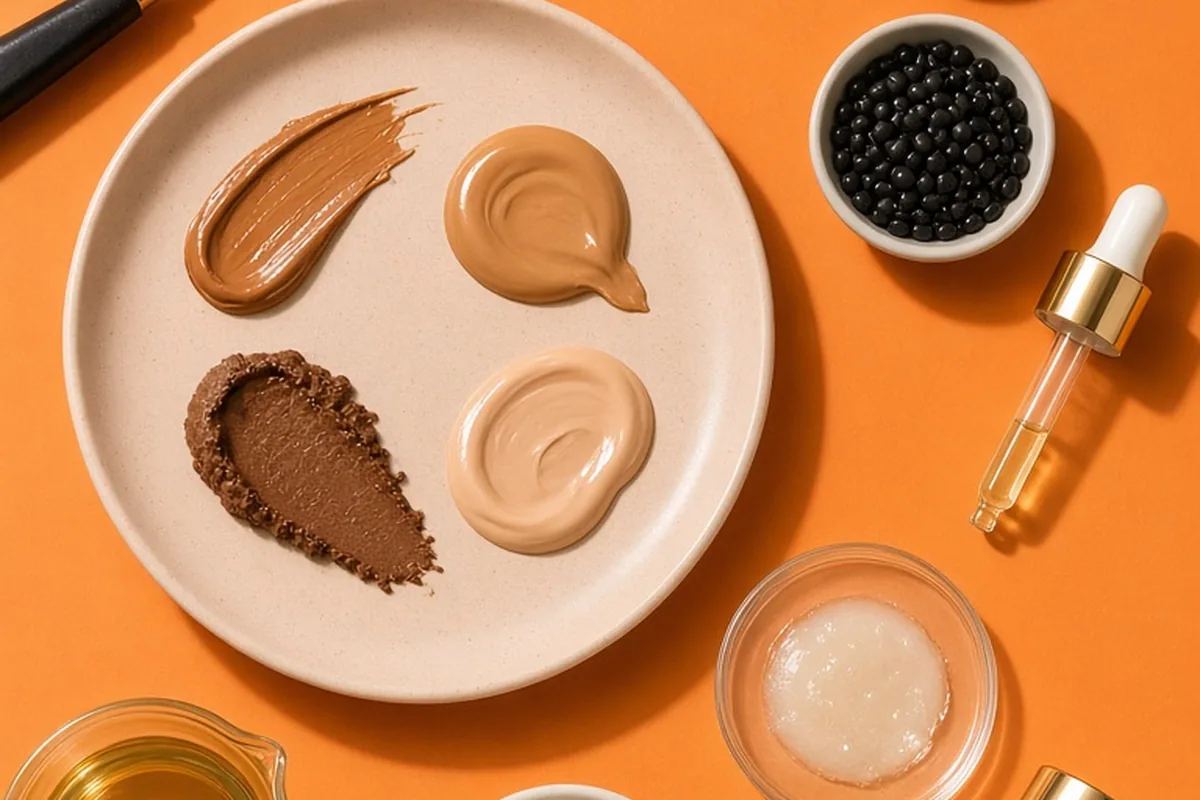
Foundation makeup is manufactured by dispersing finely milled color pigments into a liquid or anhydrous base, blending separate oil and water phases through high-shear emulsification, and stabilizing the mixture with polymers, emulsifiers, and preservatives. After cooling and precise color matching against master standards, the formula undergoes microbial testing before being filled into airtight bottles, jars, or compacts.
Understanding how cosmetic chemists formulate and manufacture foundation helps demystify product performance, shade consistency, and ingredient interactions on your skin.
The Core Ingredients and Raw Materials
Every foundation starts with a balance of four primary raw material categories: solvents, pigments, texturizers, and functional stabilizers. The solvent base forms the bulk of the product and determines its fluidity, typically consisting of purified water, volatile silicones like cyclopentasiloxane, or plant and mineral oils. Suspended within this carrier liquid are inorganic color pigments, primarily titanium dioxide for opacity and lightness, alongside red, yellow, and black iron oxides that combine to replicate human skin tones. Without precise pigment ratios, a foundation base would appear either chalky white or flat gray.
To give the liquid its blendable texture and velvety dry-down, formulators introduce dry texturizing agents such as mica, talc, silica, nylon-12, or boron nitride. These spherical or plate-like powders diffuse light, absorb excess sebum, and reduce friction during application. Finally, functional additives complete the raw formula. These include broad-spectrum preservatives like phenoxyethanol or ethylhexylglycerin to prevent microbial growth in water-containing jars, thickeners such as xanthan gum or magnesium aluminum silicate to maintain suspension, and film formers like acrylates copolymer to provide transfer resistance throughout the day.
Pigment Grinding and Dispersion Technology
Raw iron oxides and titanium dioxide arrive at cosmetic manufacturing plants as dense, aggregated clusters of dry powder. If added directly to a liquid base without pre-treatment, these aggregates would cause streaking, uneven coloration, and a gritty texture on the skin. To prevent this, technicians subject raw pigments to intense mechanical milling, often using three-roll mills, high-energy bead mills, or industrial micronizers that break particle clusters down to sub-micron sizes, typically between 0.2 and 0.5 microns.
Once crushed, the pigments are wetted out in a portion of the carrier fluid—often silicone fluid or a light ester—to form a smooth, highly concentrated paste known as a color grind or pigment dispersion. Many modern formulations utilize surface-treated pigments coated with substances like triethoxycaprylylsilane, dimethicone, or amino acids. These hydrophobic coatings prevent the pigments from absorbing too much oil from the skin, resist sweat degradation, and ensure the color particles disperse evenly without clumping together over months on the retail shelf.
Phase Preparation and Emulsion Chemistry
Most liquid foundations are emulsions, which means they force two naturally immiscible fluids—oil and water—to bond into a stable, uniform suspension. Formulators design these as either water-in-oil (W/O), oil-in-water (O/W), or silicone-in-water systems. In a specialized cleanroom manufacturing suite, the process begins in two separate heated compounding tanks: the aqueous (water) phase tank and the lipophilic (oil/silicone) phase tank.
In the water vessel, deionized water is heated to roughly 75 to 80 degrees Celsius and blended with water-soluble humectants like glycerin, glycols, and viscosity-building gums. Simultaneously, in the oil vessel, waxes, liquid emollients, surface-active emulsifiers, and the pre-milled pigment dispersion are melted and combined at an identical temperature. Keeping both phases at identical thermal levels is critical; a temperature mismatch during the upcoming joining phase can shock the waxes, causing crystallization and immediate emulsion failure.
High-Shear Emulsification and Homogenization
Once both phases reach optimal thermal and chemical equilibrium, the secondary phase is slowly metered into the primary phase under continuous agitation. To transform the mixture into a true emulsion, the liquid passes through a high-shear homogenizer or rotor-stator mixer operating at thousands of revolutions per minute. This intense mechanical force tears the internal phase liquid into microscopic droplets, suspending them permanently within the continuous external phase.
Emulsifier molecules immediately migrate to the interface between oil and water droplets, aligning their hydrophilic heads toward the water and their lipophilic tails toward the oil. This molecular barrier creates steric and electrostatic repulsion, preventing the droplets from coalescing back into separate layers. The duration and speed of homogenization directly dictate the final product's thickness and stability; shearing too briefly leaves large droplets that split quickly, while over-shearing can rupture polymer chains and thin the formula excessively.
Manufacturing Differences for Powder, Stick, and Serum Formats
While standard liquid foundations rely on heated emulsions, other foundation formats follow distinct manufacturing paths tailored to their physical states. Powder foundations, both loose and pressed, eliminate the water phase entirely. In these lines, dry pigments, binders, and absorbent fillers are blended in ribbon blenders or pneumatic fluid-bed mixers. For pressed compacts, technicians spray a small percentage of liquid binder oil over the dry powder, pass the mix through fine sieves to eliminate damp clumps, and press the powder into aluminum pans using hydraulic presses calibrated to exact poundage per square inch.
Conversely, solid stick foundations and anhydrous balms are produced through hot-pour manufacturing. These formulas rely on a matrix of high-melting-point waxes like carnauba, candelilla, or synthetic ozokerite combined with heavy emollients and concentrated pigment slurries. The entire formula is liquefied at high temperatures, thoroughly de-aerated to remove air pockets, and poured directly into final stick packaging while still molten. As the containers travel through continuous cooling tunnels, the wax structure crystallizes into a solid, portable stick.
Color Adjustment and In-Line Quality Control
Achieving consistent shade fidelity across industrial batches containing thousands of gallons is one of the most challenging steps in cosmetics manufacturing. Even fractional variations in raw pigment purity from raw material suppliers can alter the undertone of a batch. As the homogenized bulk cools toward room temperature, quality assurance chemists draw intermediate samples from the mixing vessel for rigorous color matching against an approved physical master standard.
Chemists evaluate the bulk sample using both human visual assessment under standardized D65 daylight lamps and instrumental analysis using high-precision spectrophotometers. If the batch leans slightly too pink, golden, or dark, technicians add micro-dosed adjustments from concentrated shading bases. Alongside color checks, the batch must pass viscosity testing, specific gravity measurements, and pH verification before chemical release. Accelerated stability testing and microbiological challenge tests ensure the preservative system prevents bacterial, yeast, and mold growth before bottling begins.
Packaging, Filling, and Practical Application Insights
The final manufacturing stage transitions bulk product into consumer-ready packaging on automated assembly lines. Liquid foundations pass through volumetric piston fillers or peristaltic pumps that dispense exact quantities into sanitized glass bottles, plastic squeeze tubes, or airless pump containers. Airless packaging is particularly beneficial for formulas containing volatile solvents or active ingredients like vitamin C, as it minimizes air exposure and reduces the risk of product oxidation and premature drying.
Understanding these production realities offers practical benefits when selecting and using foundation. If a liquid foundation separates slightly after sitting undisturbed for months, gentle shaking re-suspends minor droplet migration, though chronic phase separation indicates broken emulsion bonds. Furthermore, knowing whether your foundation is built on a silicone-in-water or water-in-silicone continuous phase helps you pair it with compatible skincare primers, avoiding the pilling and patchy application that happens when clashing chemical bases are layered together.
Frequently asked questions
Why do some liquid foundations separate in the bottle over time?
Liquid foundations are emulsions of oil, water, and suspended solids. Over extended periods or when exposed to fluctuating temperatures, the molecular bonds formed by emulsifiers can weaken, causing lighter carrier liquids to rise to the top while dense pigments settle toward the base.
How are shade ranges expanded to prevent ashy finishes on darker skin?
Formulators adjust the ratio of black, red, and yellow iron oxides while drastically reducing or eliminating white titanium dioxide. In deeper shades, replacing white bases with transparent iron oxides or specialized blue and violet undertone pigments maintains color depth without creating a gray, chalky cast.
What is the difference between a silicone-based and a water-based foundation formula?
A silicone-based foundation uses volatile silicones like dimethicone as its primary external continuous phase, providing slip, blur, and high water resistance. A water-based foundation uses water as its primary carrier, resulting in a lighter skin feel, faster absorption, and lower resistance to heavy perspiration.
Your next step
Inspect the first three ingredients on your current foundation bottle to identify its primary base fluid, allowing you to select a chemically compatible primer that prevents pilling and extends wear.