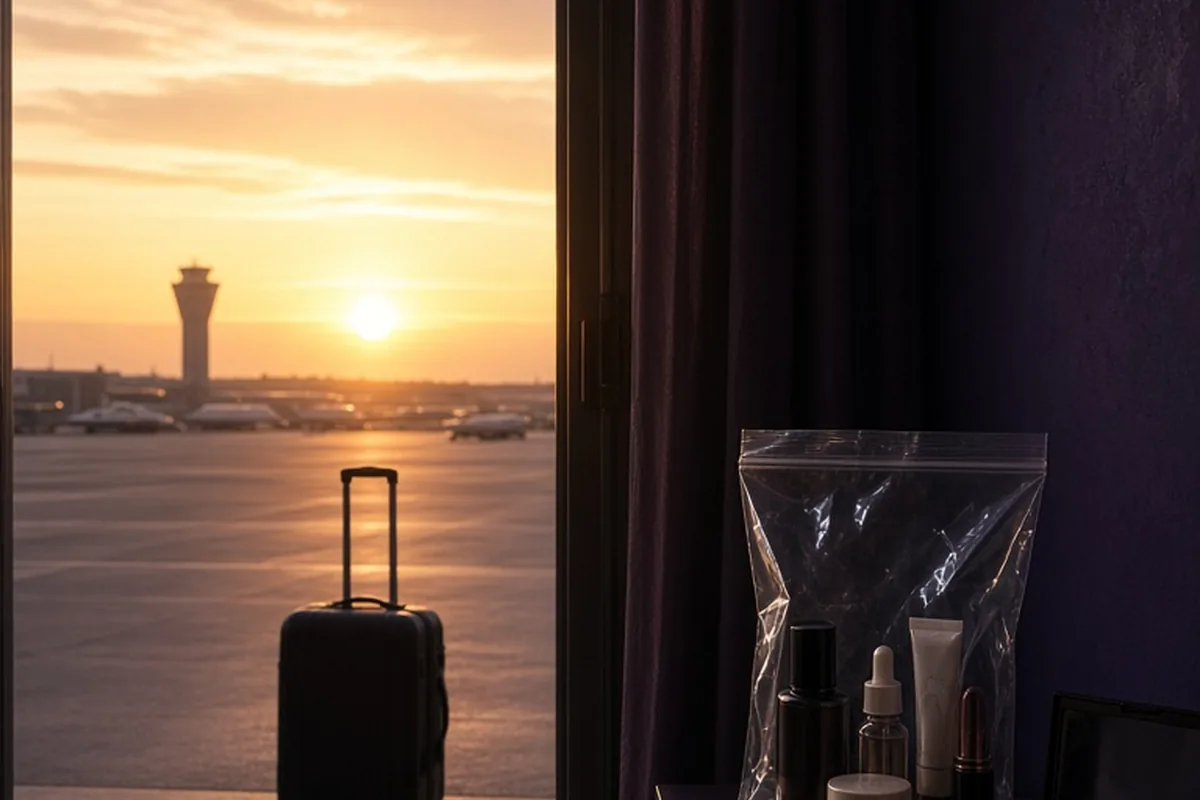
You can bring an unlimited amount of solid or powder makeup in both carry-on and checked bags. However, any liquid, gel, cream, paste, or aerosol makeup in your carry-on must be in containers of 3.4 ounces (100 milliliters) or less and fit comfortably inside a single quart-sized, clear plastic bag. In checked luggage, you can pack full-sized liquid and powder cosmetics without volume restrictions.
Packing a beauty collection for air travel often feels confusing because cosmetic formulas blur the lines between liquids, creams, gels, and solids. Knowing exactly how transportation security agencies classify your favorite beauty staples ensures your daily routine stays intact while preventing costly confiscations at the checkpoint.
Understanding the TSA Liquids Rule for Carry-On Makeup
The Transportation Security Administration enforces the standard 3-1-1 liquids rule for all carry-on baggage. Under this guideline, every liquid, aerosol, gel, cream, and paste cosmetic must be stored in a container that holds 3.4 fluid ounces (100 milliliters) or less. All of these individual containers must fit comfortably inside one clear, quart-sized, zip-top plastic bag. Each traveler is permitted only one such bag in their carry-on luggage, which must easily close without straining the zipper.
A critical detail many travelers overlook is that security officers assess container capacity rather than the remaining volume of the product. If you carry an expensive five-ounce foundation bottle that is four-fifths empty, security personnel will still confiscate it because the bottle itself exceeds the 3.4-ounce threshold. To protect your investment, always transfer remaining product into certified travel-sized bottles or purchase official mini versions manufactured specifically for travel.
When organizing your carry-on, keep your clear liquids bag easily accessible near the top of your tote or rolling suitcase. While many modern airport screening lanes with advanced computed tomography scanners no longer require passengers to pull out their liquids bag, having it within arm's reach prevents delays if an agent requests manual inspection.
Navigating Powder and Solid Cosmetics in Hand Luggage
Solid and pressed-powder cosmetics are far less restricted than their liquid counterparts. Items such as pressed eyeshadow palettes, powder compacts, powder blushes, pencil eyeliners, and traditional twist-up bullet lipsticks are classified as solids. You can bring as many of these items in your carry-on as your personal space permits, and they do not need to go inside your designated quart-sized liquids bag.
Loose powder products, however, fall under dedicated security screening guidelines. Aviation security guidelines request that loose powders measuring greater than 12 ounces (350 milliliters)—roughly the volume of a standard soda can—undergo separate screening at the checkpoint. Security officers may inspect the container manually or run an additional trace test on the powder. While high-end setting powders rarely exceed 1 to 2 ounces, oversized body powders, dry shampoos in loose form, or large mineral makeup tubs should either be kept in smaller containers or packed into checked luggage to prevent checkpoint delays.
Choosing solid alternatives over liquid formulas is one of the easiest ways to streamline your carry-on packing. Replacing liquid foundations with stick foundations, liquid highlighters with solid balm sticks, and cream blushes with pressed powders frees up valuable real estate inside your single quart-sized liquids bag for products that cannot be swapped.
Classifying Ambiguous Beauty Products: Liquid or Solid?
Cosmetic textures can make it tricky to determine whether a product belongs in your quart-sized bag. Security agencies use a simple physical standard: if a substance can be poured, pumped, squeezed, spread, sprayed, or smeared, it is categorized as a liquid, gel, or aerosol. This broad definition captures many everyday makeup essentials that people might intuitively consider solids.
Mascara, liquid eyeliner, lip gloss, lip oils, liquid concealers, cushion compact foundations, and setting sprays all count as liquids under security rules. Similarly, thick skincare and makeup hybrids—such as rich potted eye creams, pore-blurring primers, gel-based brow pomades, and thick balms in squeeze tubes—must adhere to the 3.4-ounce limit and sit inside your clear liquids pouch.
To quickly evaluate whether an ambiguous cosmetic needs to go into your liquids bag, consider how the product behaves at room temperature. The following list outlines standard classifications for common borderline makeup and grooming items:
- Liquids and Gels (Must fit in quart bag under 3.4 oz): Mascara, lip gloss, liquid lipstick, foundation, primer, BB cream, setting spray, liquid eyeliner, gel brow pomade, perfume, and cream concealer.
- Solids (Unrestricted in carry-on bags): Twist-up bullet lipstick, stick foundation, pencil eyeliner, pencil lip liner, pressed eyeshadow, compact blush, powder bronzer, and solid brush cleansing soap bars.
Packing Full-Sized Makeup in Checked Luggage
If you prefer to travel with your full beauty setup, checked luggage provides substantially greater flexibility. There are no volume restrictions on standard cosmetic liquids, creams, and powders packed inside checked suitcases, provided they are intended for personal grooming and stay within overall airline baggage weight limits.
However, packing cosmetics in the cargo hold introduces risks related to air pressure fluctuations, temperature shifts, and rough baggage handling. Aircraft cargo holds experience distinct pressure drops during flight, which can cause airtight plastic bottles and foundation pumps to expand, crack, or leak product all over your clothing. Glass perfume and foundation bottles are also vulnerable to shattering under the weight of shifting luggage.
To safeguard your cosmetics in checked baggage, unscrew the caps of liquid bottles, place a small piece of plastic wrap over the bottle opening, and tightly screw the cap back on over the plastic. Place liquid items into sealed plastic bags or padded makeup organizers positioned in the center of your suitcase, surrounded by soft clothing items to cushion against exterior impact.
Strategic Packing Methods to Maximize Cosmetic Space
Maximizing the cosmetic capacity of your carry-on requires thoughtful depotting and space management. Rather than carrying original retail packaging, which is often bulky and heavy, transfer small amounts of your daily liquid foundation, serum, and eye cream into reusable cosmetic jars or clean contact lens cases. A contact lens case provides two leak-resistant compartments that hold enough liquid foundation and concealer for a week-long trip without taking up more than a fraction of your clear pouch.
Another effective strategy is prioritizing multi-use cosmetics that cut down on the total number of containers you carry. A versatile cheek-and-lip tint serves two functions with a single stick, while a neutral eyeshadow palette containing matte brown shades can double as brow powder and contour. Multi-functional products reduce container clutter and make your morning routine faster while away from home.
Protecting delicate pressed powders during transit is equally important, as vibrations and turbulence can shatter brittle pans of blush and highlighter. Placing a round cotton pad or folded tissue directly between the pressed powder surface and the compact mirror creates a soft buffer that absorbs shock and prevents the powder from breaking into dust during travel.
International Aviation Rules and Duty-Free Makeup Purchases
While international aviation authorities like the European Union Aviation Safety Agency, Transport Canada, and the UK Department for Transport share the 3.4-ounce (100-milliliter) liquid restriction, enforcement nuances vary by airport. Some international security checkpoints enforce the single quart-sized bag rule with strict measurements, requiring you to transfer your items into airport-provided transparent plastic pouches if your personal toiletry bag is slightly too large.
Duty-free cosmetic purchases require careful planning if your travel itinerary includes connecting flights. When you purchase full-sized perfumes, luxury skincare sets, or cosmetic bundles at an airport duty-free shop after clearing initial security, the retailer will seal them inside a clear Security Tamper-Evident Bag with the receipt visible inside. Do not break the seal of this bag until you reach your final destination.
If you have a connecting flight that requires you to re-clear security screening in another country—common during international transfers—security personnel will only permit your duty-free liquids through if they remain untouched inside their sealed tamper-evident bag with a same-day purchase receipt. If your layover requires you to collect your luggage and re-check it, you can simply pack your duty-free cosmetics into your checked suitcase before dropping it off.
Rules for Beauty Tools, Tweezers, and Styling Devices
Your cosmetic collection involves more than just formulas; beauty tools and electric appliances must also meet specific cabin security standards. Traditional makeup brushes, beauty sponges, eyelash curlers, manual pencil sharpeners, and standard tweezers are permitted in carry-on baggage without limitation. They can be packed inside your primary makeup organizer alongside your dry cosmetics.
Cutting tools require closer scrutiny. Small beauty scissors, such as brow or cuticle scissors, are generally permitted in carry-on bags only if the blades measure less than 4 inches (10 centimeters) from the pivot point. However, safety razor blades and straight razors must be placed in checked luggage, whereas disposable cartridge razors and electric shavers are allowed in carry-on luggage.
Cordless beauty tools and heated styling devices powered by lithium-ion batteries present an important safety distinction. Cordless curling irons, rechargeable LED light-therapy masks, and battery-powered facial cleansing brushes must travel in your carry-on bags rather than checked luggage to comply with aviation fire-safety rules regarding lithium batteries. Corded hair straighteners and hair dryers with standard wall plugs may be packed freely in either checked or carry-on baggage.
Frequently asked questions
Does standard lipstick count as a liquid on a plane?
Traditional twist-up bullet lipsticks are classified as solids by aviation security and do not count toward your liquid allowance. However, liquid lipsticks, lip glosses, and lip oils are considered liquids or gels and must fit inside your quart-sized clear bag in containers of 3.4 ounces or less.
Can I bring full-sized makeup brushes in my carry-on bag?
Yes, makeup brushes of any size or quantity are fully permitted in carry-on baggage. They are considered non-hazardous tools and do not count toward your liquids allowance or require special screening.
What happens if my liquid foundation bottle is larger than 3.4 ounces but almost empty?
Security officers evaluate the marked capacity of the container itself rather than the amount of product inside. A 4-ounce bottle that is mostly empty will still be confiscated at security, so you should always decant remaining makeup into compliant travel containers before your trip.
Are makeup remover wipes considered liquids at airport security?
Makeup remover wipes, cleansing towelettes, and individual sheet masks are classified as solid items by airport security. You can pack as many wipes as you need in your carry-on luggage without placing them inside your quart-sized clear liquids bag.
Your next step
Sort your makeup by formula texture before packing, transfer essential liquids into labeled containers under 3.4 ounces inside a clear quart pouch, and keep solid powders in your primary luggage for a seamless security screening.