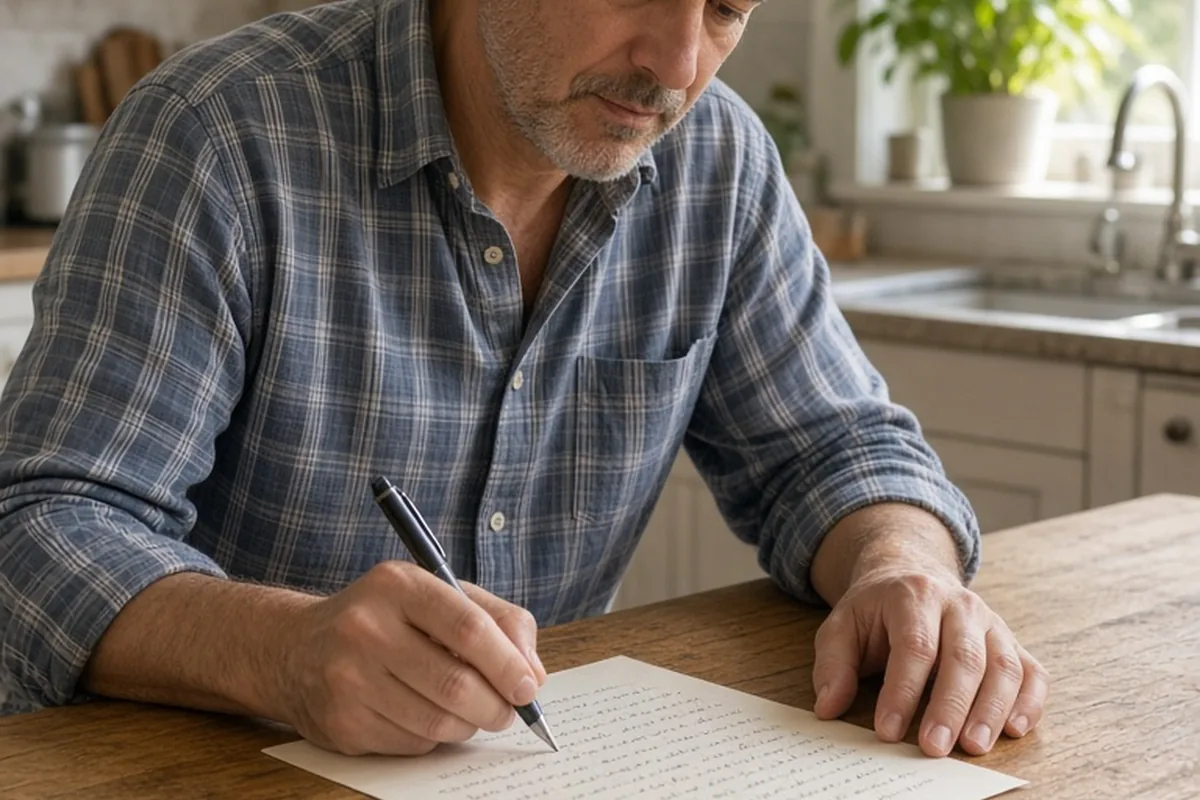
To write a real-life love letter to your wife, bypass generic romantic clichés and speak in your natural voice. Focus on one clear theme, such as gratitude for her partnership or admiration for how she handles life. Anchor your words in concrete, everyday memories rather than abstract praise, acknowledge what her presence brings to your daily world, and end with an unforced statement of commitment.
Many men freeze when sitting down to write to their spouse because they assume romance requires poetic vocabulary or dramatic grand gestures. In reality, heartfelt writing succeeds through honesty, observational detail, and emotional safety rather than borrowed florid prose.
Finding the Anchoring Thread Before You Put Pen to Paper
A common mistake when writing to a spouse is trying to summarize your entire relationship in a single sitting. When you attempt to cover the day you met, your wedding, your children, every vacation, and your future retirement on a single page, the letter turns into an unfocused timeline. Instead of trying to say everything, pick one emotional anchor that reflects where you both are right now. That anchor might be quiet admiration for how she handled a difficult transition, gratitude for her partnership during a grueling season of work, or simply the realization that you miss her company even when you share the same address.
To identify this anchor, spend five minutes recalling specific moments from the last few months rather than the distant past. Think about a quiet Tuesday morning when she made you laugh, the way she greeted you after a exhausting commute, or a difficult conversation where her patience surprised you. Choosing one central observation gives the letter momentum. It assures your wife that you are paying attention to who she is today, rather than simply coasting on memories of who she was years ago.
Drafting a Love Letter to Your Wife That Sounds Like You
If you do not talk like a Victorian poet in the kitchen, do not write like one on stationery. When a letter uses elevated vocabulary that never crosses your lips in everyday conversation, it creates emotional distance. Your wife knows your cadence, your vocabulary, and your humor. When she reads words like 'enchanted,' 'fair maiden,' or breathless declarations of eternal bliss, the sentiment often feels borrowed from a greeting card rack rather than drawn from your real life.
Aim for the voice you use when you are relaxed, candid, and entirely unhurried with her. If your communication style is understated and quiet, let the letter be understated and quiet. If your relationship is grounded in banter and shared laughter, allow a moment of that levity into the text alongside your affection. Authenticity carries far more emotional weight than flowery rhetoric. A simple sentence stating, 'I love sitting on the back steps with you after the house goes quiet,' will resonate much deeper than a dozen abstract lines about celestial devotion.
Structuring the Letter with Clear Movement from Past to Future
A solid letter does not need a complex literary framework, but it does benefit from an intentional beginning, middle, and end. Start by setting the scene or naming what prompted you to write. You do not need an anniversary or a holiday as an excuse; an unexpected note on an ordinary week can be remarkably powerful. Opening with a simple prompt—such as noticing her reading by the window yesterday or remembering an errand you ran together—gives the reader an immediate point of connection.
Move next into your central reflection: what you notice about her character and how it impacts your life. Follow this by looking forward together, expressing steady support for whatever season lies ahead. Conclude with a warm, grounded sign-off that feels natural to your relationship. This straightforward progression keeps the letter coherent, moving naturally from a specific visual memory to internal gratitude, and finally to shared commitment.
Replacing Vague Praise with Observable, Grounded Evidence
Compliments in long-term relationships often fall flat when they rely on broad generalizations. Telling your wife that she is 'the best mother' or 'an incredible partner' is pleasant, but it rarely makes an impact because it lacks specificity. Specificity is the clearest proof of genuine attention. Anyone can write an abstract compliment, but only someone who shares a life with her can name the exact details of how she moves through the world.
Consider the difference between two approaches. Writing 'You are always so thoughtful' is polite, but writing 'I noticed how carefully you packed that care package for your sister last week, even when you were exhausted from work' shows you actually see her effort. Contrast 'You look beautiful' with 'I love the green sweater you wore on Saturday and how your eyes crinkle when our neighbor tells an absurd story.' These tangible observations make your wife feel deeply known, which is the foundational purpose of marital intimacy.
Writing Through Seasons of Routine, Stress, or Disconnection
Writing a love letter is easiest when feelings are warm and uncomplicated, but it can be especially valuable during seasons when marriage feels functional, heavy, or predictable. If you have been caught in the logistics of parenting, caregiving, or financial stress, writing a letter can feel awkward. The temptation is either to ignore the strain and pretend everything is effortless, or to turn the letter into an apology manifesto. Neither serves the connection well.
A more grounded approach is to acknowledge the current reality without assigning blame or making the letter heavy. You might write: 'Things have been loud and busy lately, and we spend most of our evening hours talking about schedules and house repairs. I know I have been distracted, but I want you to know I still see you in the middle of all the noise.' This kind of honest appraisal honors her reality. It reassures her that you do not take her partnership for granted, even when daily life leaves little room for leisure.
Handling Presentation and Delivery Without Unnecessary Pressure
How you deliver the letter matters just as much as what you write. Avoid elaborate setups that create an expectation of an immediate, theatrical emotional response. Handing someone a vulnerable letter while staring at them and waiting for tears can make the recipient feel self-conscious and cornered. The gift of a written letter is that it allows the reader to process your words privately, on their own schedule.
A handwritten note on clean, unlined paper or a simple card is usually best, as handwriting carries personal presence. If your handwriting is genuinely hard to read, writing slowly or printing neatly is far better than switching to a cold digital document. Place it somewhere she will encounter it naturally: on her bedside table, tucked into a book she is currently reading, or beside her morning coffee. Give her the space to absorb the words without needing to perform gratitude the second she finishes reading.
Illustrative Scenarios
Finding Meaning in the Routine
After twelve years of marriage and two children, Nathan noticed that almost all communication with his wife Sarah had devolved into shared calendars and grocery lists. Wanting to reconnect for her birthday, he spent two evenings struggling to write romantic prose and threw away three drafts that felt stiff and artificial. Realizing he was trying to sound like a movie script, he changed his approach. He wrote one straightforward page describing how much he valued her sharp sense of humor when dinner burnt on a chaotic weeknight, and how secure he felt knowing they were tackling challenges together.
Key point: Authentic observation of daily life creates deeper emotional resonance than theatrical romantic clichés.
Reconnecting Without Creating Obligation
Following a tense month marked by an exhausting home renovation, Daniel wanted to express affection to his wife Elena, but worried that a grand romantic gesture would feel defensive or manipulative. Instead of apologizing profusely or demanding an immediate romantic reset, he wrote a brief card that named her steady endurance through the mess and thanked her for her patience. He placed the card next to her keys before leaving for an early shift, without mentioning it beforehand.
Key point: A thoughtful note delivered without demanding an immediate emotional reaction gives your partner room to receive affection comfortably.
Frequently asked questions
How long should a love letter to my wife be?
A meaningful letter does not need to be long; one to two focused pages or even a single card with four well-developed paragraphs is often ideal. What matters is the clarity and specificity of your thoughts, not the total page count.
What should I avoid including in the letter?
Avoid rehashing past arguments, giving backhanded compliments, venting about household frustrations, or demanding reassurance about her feelings. Keep the focus on genuine appreciation, shared memories, and your own steady affection.
Is it acceptable to type the letter instead of handwriting it?
Handwriting is generally preferred because it shows physical care and time, even if your penmanship is imperfect. However, if your handwriting is completely illegible due to a physical tremor or condition, a neatly formatted printed letter with a handwritten signature and personal closing is completely acceptable.
What if my wife reads it and doesn't have an emotional reaction?
People process affection differently, and an absence of tears does not mean your words went unnoticed. Some people need time to digest deep sentiments quietly, so let the gesture stand on its own without asking for a review or immediate validation.
Your next step
Take ten minutes today to write down three specific, everyday moments from the past month where your wife's presence grounded you, and use the clearest one as the opening sentence of a short handwritten note.