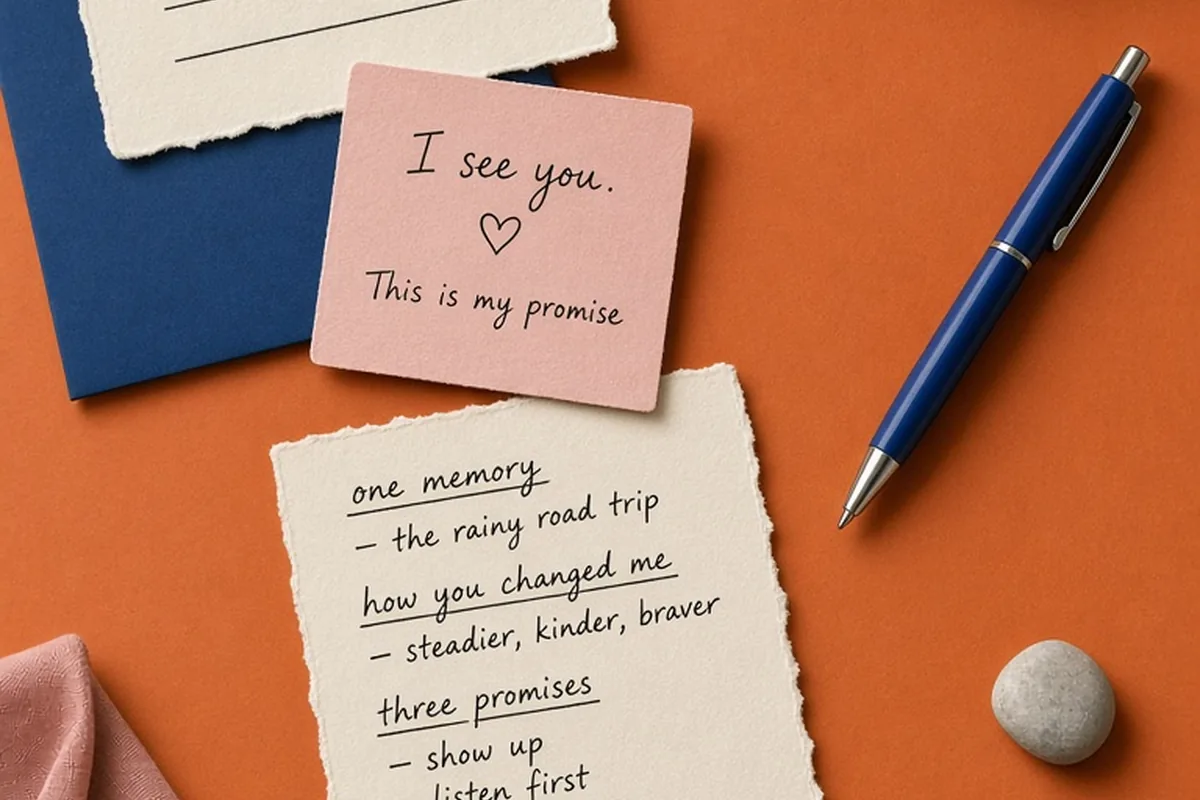
Start with one specific memory, name what your partner changed in you, make three realistic promises, and end with a clear commitment. Keep it under two minutes, use your normal voice, avoid inside jokes that exclude guests, and read it aloud until it sounds like something you would actually say.
A strong vow is less about sounding poetic and more about making your partner feel accurately seen in front of the people who matter to you.
Know what a wedding vow is and is not
A wedding vow is a public promise shaped by private knowledge. It is not a speech about how perfect your relationship is, a roast with a romantic ending, or a performance designed to make guests cry. Its job is simpler and harder: to say, in your own words, who this person is to you, what you are choosing, and how you plan to keep choosing it when life becomes ordinary or difficult.
That distinction matters because many people freeze while trying to sound impressive. If you aim for timeless, you may end up with lines that could belong to anyone. If you aim for honest, the vow usually becomes memorable on its own. A useful test is whether your partner could hear the sentence and think, yes, that is us, rather than, that sounds like a movie. The trade-off is that honesty can feel exposed, so you get to decide how much detail belongs in public and what stays between the two of you.
Gather material before you try to draft
Before writing, collect raw material instead of hunting for perfect sentences. Think of three moments: one when you first understood who your partner was, one when they showed up for you, and one ordinary habit that still makes you feel chosen. Add a short list of traits you rely on, such as patience, directness, humor, steadiness, courage, or tenderness. Concrete nouns help more than adjectives: the way they make coffee when you are overwhelmed, the text they send before a hard meeting, the calm they bring to family chaos.
Also gather limits. Decide what is too private, what might embarrass your partner, and what guests would not understand without a long explanation. A vow can be intimate without being revealing. If a story needs context, compress it to the emotional point rather than retelling every detail. This step saves time later because you are not inventing love under pressure; you are selecting from evidence you already have.
Use a simple structure that keeps you steady
A reliable shape is: open with a direct address, tell one specific memory, name what it taught you, make three promises, then close with a clear commitment. That structure gives guests a path to follow and gives you something to hold when emotion rises. You do not need transitions that sound literary. Simple lines such as, I knew it mattered when, or, Because of you, I am learning to, can carry more weight than ornate phrasing.
Keep the middle focused. One vivid scene usually beats five summarized ones because detail creates trust. For example, instead of saying you supported me through everything, describe the night they drove across town with soup and sat quietly while you panicked. Then move from story to promise: because you steadied me, I promise to make room for your fear instead of fixing it too fast. The limit is time; if a section needs more than a breath or two, cut it.
Write promises you can actually keep
The best promises are specific enough to guide behavior and humble enough to survive real life. Promise to listen before defending, to tell the truth kindly, to protect time together, to ask instead of assuming, to repair after conflict, or to keep learning what love means to your partner as both of you change. Avoid vows that require perfection, such as never hurting you or always making you happy. Those sound grand but can turn a human mistake into a broken oath.
A strong promise also respects your partner as a separate person, not a role in your story. You can promise devotion without promising to complete them, control outcomes, or carry every feeling alone. Try pairing each promise with a practice: I promise to say when I am overwhelmed before I go cold, or, I promise to celebrate your wins without making them about me. The trade-off is that concrete vows are easier to be held to, which is exactly why they mean more.
Make it sound like you, not a template
Your normal voice is the style. If you are dry, let the vow be dry with one warm turn. If you are sentimental, let it be tender without stacking clichés. Read every sentence aloud and ask whether you would say it at the kitchen table. If not, simplify. Replace words such as forevermore with plain language unless that is truly how you speak. Guests should recognize you, and your partner should feel met rather than managed.
Humor can work when it shares affection instead of scoring points. A light line about how they always find the one parking spot farthest from the door can soften the room if it leads somewhere kind. Avoid jokes about exes, sex, money resentment, family conflict, or anything your partner has asked you not to share. A good rule is that the joke should cost you a little dignity, not them. If you are unsure, choose warmth over cleverness.
Prepare for nerves, emotion, and the room
Delivery is part of writing. Keep the vow around one to two minutes, usually 150 to 250 spoken words depending on pace, because emotion slows most people down. Print it in large type, mark pauses, and bring a backup copy even if you plan to memorize. Practice standing, breathing out before the first line, and looking up at your partner on the promises. If you cry, pause, breathe, and continue; emotion is not failure.
Decide in advance how public you want the most tender parts to be. Some couples exchange private letters before the ceremony and keep spoken vows shorter; others share everything aloud. There is no braver option, only the one that fits your relationship and setting. If a microphone, religious format, or officiant has requirements, ask early so your draft fits the moment. Preparation does not remove feeling; it keeps feeling from stealing the words you chose.
Avoid common mistakes without losing heart
The most common problems are length, vagueness, and accidental pressure. A vow that tries to include the whole relationship can blur the one thing your partner most needs to hear. Vague praise such as you are my everything may feel good in the moment but gives little to hold later. Pressure can sneak in through lines that imply your partner must heal you, stay unchanged, or prove love through sacrifice. Keep the focus on what you are offering.
Quick fixes are usually cuts, not additions. Remove the second anecdote, the quote you do not fully believe, the comparison to other couples, and any sentence written mainly for applause. If a line makes guests laugh but leaves your partner exposed, move it to a card or delete it. End with language that is unmistakable: I choose you, I will keep choosing you, and here is how. A clean ending helps both of you step into the ceremony with steadiness.
Illustrative Scenarios
The polished draft that lost the person
In one composite scenario, a groom kept revising until every line sounded like a reading from a ceremony website. His first interpretation was that elegance would prove seriousness, so he removed the small details: the burnt pancakes after a hard week, the way his partner labeled moving boxes, the quiet thumbs-up before his presentation. A more useful response was to keep one elegant sentence and rebuild around two real memories. The final vow was shorter, less impressive, and much more recognizable.
Key point: If the draft could be said to almost anyone, add one detail only your partner would understand.
The joke that needed a softer landing
In another composite example, someone planned a funny vow about their partner being chronically late, expecting laughter to calm nerves. During rehearsal, the partner smiled, but the line carried an old argument about feeling disrespected. The better move was not to ban humor; it was to shift the target. They kept a gentle joke about their own overplanning, then promised to build margin into shared mornings and to talk about time without contempt. The room still relaxed, and the promise became usable.
Key point: Humor works best when it opens a door to care rather than repeating a sore spot.
Frequently asked questions
How long should a wedding vow be?
Aim for about one to two minutes when read aloud, often 150 to 250 words depending on your pace. If you have more to say, put the extra detail in a private letter so the ceremony stays clear.
What if I am not a good writer?
You do not need literary skill; you need accurate attention. Describe one real moment, name what it meant, and make promises you can practice. Plain sentences usually sound more confident than borrowed poetry.
Should vows be funny, serious, or both?
Both can work if the tone matches your relationship and the setting. Let humor create warmth, then land on a sincere commitment. Avoid jokes that expose private conflict or make your partner the punchline.
Can we write our vows together?
Yes, if you want shared structure or matching length while keeping the words personal. Agree on boundaries such as time, privacy, and tone, then draft separately so each vow still sounds like the person speaking.
Your next step
Tonight, write three rough sentences: one memory, one trait you rely on, and one promise you can practice this year; then read them aloud and keep only what sounds like you.