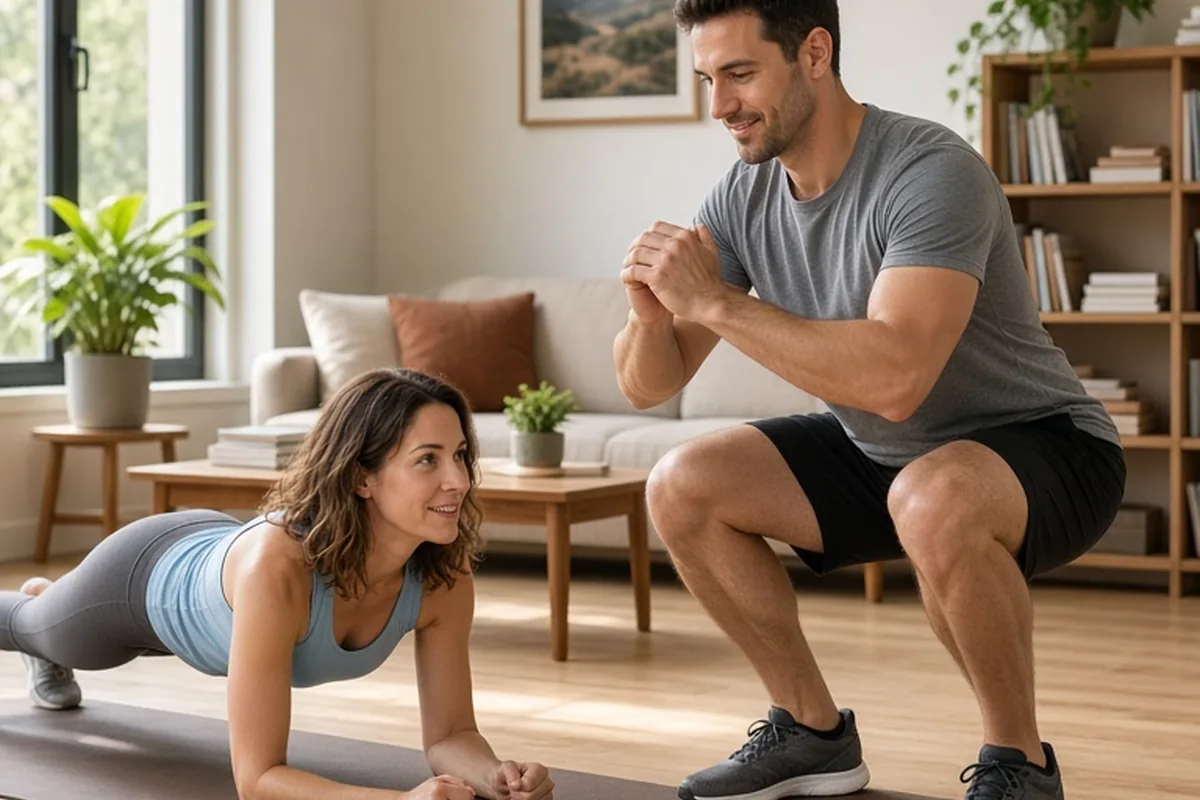
Working out as a couple makes you stronger physically and emotionally by creating shared accountability, nonverbal attunement, and common goals. Exercising side by side allows partners to witness each other's persistence, celebrate incremental wins, and manage stress together through physical activity. When approached with clear personal boundaries, mutual encouragement, and tailored pacing that respects differing fitness levels, regular joint training fosters teamwork, deepens mutual trust, and reinforces healthy daily habits across your entire shared life.
Stepping into a fitness routine alongside your partner offers an experience that casual date nights rarely replicate. Between shared exertion, physical fatigue, and shared progress, exercising together strips away social posturing and reveals how you communicate during moments of challenge.
Shared Physical Effort Builds Emotional Attunement and Trust
Sweating alongside your partner creates an environment where words matter less than presence. Physical exercise naturally strips away daily pretense; when your heart rate rises and your muscles fatigue, you encounter authentic effort together. Watching your significant other persist through a difficult hill climb, a taxing set of barbell squats, or a challenging yoga flow reveals their patience, resilience, and vulnerability. Experiencing these moments as teammates shifts your perspective from managing domestic logistics to sharing a genuine physical challenge.
Moving together also fosters physical synchronicity and nonverbal coordination. Pacing your footsteps during an evening run, matching breathing during a cool-down stretch, or trading places on an interval timer creates a rhythm of reciprocal awareness. These shared physiological responses help break down conversational stalemates that accumulate during stressful workweeks. After releasing physical tension through movement, couples frequently find that later conversations about home finances, career shifts, or family concerns happen with softer tones and greater perspective.
Navigating Disparate Fitness Levels Without Resentment
A common pitfall couples encounter is assuming joint training requires matching every movement rep for rep or pound for pound. When one person has years of running experience while the other is returning from a long period of inactivity, forcing identical workouts creates frustration, feelings of inadequacy, or physical injury. The goal of exercising together is shared presence and common purpose, not identical athletic metrics. Designing sessions around shared time intervals rather than matching mileage or resistance allows each partner to challenge themselves appropriately while staying in the same room.
Effective adjustments include structured circuit training where both partners work for forty seconds and rest for twenty, utilizing weights and variations appropriate to their individual capacity. For instance, while one person performs strict pull-ups, the other might execute inverted ring rows or lat pull-downs. For outdoor cardio, consider tracks, park loops, or out-and-back trails where you warm up and cool down together, but complete the middle portion at individual paces. By deliberately decoupling personal worth and athletic capability from the shared experience, both partners protect their self-esteem and sustain enthusiasm for working out together.
Couple Workout Formats for Home, Gym, and Outdoor Settings
Selecting the right environment helps keep training engaging and responsive to your schedules. For home environments with limited equipment, bodyweight partner circuits offer simplicity and minimal distraction. A twenty-minute living room session pairing alternating sets of bodyweight squats, plank variations, push-ups, and mobility stretches allows you to stay connected between busy work meetings without packing gym bags or commuting.
At a traditional fitness facility, split routines centered on supersets provide natural opportunities for spotting, loading plates, and trading machines. While one partner completes a set of dumbbell bench presses, the other can act as a spotter, provide safety checks, or perform a complementary core exercise before trading places. For outdoor settings, weekend trail hikes, cycling along paved greenways, or visiting an indoor climbing gym introduce novel problem-solving challenges that feel like shared adventures rather than routine calendar obligations.
Partner Support: When to Encourage, Spot, and Give Space
Partner support in a fitness setting requires intentional communication regarding what each person actually wants. Some people thrive on vocal cheerleading and enthusiastic cues, whereas others feel micromanaged, patronized, or overwhelmed by noise when concentrating under load. Before your session starts, ask a direct question: 'Today, do you want verbal motivation, technical spotting, or quiet companionship?' Honoring that answer prevents well-meaning encouragement from triggering irritation.
Effective spotting also demands clear physical boundaries and safety rules. A partner who spots a heavy squat or bench press must know proper hand placement, rack mechanics, and emergency bailouts to protect both people from harm. If one partner prefers to handle technical lifts alone or work with an independent trainer for complex barbell work, respect that preference without taking it as personal rejection. Supporting a partner often means holding their water bottle and cheering their success from across the platform rather than hovering over every repetition.
Managing Unsolicited Coaching, Ego, and Post-Workout Moods
The impulse to critique a partner's technique is one of the quickest ways to derail a joint fitness habit. Unless you are a certified coach invited to offer instruction, offering unsolicited corrections during a workout frequently reads as criticism rather than care. If you observe form that looks potentially dangerous, phrase observations neutrally: 'That looked a little uncomfortable on your lower back; do you want to adjust the bench angle or lower the weight for the next set?' Avoid declarative judgments like 'You are doing that completely wrong.'
Ego and physiological fatigue also affect post-workout dynamics. Intense exertion drains glycogen reserves and causes temporary nervous system exhaustion, which can leave partners feeling irritable, quiet, or short-tempered immediately after training. Recognizing 'hanger' or physical fatigue as a biological response rather than relationship dissatisfaction prevents post-workout arguments. Keeping a quick protein snack, fruit, or water readily available for the drive home smooths out mood dips and keeps the post-workout glow positive.
Creating a Sustainable Joint Routine That Respects Autonomy
Long-term relationship health thrives on balance between shared pursuits and individual autonomy. Forcing every workout to be a joint activity can make exercise feel like an obligation, stripping away its role as personal stress relief. Many people use solitary workouts to listen to their own music, process workday thoughts, or clear their mental slate without attending to anyone else's needs. Maintaining independent exercise days safeguards your personal routine while keeping joint workouts fresh and deliberate.
A practical weekly cadence might include one or two joint sessions—such as a Saturday morning track session followed by breakfast, or a Tuesday evening circuit—while dedicating other days to independent gym visits, solo running, or individual classes. Setting this framework collaboratively ensures that if one person needs to reschedule due to professional deadlines or fatigue, the other partner still feels complete freedom to complete their planned workout without resentment or disruption.
Illustrative Scenarios
Resolving Pacing Friction During Outdoor Runs
Elena and Marcus committed to running three mornings a week along a neighborhood park path. Marcus had trained for half-marathons and found himself constantly slowing down, looking back, and impatiently checking his watch, while Elena felt pressured, breathless, and resentful of being perceived as a burden. Instead of abandoning joint exercise, they changed their format: they now complete a five-minute dynamic warm-up walk together, run a one-mile loop at their own comfortable paces for twenty-five minutes, and meet at the park gazebo for a combined stretching routine.
Key point: Designing shared workouts around common start and finish intervals rather than matched running speeds allows both partners to train comfortably without feeling held back or pushed beyond their limits.
Establishing Healthy Boundaries Around Unsolicited Coaching
Jordan, who had lifted weights for years, accompanied Taylor to the gym after Taylor expressed interest in strength training. During their initial session, Jordan frequently interrupted Taylor's sets to tweak foot positioning, criticize elbow angles, and adjust weight plates, leaving Taylor feeling judged and disinclined to return. After talking openly that evening, Taylor stated a preference to learn lift mechanics independently from gym staff while Jordan provided assistance only when asked. They returned the following week with Jordan focusing on their own program while offering supportive fist-bumps between sets.
Key point: Separating romantic partnership from personal coaching preserves mutual respect and prevents technical instruction from turning into relational tension.
Frequently asked questions
What should we do if one partner loses motivation to work out?
Maintain your individual routine consistently without pressuring, guilt-tripping, or lecturing your partner. Often, seeing a partner return from workouts energized and positive is far more motivating than verbal persuasion. You can leave an open, low-pressure invitation for casual activities like a walk or light stretch, while fully respecting their choice if they need rest.
Can working out together replace traditional date nights?
Active sessions make great shared experiences, but they should complement rather than fully replace dedicated quiet dates. Workouts involve focus, exertion, and physical fatigue, which do not always leave room for deep romantic conversation or relaxed intimacy. Balancing active outings with unhurried meals or quiet evenings ensures all facets of your connection are nurtured.
How do we handle workouts if our schedules are completely misaligned?
Focus on high-yield, short-duration activities rather than full-length gym sessions. A fifteen-minute weekend morning mobility routine, a brisk evening walk around the block after dinner, or a quick bodyweight sequence before breakfast can deliver the connection of working out together without requiring identical daily work schedules.
What if my partner's competitive nature makes exercising together stressful?
Shift away from directly comparable exercises like timed runs or weight benchmarks toward non-competitive, cooperative activities. Consider partner yoga, recreational swimming, partner resistance-band drills, or outdoor hikes where the primary objective is completing the route together rather than outperforming each other.
Your next step
Pick one specific day this week, choose an interval-based or outdoor activity where both of you can work at your own pace, and agree ahead of time on how you want to support each other during the session.