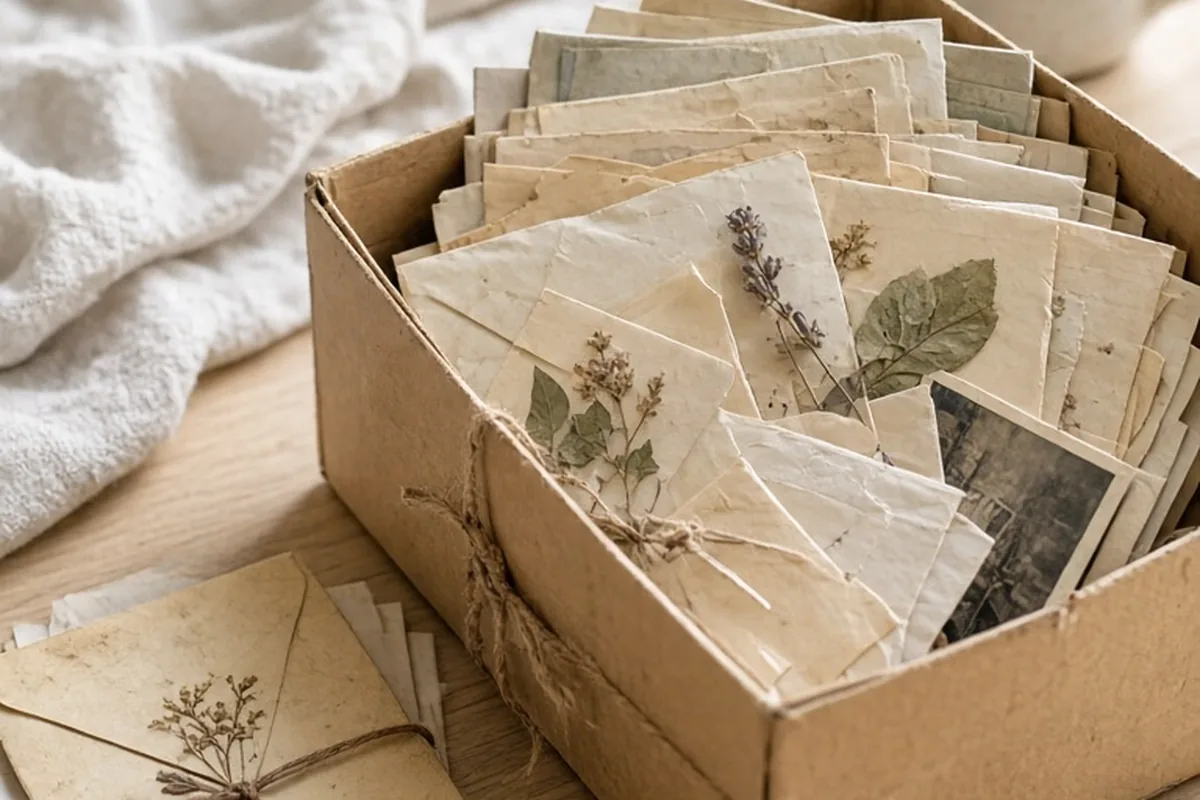
Keeping old love letters and memories is normal and doesn't automatically mean you're not over an ex. The practical test is function: if rereading them brings warmth and perspective, keeping them is fine; if they keep you stuck, comparing, or secretly hoping, it's time to store them away, return them, or let them go deliberately.
A shoebox of letters can sit untouched for years and still hit like a wave the day you finally open it. Whether you found them during a move, after a breakup, or while cleaning out a drawer, the real question isn't whether the feelings are valid. It's what you want those objects to do in your life now.
Why Old Love Letters Still Carry So Much Weight
A love letter is different from a photo or a souvenir because it captures a voice. Someone sat down, chose words, and tried to reach you. Years later, reading those words can briefly resurrect a version of yourself: younger, more hopeful, loved in a specific way. That pull isn't weakness or a sign you made a mistake by moving on. It's simply how memory works. Objects anchor feelings, and handwritten words anchor them more strongly than almost anything else.
The weight also comes from ambiguity. A letter doesn't just remind you of a person; it reminds you of a story that ended without a clean final page. If the relationship faded, ended badly, or was cut short by circumstances, the letter can feel like evidence of something unresolved. That's why two people can look at the same box and have opposite reactions. One feels gratitude. The other feels a dull ache. Neither reaction is wrong, but each points to a different decision about what to do next.
The Real Question: What Job Are These Letters Doing?
Before you decide anything, get honest about function. Ask what the letters actually do for you when you read them. If they give you a warm sense of your own history, a reminder that you've been loved and have loved well, they're functioning like any meaningful keepsake. Plenty of happily partnered people keep a box of old letters the way they keep a yearbook: as a record of a life, not a longing for it.
The picture changes if the letters function as a door you keep reopening. Signs of that include rereading them when you're lonely in your current relationship, comparing a new partner's affection to the intensity on those pages, or feeling a secret hope that the writer might come back. In that case the letters aren't a keepsake; they're a habit that keeps a wound slightly open. The distinction matters because the same box can be harmless for one person and corrosive for another. Judge the job, not the object.
How to Sort Through Them Without Getting Stuck
If you've decided to go through the letters, treat it like a bounded task rather than an open-ended emotional excavation. Pick a time when you're calm, not right after a fight with your partner or a lonely Sunday night. Give yourself a window, maybe an hour, and a simple sorting system: keep, release, and undecided. Read each letter once, notice what it stirs, and place it in a pile. Don't reread favorites five times in one sitting; that's how a sorting session turns into a spiral.
For the keep pile, be selective. A few letters that genuinely represent the relationship are usually enough; you don't need all forty to prove it happened. For the release pile, decide on a method that feels respectful to you: recycling, shredding, or a small private ritual like reading one aloud and letting it go. The undecided pile can go into a sealed envelope with a date on it. If you haven't opened it in a year, that tells you something. The trade-off here is real: sorting can stir up grief you thought was finished, so plan something grounding afterward, like a walk or dinner with a friend.
Digital Memories Deserve the Same Honest Audit
Old texts, saved photos, and archived chats are the modern version of the shoebox, and they're often harder to deal with because they're always one search away. The same functional test applies. A photo album you never open is a keepsake. A chat thread you scroll through at 1 a.m. is a tether. Be honest about which you have, because digital memories are easier to hide from yourself and from a partner.
Practical options include moving photos to an external drive you don't keep plugged in, archiving rather than deleting conversations if you're not ready to lose them, and muting or unfollowing an ex whose posts keep pulling you back. Deleting everything isn't required, and for some people it feels like erasing part of their own life. But if you notice that digital access keeps restarting the emotional clock, distance is a legitimate choice, not a dramatic one. The limit to note: deleting files doesn't delete feelings, so pair any digital cleanup with the same self-honesty you'd bring to paper letters.
Old Letters and a New Relationship
This is where the question gets practical stakes. Keeping letters from an ex while in a new relationship isn't inherently a betrayal, but secrecy changes the meaning. If your partner found the box tomorrow, would you be comfortable explaining it? If yes, you're probably fine. If the thought makes your stomach drop, the issue isn't the letters; it's that some part of you suspects they're doing a job you wouldn't want to say out loud.
You don't owe a partner a full inventory of your past, and you don't need to perform a bonfire to prove your commitment. What helps is a simple, calm framing if it comes up: these are part of my history, they stay in a box, and you're who I'm building with now. Most reasonable partners accept that. Where it gets harder is if you're using the letters as a private escape hatch during rough patches. That's worth addressing honestly, because the problem isn't paper in a drawer; it's where your attention goes when things get hard. A useful boundary some people set is keeping the letters but not reading them while the current relationship is active.
When the Memories Point to Unfinished Grief
Sometimes a box of letters is less about the letters and more about a loss you never fully processed. If the relationship ended without closure, if the person died, or if the breakup coincided with a hard chapter of your life, the letters can become the container for grief that never got expressed. In that case, deciding whether to keep them is secondary to actually letting yourself feel what they represent.
A few signs suggest the grief is the real issue: you can't think about the relationship without a heavy drop in your mood, the memories interfere with your ability to be present with new people, or you've avoided the box for years because opening it feels dangerous. Those are reasonable reasons to talk it through with a trusted friend or a therapist, not because keeping letters is pathological, but because stuck grief tends to leak into everything else. There's no timeline you're failing to meet. The goal isn't to stop caring about the past; it's to let the past be past tense.
Ways to Honor the Past Without Living in It
There's a middle path between shrine and shredder, and it's often the healthiest one. Some people keep a single letter that represents the best of what that relationship taught them. Others write a response they'll never send, saying the thank-you or the goodbye that never got said, then keep or destroy that instead. Some digitize a few favorites and let the paper go. The point is to convert the letters from a live wire into a closed chapter: still part of your story, no longer an open question.
It also helps to name what the letters actually gave you. Maybe that relationship taught you that you're capable of deep love, or showed you what you won't accept again, or simply marked a season of your life that mattered. When you can say that clearly, the physical objects matter less, because you've extracted the value and no longer need the container. That's the real difference between keeping memories and being kept by them.
Illustrative Scenarios
The Box Found During a Move
While packing to move in with his girlfriend, Marcus found a shoebox of letters from a college relationship that ended eight years ago. His first instinct was to throw it away before she saw it, which made him pause: if it was harmless, why did hiding it feel necessary? He spent an evening reading through them, realized they mostly made him smile at who he used to be, and kept three that captured the relationship honestly. He told his girlfriend about the box when she asked what was in it. She shrugged and said she had a journal from an old relationship too.
Key point: If your first instinct is to hide something, examine why before you act. Often the honest version is far less dramatic than the secret one.
The Letters She Kept Rereading
Six months after a breakup, Priya noticed she was rereading her ex's letters every few weeks, always late at night, always ending up sad. She told herself it was just nostalgia, but she also realized she'd turned down two dates because no one seemed to measure up to the person on those pages. Instead of deciding in the moment, she sealed the letters in an envelope, wrote a date on it, and put it in a closet. When she found it a year later and felt only mild curiosity, she recycled them without opening it.
Key point: You don't have to decide forever today. Putting distance between yourself and the letters can show you what they were really doing.
Frequently asked questions
Is it normal to keep love letters from an ex?
Yes, it's common and doesn't automatically mean you're not over the relationship. Many people keep them as part of their personal history, the same way they keep old photos or journals. What matters is whether they function as a keepsake or as a way of staying emotionally attached.
Should I tell my current partner about old love letters?
You don't need to announce them, but you shouldn't need to hide them either. If the topic comes up, a calm, honest explanation usually lands well. If the thought of your partner finding them makes you anxious, that discomfort is worth examining.
Should I return old love letters to my ex?
Usually there's no need, and reaching out just to return letters can reopen contact for the wrong reasons. If the letters clearly belong to them or they ask for them back, returning them is reasonable. Otherwise, the decision about what to do with them is yours.
Does keeping the letters mean I'm still in love with my ex?
Not necessarily. Keeping letters can reflect sentimentality, respect for your own past, or simple inertia. A better signal is behavior: if you're rereading them to feel close to that person or comparing new partners to them, the attachment may be more active than nostalgic.
Your next step
Pick one letter or memory this week and ask what it actually does for you when you engage with it. That honest answer, not a rule about what's allowed, should guide whether you keep the box, seal it, or let it go.