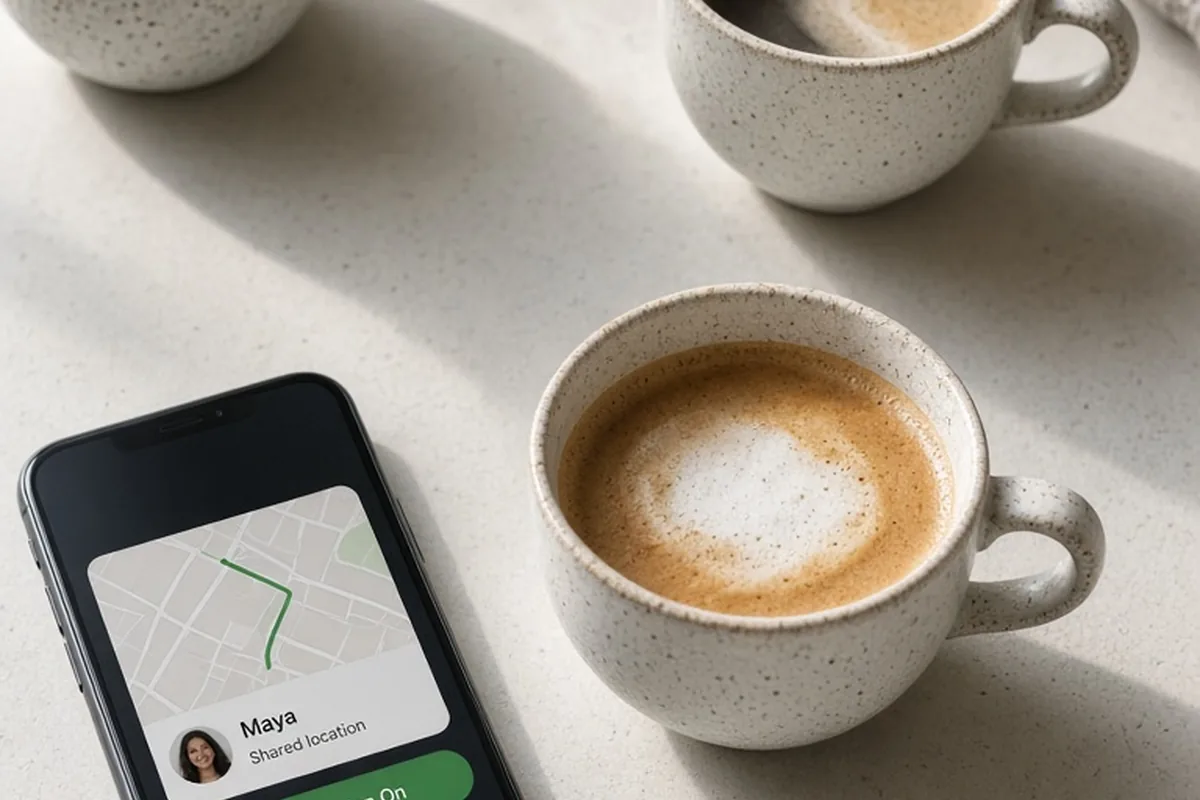
Sharing your location with a trusted friend or family member on a first date is a smart, standard safety practice. However, you should generally avoid sharing your live location directly with your date. Sending tracking data to a trusted contact keeps you safe without handing over your continuous personal whereabouts to a stranger before mutual trust has been established.
Meeting someone new from a dating app or social circle brings excitement, but entering an unfamiliar setting with a stranger also demands grounded practical caution. Modern smartphone tools make it effortless to signal your whereabouts, yet knowing who to share that data with determines whether the technology protects your autonomy or unintentionally compromises your privacy.
Sharing with a Friend Versus Sharing with Your Date
The single most important distinction in first-date location sharing is the recipient. Broadcasting your live coordinates to a close friend or family member creates an external safety net that operates silently in the background. It ensures that an ally knows where you are, who you planned to meet, and when to expect an update from you. This practice requires minimal effort, does not intrude upon the date itself, and provides genuine peace of mind while you focus on conversation.
In contrast, sharing your live location directly with your date is rarely necessary and often counterproductive. Sending a live tracking pin to someone you have never met can create an artificial sense of intimacy, blur personal boundaries, or open the door to unwanted monitoring before you have even assessed mutual respect. While sending a static address for a public meeting spot helps with coordination, continuous real-time tracking should be reserved for established relationships where mutual trust has already been proven over time.
How to Set Up a Frictionless Safety Plan with a Friend
To make external location sharing effective without turning it into an anxious chore, establish a simple protocol before leaving home. Built-in tools like Apple Find My, Google Maps location sharing, or messaging platform location features allow you to share your real-time position for a limited duration, such as four or eight hours. Choosing a timed window prevents you from forgetting to revoke access later, preserving your everyday digital privacy once the outing concludes.
Along with your live location, send your chosen contact a quick summary message containing three essential details: the first name of your date, a link to their profile or their phone number, and the specific venue address. Agree on a realistic check-in time, such as two hours into the meeting, along with an explicit understanding of what steps your friend should take if you miss that check-in. This structured approach prevents needless panic while ensuring that someone has actionable facts if an emergency ever arises.
Handling Requests When a Date Asks for Your Live Location
Occasionally, a date might ask you to share your live location under the guise of logistical convenience, such as finding each other outside a crowded train station or inside an expansive park. While the request often stems from simple convenience rather than malice, you are under no obligation to share continuous GPS data with someone you do not know. Yielding personal boundaries to avoid a moment of social awkwardness usually leaves people feeling uncomfortable and compromised.
Instead of enabling live tracking, offer a clear, descriptive alternative that resolves the logistical hurdle without sacrificing privacy. You can reply with a precise landmark and an arrival timeline, such as stating that you are standing by the bookstore entrance wearing a navy jacket and will be there in five minutes. This response demonstrates cooperative communication and self-assurance while maintaining firm, healthy personal boundaries.
Responding Securely When a Date Mentions Their Friends Track Them
Many people casually mention during a first date that their roommate, sibling, or best friend has their location or is expecting a check-in text. For men in particular, hearing this can occasionally trigger an unhelpful defensive reaction if it is misinterpreted as an accusation of untrustworthiness. Taking offense or acting defensive signals insecurity and misreads a universal modern habit designed to manage general risk.
A confident and emotionally secure response simply validates their prudence without making a spectacle of it. A brief remark acknowledging that having attentive friends is smart, followed by an immediate return to your conversation, demonstrates that you respect their comfort and have nothing to hide. Treating their safety awareness as normal, practical behavior establishes an atmosphere of mutual ease and mature consideration.
Managing Mid-Date Location Changes and Unplanned Stops
First dates frequently evolve organically, such as deciding to leave a coffee shop to walk through a nearby neighborhood or heading to a nearby restaurant for dinner. While spontaneity is a natural component of dating, moving between venues changes the safety equation if your external contact believes you are still at the initial location. Keeping your support system updated takes only a few seconds and maintains your safety baseline.
You do not need to interrupt the rhythm of the date or make an announcement to send an update. A quick text while using the restroom or ordering at the counter—such as letting your contact know you are walking three blocks south to a specific diner—maintains your accurate paper trail. If a date pressures you to relocate to an isolated area or a private residence before you feel completely ready, treat that pressure as a clear sign to decline the move and end the date on your own terms.
Protecting Long-Term Digital Boundaries After the Date Ends
Once a date concludes, managing your digital footprint is just as essential as your precautions during the meeting. If you used temporary location sharing with a friend, confirm that the share has ended or turn it off manually once you arrive safely home. Allowing indefinite tracking among an ever-growing list of contacts creates passive privacy erosion, leaving personal movement data visible long after the immediate need has passed.
Similarly, avoid sharing personal location markers with your date early on, such as having them pick you up directly from your front door or tagging specific neighborhood spots on shared social media. Preserving a degree of domestic privacy gives both people the room to evaluate mutual compatibility over multiple interactions without premature entanglement. Clear boundaries early in the dating process protect your peace of mind and foster healthier long-term dynamic built on progressive trust.
Illustrative Scenarios
Handling the Mention of a Friend Safety Check
Marcus met a woman for drinks at a downtown lounge after matching on a dating app. Forty minutes into an engaging conversation, she checked her phone and casually mentioned she had to send a quick thumbs-up text to her roommate, who had her live location. Marcus felt an initial flash of embarrassment, wondering if he had seemed threatening or suspicious. Instead of withdrawing or defending his character, Marcus smiled, remarked that his sister used the exact same system, and gave her an unhurried moment to send the message. His calm, supportive reaction immediately put her at ease, and the conversation flowed naturally for the rest of the evening.
Key point: A date sharing their location with an outside friend reflects standard modern safety precautions, not a personal critique of your character.
Declining a Request for Real-Time Coordinates
Elena arranged to meet a date at a busy waterfront promenade on a Saturday afternoon. Twenty minutes before the meeting, he sent a text asking her to drop a live tracking pin on a messaging app so he could locate her in the crowd. Elena felt uneasy handing over real-time tracking to someone she had never met, but she worried that refusing might make her appear uncooperative or distant. Rather than complying against her instincts, she politely texted back that she preferred not to use live location sharing, adding that she was sitting on the bench directly opposite the main fountain in a red sweater. They met without confusion, and her boundary was respected.
Key point: You can resolve logistical hurdles with clear landmarks and arrival descriptions without conceding your digital privacy to a stranger.
Frequently asked questions
Is it rude to tell your date that a friend has your location?
No, it is not rude, but there is rarely a need to announce it unless it comes up naturally. If you need to step away to send a planned check-in text, you can mention it casually and briefly without treating it like a confrontation.
Which app is best for sharing location on a date?
Native smartphone tools like Apple Find My or Google Maps location sharing are ideal because they allow you to set an automatic expiration time. These tools keep your coordinates private between you and your trusted contact without requiring third-party dating apps to access background data.
What should I do if a date insists on picking me up from my home on date one?
Politely decline and state that you prefer to meet directly at the venue and handle your own transportation. A mature, respectful person will accept that boundary immediately without demanding an extensive justification.
When is it appropriate to share live location directly with someone you are dating?
Direct live location sharing works best after you have established consistent trust, clear communication, and mutual respect over multiple dates. Even in established relationships, location sharing should remain entirely voluntary rather than an instrument of surveillance or reassurance.
Your next step
Before your next first date, pick one trusted friend, set up a timed four-hour location share using your phone's native map tool, and text them the venue name and your date's basic profile details.