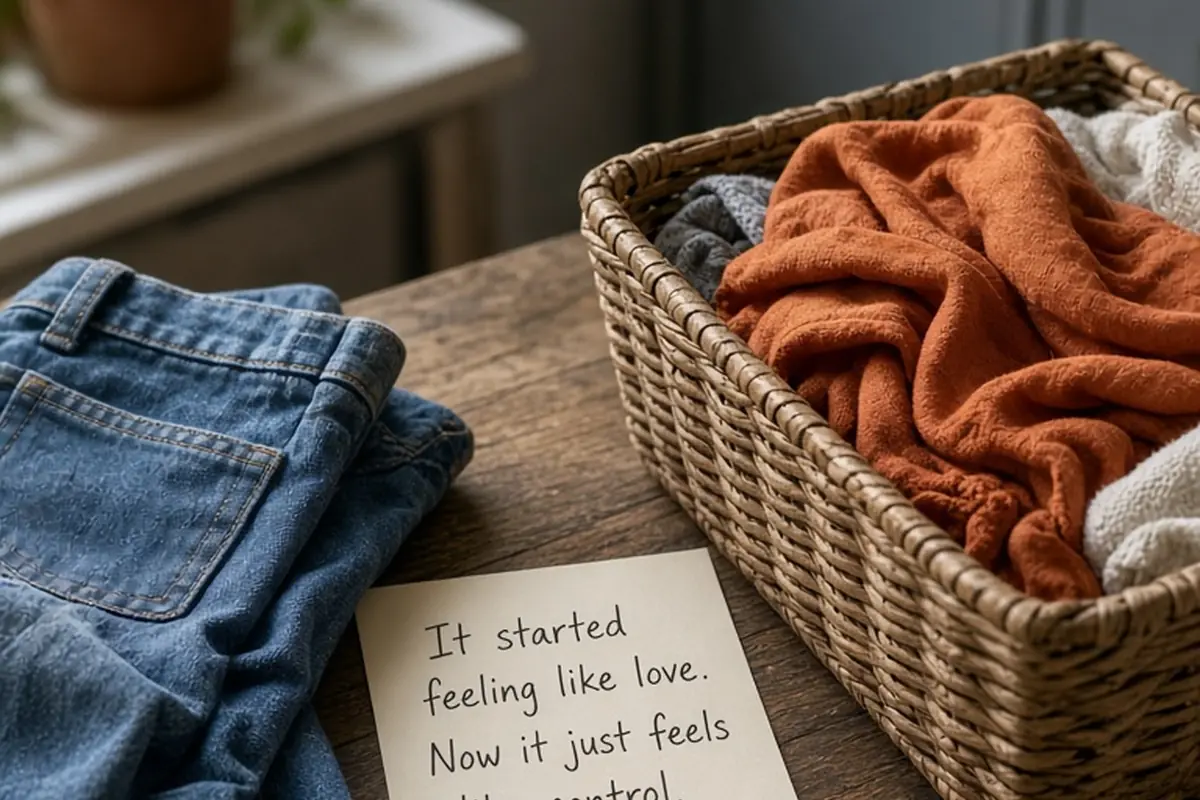
Common ways guys manipulate and control their girlfriends include gaslighting, guilt-tripping, jealousy framed as love, monitoring phones and locations, cutting her off from friends and family, controlling money, pressuring for sex, love bombing followed by coldness, and using threats or self-harm claims to keep her from leaving.
Most controlling relationships do not start out looking controlling. They start out looking intense, attentive, even flattering, and the shift happens slowly enough that many women only see the full pattern in hindsight. Knowing the specific tactics makes them much easier to spot while they are happening.
What manipulation and control actually look like
Manipulation is not the same as conflict. Every couple argues, and plenty of boyfriends say the wrong thing, get defensive, or act selfishly on a bad day. Control is different because it is a pattern with a direction: over time, one partner's choices, friendships, money, and sense of reality shrink while the other partner's power grows. The question is not whether he ever behaves badly but whether his behavior consistently leaves you smaller, more isolated, and more afraid to disagree.
A useful test is to look at what happens when you push back. In a healthy relationship, raising a concern leads to an uncomfortable but genuine conversation. In a controlling one, raising a concern leads to punishment: the silent treatment, a counterattack about your flaws, or a crisis that somehow makes you the one apologizing. If every disagreement ends with you managing his feelings instead of discussing yours, that is information worth taking seriously.
Emotional tactics: gaslighting, guilt, and blame-shifting
Gaslighting is the tactic most people have heard of, and it earns the attention. It means systematically making you doubt your own memory and judgment: insisting a conversation never happened, claiming you agreed to something you did not, or telling you that you are too sensitive, crazy, or dramatic whenever you react to something he did. One instance might be a genuine misunderstanding. A steady pattern of it trains you to stop trusting yourself, which makes every other form of control easier.
Guilt and blame-shifting work alongside it. A controlling boyfriend turns his behavior into your fault: he yelled because you provoked him, he checked your phone because you gave him reasons not to trust you, he sulked all weekend because you went out with friends. Notice the move. The topic shifts from what he did to what is wrong with you, and you end up defending yourself instead of getting an answer. Over months, many women start pre-apologizing and shrinking their lives just to avoid these spirals, which is exactly the point.
Isolation and monitoring disguised as love
Isolation rarely arrives as a demand. It arrives as preference and complaint: he does not like your best friend, your family does not treat him right, your coworkers are a bad influence, why do you even need a girls' night when you have him. Each objection sounds reasonable on its own. Added together, they mean your support system quietly thins out until he is your main source of information, comfort, and reality-checking. That is not an accident. People who want control benefit when you have no one left to say, that is not normal.
Monitoring follows the same logic. Wanting your location, your passwords, a running account of who texted you, or a photo proving where you are gets framed as transparency or concern. The tell is asymmetry and consequence: he demands access he does not offer, and there is a price for refusing. Occasional jealousy is human. A boyfriend who treats your privacy as a crime and your friendships as threats is not showing how much he loves you. He is showing how much he wants to run your life.
Control through money, sex, and threats
Financial control can look like generosity at first: he insists on paying for everything, suggests you quit the job he complains about, or offers to handle all the bills. The problem reveals itself when money becomes leverage. If you have to ask permission to spend, if he monitors your purchases while his are private, or if leaving the relationship would leave you with no access to funds, the arrangement is about dependence, not generosity. Keeping your own account, your own income where possible, and your own credit is not disloyal. It is basic self-protection.
Sexual pressure and threats sit at the sharper end. Pouting, sulking, or picking fights until you give in is coercion even when no force is involved, because consent given to end a conflict is not freely given. So is threatening to share private photos, to hurt himself if you leave, or to ruin your reputation. Threats of self-harm in particular put you in an impossible position on purpose. You can take them seriously by contacting a crisis line or his family, but his safety is not a debt you owe with your freedom.
Why it is so hard to see from the inside
If these tactics were obvious, no one would stay. Controlling behavior usually escalates gradually, and each step is small enough to explain away. He was stressed. He had a rough childhood. Every couple fights. Meanwhile, the baseline keeps moving, so behavior that would have shocked you in month one feels almost normal by month twelve. Friends watching from outside see the cliff; you only ever saw the next small step.
The other reason is intermittent kindness. Controlling partners are rarely cruel all the time. After a bad episode comes the apology, the flowers, the tender week that reminds you why you fell for him. That cycle is not a sign the relationship is healing. It is often the mechanism that keeps it going, because the good stretches give you something to hope back toward and make you doubt whether the bad ones were really that bad. Judge the pattern by the worst recurring behavior, not the best apologies.
How to tell manipulation from a rough patch
Plenty of relationships go through ugly seasons without being controlling, and it is fair to want a way to tell the difference. Three questions help. First, direction: is the relationship getting more equal over time or less? Second, repair: when you name a problem, does he engage with it eventually, even clumsily, or does he punish you for raising it? Third, freedom: are your friendships, money, work, and privacy intact, or have they quietly narrowed since the relationship began?
A boyfriend having a bad month will still respect a boundary once he calms down. A controlling boyfriend treats boundaries as insults. The distinction matters because it changes your options. A rough patch can be worked on together, sometimes with a couples counselor. A control pattern is not a communication problem you can fix by explaining yourself better, and couples counseling with a manipulative partner can actually give him new language to use against you. Individual support for yourself is the safer starting point.
What to do if you recognize these patterns
Start by trusting your own read. You do not need a courtroom standard of proof to take your discomfort seriously, and waiting until you are certain usually means waiting until things are worse. Write down incidents privately, somewhere he cannot access, because gaslighting thrives on fuzzy memory. Reconnect with one or two people you trust and tell them plainly what has been happening. Isolation only works if it stays intact, and saying it out loud to someone who loves you is often the moment the fog lifts.
If you are considering leaving, plan for safety rather than announcing it. The period around a breakup is when controlling partners often escalate, so think through where you would stay, what documents and money you would need, and whether he has access to your accounts, devices, or location. If you suspect your phone or computer is monitored, use a device he cannot see to research help. In the US, the National Domestic Violence Hotline is available at 1-800-799-7233, by texting START to 88788, or at thehotline.org, and it is not only for physical violence. Emotional and financial control are exactly what they handle, and calling does not commit you to anything.
Illustrative Scenarios
The boyfriend who just wanted to keep her safe
Maya's boyfriend asked for her location within the first month, framing it as worry about her commute home late from her restaurant shifts. It felt caring. Six months later he was questioning her about every male name in her phone, showing up unannounced at her sister's apartment, and calling her selfish when she turned off location sharing. Her first interpretation was that she was being cold and secretive. A coworker finally asked her a simple question: does he share everything he demands from you? He did not. Maya reconnected with her sister, moved her savings to an account only she controlled, and ended the relationship with a friend waiting nearby.
Key point: Concern and control can look identical at first. The difference shows up in symmetry, in what happens when you say no, and in whether your world is getting bigger or smaller.
The argument that never happened
After a fight where her boyfriend mocked her in front of his friends, Dana brought it up the next morning. He looked genuinely puzzled and said it never happened, that she had been drinking and always exaggerated. This kept occurring: cruel comments followed by confident denials, until Dana started recording conversations on her phone just to check her own sanity. Listening back, she heard exactly what she remembered. Her dilemma was whether she was losing her memory or being lied to. Showing the recordings to a therapist gave her a clear answer and a plan to leave safely.
Key point: When you keep doubting your own memory after every conflict, the problem may not be your memory. Documenting reality is a reasonable response to being told it is unreliable.
Frequently asked questions
Is it still abuse if he has never hit me?
Yes. Emotional, psychological, sexual, and financial control are recognized forms of abuse even without physical violence, and they often precede it. You do not need bruises to justify taking the pattern seriously or asking for help.
Can a controlling boyfriend actually change?
Change is possible but rare, and it requires him to fully acknowledge the pattern and usually commit to long-term individual work, not just apologize after a blowup. Promises made to stop you from leaving are not the same as change, and you are not obligated to stay and find out.
What if I am not sure it is really manipulation?
Uncertainty is common, partly because gaslighting is designed to create it. Try describing specific incidents to a trusted friend or a hotline counselor and watch their reaction, or write incidents down and look for a pattern over a few weeks. You do not need certainty to set a boundary.
How can I help a friend in a controlling relationship?
Stay connected without ultimatums, since isolation is part of the trap and pressure can push her closer to him. Name specific behaviors you have noticed rather than attacking him broadly, tell her you believe her, and let her know you will be there whenever she is ready. Sharing the hotline number as a resource, not a demand, keeps the door open.
Your next step
Pick one trusted person today and tell them one specific thing your boyfriend does that has been bothering you. Saying it out loud breaks the isolation that manipulation depends on, and if you are not ready for that step, save the National Domestic Violence Hotline number, 1-800-799-7233, somewhere only you can find it.