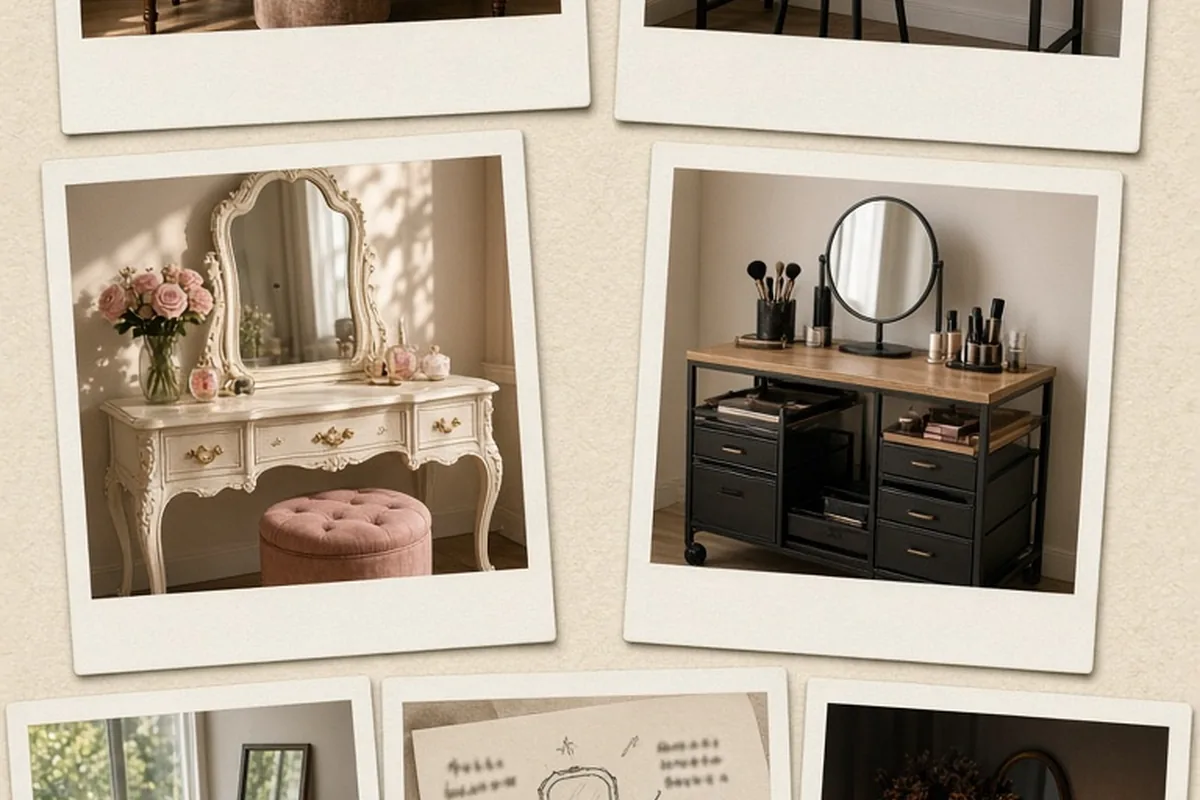
Makeup desks are most commonly called vanities, vanity tables, or dressing tables. Retailers and designers also refer to them as makeup vanities, vanity desks, or beauty stations. Historically, they have been known as toilet tables, lowboys, or poudreuses. When sold with a matching mirror and bench, manufacturers typically label the complete bundle as a vanity set.
While these names are often used interchangeably in everyday conversation, each term carries subtle distinctions regarding design, origin, and functionality. Knowing the precise vocabulary makes searching catalogs, shopping secondhand markets, and planning your morning routine significantly easier.
Standard Terminology: Vanities, Dressing Tables, and Vanity Sets
The term vanity table, or simply vanity, is the most widespread name for a dedicated cosmetic desk in American English. The word originally derived from the biblical concept of vanity, referring to worldly pride and self-adornment, but by the nineteenth century, it became the standard commercial term for furniture designed specifically for personal grooming. Today, shopping for a vanity will typically present you with freestanding tables that include built-in drawers, a central mirror, and an open kneehole area for comfortable seated application.
Dressing table is an equally common term that is particularly favored in British English and traditional interior design circles. While American retailers treat dressing table and vanity as synonyms, high-end furniture makers sometimes use dressing table to describe larger, more formal bedroom furniture pieces that emphasize clothing accessories and perfume storage alongside cosmetics. If a product listing uses the phrase vanity set, it signifies a bundled package containing the table, an attached or matching detached mirror, and a coordinating stool or bench.
Understanding these primary labels prevents confusion when browsing different furniture vendors. For example, a search for dressing table often yields classic wooden furniture with broader storage drawers, whereas searching for vanity desk frequently turns up contemporary, compact designs built to fit modern apartment bedrooms or walk-in closets. One trade-off to keep in mind with pre-packaged vanity sets is that the included stool may lack ergonomic back support for longer beauty sessions, prompting some users to purchase their seating separately.
Historical Names and Vintage Furniture Terms
If you are exploring antique shops, estate sales, or vintage furniture auctions, you will encounter historical names that reflect how personal grooming rituals evolved over centuries. The earliest direct predecessor to the modern vanity was the toilet table, derived from the French word toilette, which referred to the cloth spread over a table where grooming accessories were arranged. In eighteenth-century Europe, this was a centerpiece of upper-class personal quarters, holding silver-backed brushes, powders, and wash basins.
Another classic term you may see in auction catalogs is poudreuse, which is the French designation for a small table dedicated specifically to applying hair powder and facial pigments. Poudreuses typically featured a three-part hinged top that opened to reveal a center mirror flanked by covered compartments. In American antique furniture, the term lowboy describes a short chest of drawers standing on cabriole legs, which frequently functioned as a dressing station when paired with an independent wall mirror.
Shopping for authentic vintage pieces under these terms provides unique craftsmanship, such as dovetail joints and solid hardwood construction, but it also introduces practical limitations. Antique toilet tables and poudreuses rarely accommodate modern electrical items like hair straighteners or lighted magnifying mirrors without creative cord routing or tabletop adapters.
Modern Variations and Specialized Beauty Stations
Contemporary design has expanded the category beyond traditional wooden tables into specialized configurations engineered for specific lighting and space needs. One of the most prominent variations is the Hollywood vanity, also known as a lighted makeup station or glam room vanity. These units feature large vertical mirrors framed by exposed, warm-to-neutral LED bulbs that replicate professional dressing room lighting to eliminate shadows across the face during detailed cosmetic application.
For small spaces, wall-mounted or floating vanities have gained significant popularity. These units anchor directly into wall studs without floor legs, creating an open, airy visual footprint that makes a small bedroom feel larger while still offering shallow drawer storage and a stable surface. Conversely, corner vanities utilize triangular tops to turn unused bedroom or bathroom corners into functional dressing alcoves.
Another distinct modern style is the flip-top or hidden mirror vanity. When closed, this piece appears to be a minimalist writing desk or console, but lifting the hinged center panel reveals a built-in mirror and divided cosmetic compartments. This configuration is ideal for multi-use guest rooms, though it requires clearing all products off the center lid whenever you want to open the mirror.
Hybrid Workstations: Repurposing Desks and Consoles
Many people create their makeup stations by repurposing other standard household furniture, resulting in hybrid names like desk-to-vanity, vanity desk combo, or converted console. A standard writing desk with wide, shallow drawers can transition effortlessly into a cosmetic table simply by mounting a quality vanity mirror on the wall above it and adding acrylic drawer organizers. This approach allows you to choose from a far wider selection of aesthetic styles than the dedicated vanity market alone provides.
Console tables, which are traditionally narrow tables designed for entryways or sofa backs, are another frequent choice for compact cosmetic stations. Because console tables typically measure only twelve to fourteen inches deep, they fit neatly into narrow hallways or tight bedroom walls where a standard twenty-inch deep vanity would obstruct foot traffic. However, console tables often lack significant drawer depth, meaning you may need external tabletop organizers or adjacent shelving to house larger skincare bottles and palettes.
Secretary desks, which feature a fold-down desktop over lower drawers, also make practical converted vanities. When the fold-down lid is opened, it provides a stable makeup surface surrounded by small cubbies for lipsticks and brushes; once grooming is complete, closing the door instantly conceals clutter. The primary trade-off with converted pieces is the occasional lack of comfortable legroom, as some desks and consoles have support crossbars that prevent pulling a vanity stool completely underneath.
Key Differences Between a Makeup Vanity and a Standard Desk
Although a standard home office desk and a makeup vanity share a similar general profile, their functional engineering serves fundamentally different tasks. Office desks are built around computer ergonomics, featuring deeper surfaces meant to accommodate monitors, keyboards, and paperwork, along with deep file drawers. In contrast, dedicated makeup desks prioritize shallow drawers designed to keep small cosmetic items, compacts, and brushes visible in a single layer without requiring deep digging.
Surface materials also differ substantially between the two categories. Makeup vanities frequently incorporate tempered glass tops, lacquered surfaces, or stone inlays that resist staining from liquid foundations, setting sprays, and pigmented powders, while also offering easy wipe-down cleanup. Standard office desks, which are often made of untreated wood veneer or porous laminate, can absorb cosmetic pigments and stain permanently if spills occur.
Furthermore, makeup desks typically feature lower desktop heights—often between twenty-eight and thirty inches—to pair comfortably with lower, armless vanity stools that slide completely out of sight when not in use. Office desks, positioned higher for ergonomic office chairs, can leave seated users uncomfortably low relative to their tabletop mirrors if paired with standard decorative seating.
How to Select the Right Style for Your Daily Routine
Selecting the ideal makeup desk begins with assessing your available space, power access, and lighting conditions rather than choosing solely on visual appeal. Natural light is ideal for color matching, so positioning your station perpendicular to a window provides balanced, indirect illumination without direct glare. If natural light is limited, prioritizing a vanity with integrated LED lighting or ensuring room for tabletop lamps with adjustable color temperatures will deliver consistent results.
Next, evaluate your storage habits objectively. If you maintain an extensive cosmetic collection, look for a vanity featuring wide horizontal drawer banks, such as modular drawer units paired with a glass tabletop bridge. If you prefer a minimalist routine with just a few daily essentials, a compact wall-mounted unit or a small dressing table with two drawers will keep your space uncluttered without overwhelming the room.
Finally, ensure adequate clearance around your chosen spot. Measure both the table dimensions and the pull-out space required for your stool or chair, allowing at least twenty-four inches of clearance behind the desk to sit down and stand up comfortably. Factoring in proximity to electrical outlets will also prevent unsightly extension cords from cluttering your bedroom floor when powering hair tools, illuminated mirrors, and brush sanitizers.
Frequently asked questions
Is there a difference between a vanity and a dressing table?
In modern conversational use, vanity and dressing table refer to the same type of furniture. Dressing table is more common in traditional and British English, while vanity or vanity table is the standard American term.
What is a lighted makeup vanity called?
A makeup desk featuring a mirror surrounded by perimeter light bulbs is commonly called a Hollywood vanity, illuminated vanity, or lighted makeup station. These mirrors provide shadow-free illumination modeled after professional theatrical dressing rooms.
Can I use a regular writing desk as a makeup vanity?
Yes, a writing desk can easily function as a vanity by adding a freestanding or wall-mounted mirror and tabletop organizers. Adding a clear glass or acrylic topper is advisable to protect the desk surface from cosmetic stains.
What is a flip-top vanity?
A flip-top vanity is a dual-purpose desk with a hinged center section that lifts upward to reveal an underside mirror and built-in storage compartments. When closed, it creates a completely flat surface suitable for writing or laptop use.
Your next step
Measure your available wall space and assess your lighting and storage needs to choose the right vanity, dressing table, or converted desk for your daily routine.